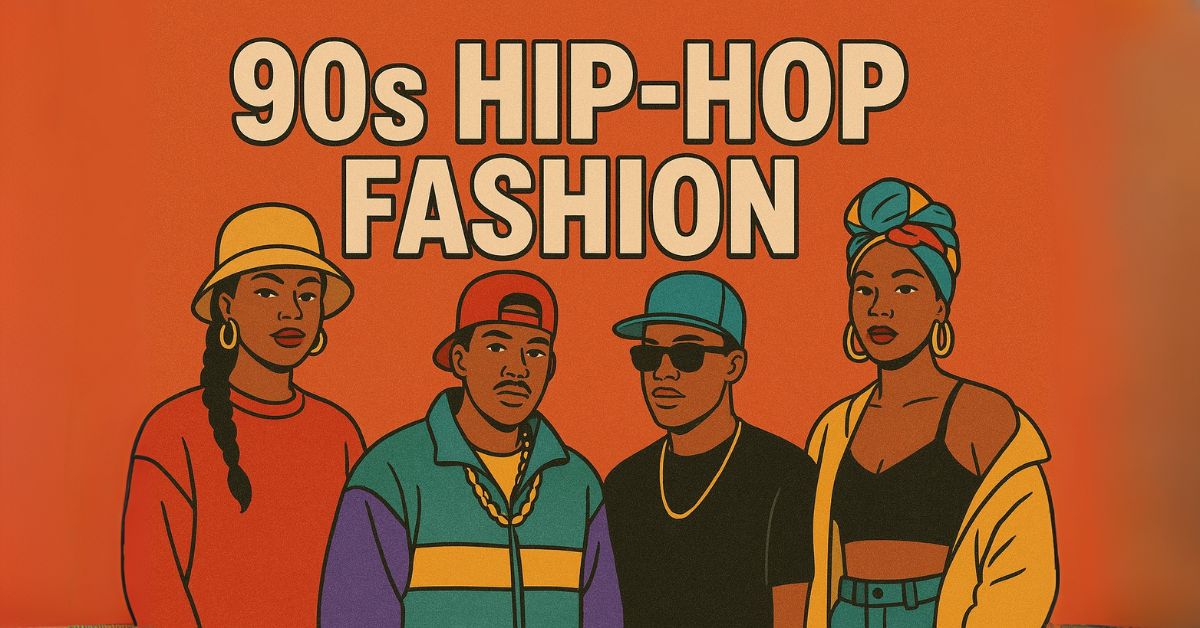
Look, we need to talk about something that’s been haunting my feed lately – everyone’s trying to recreate that effortless 90s hip-hop fashion vibe, Most are getting it totally backwards. It was like someone attempted to remake a classic film but had a fifty dollar budget and not a clue as to what made the classic such a good film in the first place.
The truth is, 90s hip-hop fashion wasn’t just about throwing on some baggy jeans and calling it a day. It was a cultural revolution draped in oversized denim and gold chains, and to be quite honest it’s time we acknowledge it in its full form instead of turning it into another quick-trend.
The Real Revolution Behind the Threads
Let’s get one thing straight – the 90s hip-hop fashion movement wasn’t born in some fancy design studio or dreamed up by corporate executives trying to sell more clothes. This was the best of street culture; necessity, inventiveness and just flat-out attitude.
Years ago, the music of such artists as Tupac, Biggie, and Salt-N-Pepa was not only a music, but a whole stylistics. Tupac was no follower when he wore his baggy jeans and oversized flollen, he was creating the trends and fashions. Just like Coogi sweaters and Versace shirts worn by Biggie or how Salt-N-Pepa made a household name out of door-knocker earrings and asymmetrical hairstyles.
The brilliance of this work was demonstrated in the use of common objects but to make them a statement. A mere bandana was a symbol of a good place. Baggy jeans were cool not only in terms of comfort but also full of protest against the predominating mainstream fitting styles that prevailed those days.
Breaking Down the Essential Elements
The Oversized Everything Philosophy
If there’s one thing that defined 90s hip-hop fashion, it was the “bigger is better” mentality. What most people overlook though is that it did not oversize arbitrarily: Madness had method in it.
Baggy jeans were not just flung on. They taught us to wear oversized clothing in a purposeful and appealing way thanks to artists like Kriss Kross and TLC. The trick was scale and assurance. When the Left Eye did her giant overalls, she did them up with tight tops and flashy bling.
This was not so much about concealing your body or being untidy It was more about comfortability, mobility and being able to make a statement by saying, “I do not have to fit into your precision of the way that the clothing should fit.”
The Power of Accessories
Nobody understood the assignment quite like 90s hip-hop fashion when it came to accessories. This refers to a time when your jewelry would not have been an accessory – instead it was the star.
Run-DMC put the sneakers with no laces produced by Adidas on the map. LL cool j made bucket hats a trademark Then there is the matter of how Slick Rick has one of the most iconic pieces of style accessories with his eye patch.
What was beautiful was the layering. Chains, large hoop earrings, sideways caps and oversized rings all came into play to make looks that could not be ignored. However, it was not about flaunting money (though some of it was) it was about talking about yourself and being proud of your culture.
The Brands That Built the Movement
Here’s where things get interesting. While today’s 90s hip-hop fashion revival is dominated by expensive “vintage-inspired” pieces, The original movement was constructed on approachable brands to real people.
Karl Kani was not a mere cloth line, it was an historical urban hip-hop fashion brand that was established to the hip-hop community. When Aaliyah and Tupac wore Karl Kani they did not only wear clothes, they made a statement that they support their community and represent it.
FUBU (For Us, By Us) went a step further with the idea. When LL Cool J sported FUBU in a Gap commercial (an epic move in and of itself), he was doing more than practicing fashionable hip-hop.
Cross Colours introduced colorful, bold design which best embodied the exuberant, expressive spirit of the age. They were not only clothes; their pieces were wearable art that showed celebration of diversity and creativity.
The Women Who Changed Everything
Let’s be real – when people talk about 90s hip-hop fashion, they can give us that focus on the man but the women were the real style setters. They were risking, violating some principles, and disagreeing on styles that are still inspiring current fashion.
the crop top/baggy pants outfit became the official uniform of the cool girl, fronted single-handedly by the video for Janet Jackson song, That?s the Way Love Goes. Lauryn Hill exemplified ways that we could combine bohemian style with street style in a manner that seemed so natural and yet so chic.
TLC needs an entire museum to their wardrobes. Be it the iconic and significant condom outfits of Left Eye or the colorful hair accessories of T-Boz, their style was always bold and questions were being sparked by their wardrobe choices all the time.
And Missy Elliott can we talk about Missy Elliott? She decided to turn the inflatable pants into high fashion and all of us to think about what clothes could and should be. Her Supa Dupa Fly phase was not all music, it was a tutorial in how fashion could be fun and experimental, at the same time it could be total game-changer.
How Modern Fashion Is Getting It Wrong?
Now here’s where I get a little heated. The way 90s hip-hop fashion is being interpreted in 2025 is honestly insulting to the original movement. I am presenting with these massively overpriced so called vintage-inspired items, which have absolutely no understanding of what initially made the original style so strong.
It is the issue of commercialization devoid of comprehension. When luxurious companies attempt to replicate a baggy jean concept and make them cost them 800 dollars, they are entirely lost. The beauty of the original 90s hip-hop fashion was its accessibility and authenticity.
The modern takes tend to remove the cultural connotation and make these significant style decisions into merely empty fads. Inspired-by bandanas costing $300 cannot be interchangeably used with the halal alternative of the price $2 bandana that actually had some cultural value.
The Future of Hip-Hop Fashion Legacy
So where do we go from here? How do we honor the legacy of 90s hip-hop fashion while moving forward in a way that makes sense for 2025 and beyond?
There exists a need to understand the reason behind the fact. It is not the only reason that the oversized clothes were not only a fashion; it was also a symbol of relief, movement, and a protest against the constraining fashion rules. The flashy jewelry wasn’t just foppery, it was the statement of authority and pride of culture.
Advanced designers, as well as design enthusiasts, have to stimulate that feeling of change and originality instead of merely reproducing the skin-deep appearance. Future of hip-hop influenced fashion must remain the closed use of common things and creatively showing them as extraordinary by being creatively and confidently outrageous.
Making It Work for Today
If you want to incorporate elements of 90s hip-hop fashion into your modern wardrobe without looking like you’re wearing a costume, focus on the principles rather than the exact pieces.
Masquerade about scale and ease. Combine tight items with loose items. Spend on good accessories that make you feel unique as opposed to duplicating the style of whoever you are emulating.
And above it all, don t forget that confidence was the hidden success factor behind all those iconic looks. Aaliyah did not simply dress in what her outfits, but she possessed them. That is what we ought to learn out of this period.
The legacy of 90s hip-hop fashion isn’t just in the clothes Not the style but the manner of providing it–it was in the attitude, the creativity and the way it made us realize that fashion could be a means of cultural expression and empowerment of the individual. And to tell you the truth, we are in need of more of that energy in 2025.