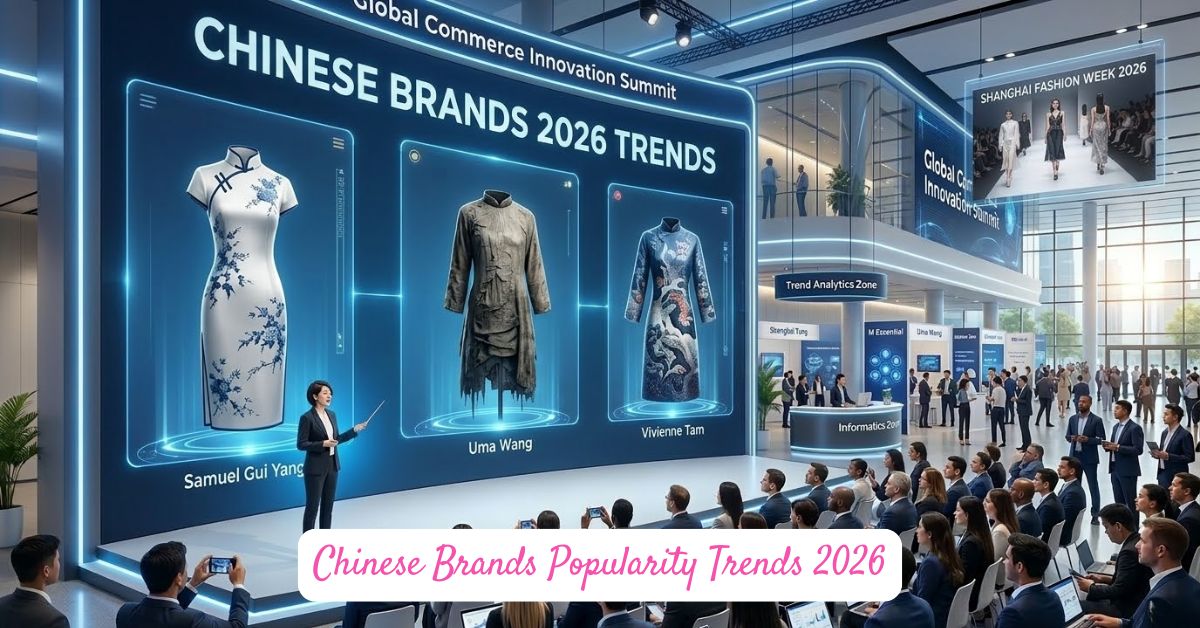
I will be honest with you, look. It was when I was surfing the internet at an ungodliness of an hour, wearing oddly colored socks, and eating cereal without any milk in it, that I realized that the whole fashion community of the world had moved, quietly, confidently and dramatically out to the East. Not just shifted. It virtually packed its bags, bought a one-way ticket and landed directly into Shanghai Fashion Week. Chinese brands popularity trends 2026 is not a niche topic anymore. It’s the topic. And in case you are modish, or even merely vaguely interested in not appearing to be dressing in the dark, you must be listening.
The Power Shift Nobody Can Ignore
Let’s not sugarcoat it. Over the decades, the show was operated by Western fashion houses. Paris. Milan. New York. That was the Holy Trinity. Something really big occurred, though, between 2020 and right now. Chinese brands have been gaining momentum with regards to global expansion, Chinese designers are gaining ground in the world, and Chinese consumers form the second-largest in the world of the apparel market. That’s not a small flex. That is an entire nation strutting into the fashion room and making herself seated at the top of the table.
And the wild part? It’s not slowing down. It’s accelerating.
From “Made in China” to “Designed in China”
At one point Made in China was regarded as a short cut, a label of mass production. Not anymore. Chinese designers in the young generation are redefining the old make the mandarin collars, cheongsam buttons, embroideries, a modernist twist, and the new Chinese style has become a universal language, and the fashion is addressing the past and future alike. It is both a complete identity recovery, and, frankly? It is one of the best things that is occurring in fashion today.
Guochao: The Cultural Pride Movement Taking Over Everything
You are not aware of Guochao yet, and you had better write it down, and tattoo it somewhere, or do something– as this is a word that is carrying the 2026 fashion talk. The movement that is currently taking place in China as Chinese consumers are progressively opting to buy local brands as opposed to foreign ones due to actual pride and connection with their culture rather than due to the status of price is known as guochao which literally translates to national trend.
The Guochao movement contributes to 75% of the young Chinese consumers giving preference to local products rather than fast fashion imported. Seventy-five percent. That is not a niche preference that is a cultural mandate. And it is transforming street to high-profit.
Why Gen Z Is the Engine Behind This Whole Thing
Gen Z is taking the lead – they are all about being mindful and comfortable these days and Chinese designers are receiving an international calling by blending vintage with recent and modern style. These children are not simply purchasing clothes. They are also purchasing identity, heritage and an entire vibe suggesting that I am aware of my origin and am proud of it. That’s powerful. That sells. And that’s not going anywhere.
The Brands You Need to Know Right Now
Now this is where we enter into the actual names, as being aware of the trend is one thing, and making more informed decisions by knowing the people behind it is another level.
Shanghai Tang
Since the company was founded in 1994, Shanghai Tang has developed a light-hearted but modern vision of Chinoiserie in cheongsams, knotted fastenings, extravagant silks and Mongolian cashmere, which embraces colour and ornamentation freely and reinvents the traditional by using modern cuts. Consider them as the brand that began the cultural fashion discourse prior to it being fashionable to own. A true OG.
M Essential
M Essential takes the new Chinese aesthetic back into life. The brand by designer Ma Kai revolves around the concept of self-dressing, which gives the brand permission to incorporate embroidery, cloud collars and classic motifs into the everyday wardrobe seamlessly based on the principles of contemporary proportions and tailoring. The peculiarity of this brand is that it has a strong partnership with intangible cultural heritage traditions the culture runs through the garment, it does not have a costume on top of it.
Uma Wang
Uma Wang is the one who will create fashion that will make you stop and stare. Uma Wang utilizes natural fabrics, distressing, crumpling and scorching methods to produce clothing with nearly sculptural surfaces – oversized shapes, one-piece constructions and gender-fluid design that hover between Eastern mindfulness and Western avant-garde expression. This is not fast fashion. This is art that you wear.
Vivienne Tam
Vivienne Tam redefines Chinese culture symbols Guanyin and peonies, as well as the architectural images using digital prints and custom-made tailoring, creating a visually strong language of East-meets-West. Her work also goes as far as museum shows and technology partnerships. She has been doing the East meets West thing since it was a lifestyle aesthetic board of everybody.
Samuel Gui Yang
There is a reason why the name of designer Samuel Gui Yang is so discussed in the international circle. Since 2014, Samuel Gui Yang has positioned his work with the tagline of Proudly Made in China and his Spring/Summer 2025 collection demonstrates contemporary Chinese and Western fashions combined into the qipao. He is also the designer who created the headlines in selecting Shanghai Fashion Week instead of London. That’s a statement.
Feng Chen Wang
Feng Chen Wang has incorporated the traditional Chinese aspects in her collections but in a way that they are shown to the outside world. Her publication is often used as the testimony that Chinese fashion occupies its own place on the global table not as a guest, but as a host.
The Adidas Tang Jacket Moment: When a Jacket Broke the Internet
We have to talk about this. In early 2026, an Adidas jacket had been so viral that it was being compared by people as a cultural phenomenon. The Tang jacket which is technically the Adidas Chinese Track Top was seen at Shanghai Fashion Week and immediately is losing its head on TikTok and Instagram. The jacket turned into a holy grail of Gen Z and the symbol of the increasing interest of young people to everything related to China.
One brand expert termed it as the ultimate armor to bind this trend together and pointed out that it came at the right time with the larger trend to a positive perception of Chinese culture in the West. And here is the point – it was not only a fashion moment. It was a cultural moment. They were so proud that the non-Chinese population was wearing it in Toronto, Melbourne, Amsterdam and in between. The creator of one of the YouTube pages stated that he traveled to China and discovered that those who purchased and put on these jackets were not even Chinese but Singaporeans, Malaysians, Americans, and Australians. When your culture aesthetic is globalized like that, you have won.
Sustainability Is Quietly Becoming a Chinese Fashion Statement
Here’s a thread that doesn’t get enough airtime in the Chinese brands popularity trends 2026 conversation — sustainability. The Chinese brand ICICLE manufactures their collections with 100 percent organic or recycled fabrics, whereas JNBY had a specific emphasis on linen as one of the possible materials of environment-friendly fashion. These are not the minor indie labels and they are trying to put a check in a box. These are important local brands that are incorporating the concept of sustainability into their brand DNA – and the Chinese customers are reacting.
Millennial Chinese consumers are now more willing to purchase secondhand fashion (72 percent) to save on money and the environment, compared to 40 percent in 2018. And that is a radical change in a few years. The Chinese fashion green movement exists, it is gaining traction, and it is a big story that will take a center-stage all the way to the end of the decade.
Social Media Is Running This Whole Show
You cannot talk about Chinese brands popularity trends 2026 without discussing Xiaohongshu (Little Red Book) and Douyin as they are the fashion industry at this point in fact. Trends begin on Xiaohongshu with serious conversations, which are disseminated through posts, and climax on Douyin with videos and lives, and immediately sell out in the app, without much waiting or clicking on it, the social shopping is enormous.
Chinese consumers use social media to research their fashion purchases 67 percent of Chinese consumers research their fashion purchases on social media prior to making a purchase and the livestream shopping conversion rates in China are 30 percent, which is greatly higher than 3 percent of traditional e-commerce. Brands that fail to appear on these platforms do not miss out by chance. They’re becoming invisible.
What This All Means for the Future
Here’s my honest take, sitting here at itismandystyle watching all of this unfold in real time: Chinese brands popularity trends 2026 symbolize more than a fashion cycle. They constitute a lasting reallocation of power. The redistribution of power is taking place – the Western brands reigned over decades and domination over other countries, and now it does not concern domination but equal representation and influence.
Fashion does not have a single capital in the future. It’s not one aesthetic. It is not one culture with all the cards. It is Shanghai and Paris and Lagos and Seoul at one table and 2026 is the year that became undisputably, lovelily, anarchically clear.
The Chinese brands do not come. They’re already here. And they are all perfected in dress.
Written with love, too much caffeine, and genuine obsession with fashion — itismandystyle.