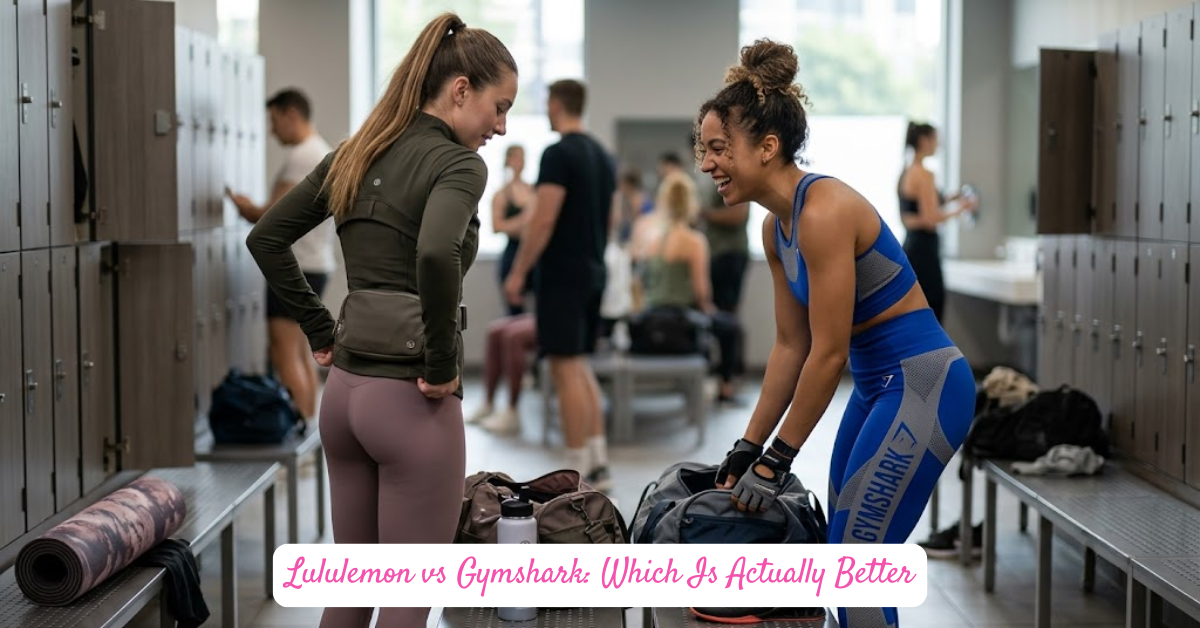
Let’s discuss the debate that’s been roaming around the gym changing area and TikTok-comment sections for years now. You know the one. A person uploads a fitness video and in under a minute, people are either saying “omg her Aligns are everything” or “Gymshark hits different tho.There’s a fitness video posted and by the end of the first minute, some people go “omg her Aligns are everything” and some people go “Gymshark hits different tho. Fighting the Lululemon vs Gymshark battle is a thing, it’s serious, and let’s face it? Both sides are right. I have been wearing both and I am watching the drama and doing my research and here in 2026 to give you the honest and no fluff breakdown that you deserve. No “corporate fence sitting”, no “it depends on your lifestyle!” cop-outs. Just Mandy’s honest words to you.
The Origin Stories (Because Context Matters)
Lululemon: The Canadian That Started a Whole Movement
This is where Lululemon began in 1998 with the Vancouver, Canada, vision of its founder Chip Wilson, who essentially invented “premium athleisure” before the term existed. The brand debuted in yoga studios and quickly became the must-have for women seeking workout pieces that felt high-tech, looked high-end, and could effortlessly transition from a 7am vinyasa class to a coffee shop. Lululemon’s positioning right out of the gate as a luxury product was always backed by the price tags. Today the brand is running more than 700 stores worldwide and is equipping Team Canada for the Milano Cortina 2026 Winter Olympics – a very Lululemon move to make, indeed.
Gymshark: The Garage-to-Billions Glow-Up
Gymshark’s origin story is one of the most wild of all fashion stories. Ben Francis is a 19-year-old Birmingham, UK, pizza delivery man and university student who started to sew in his parents’ garage in 2012. He bought a sewing machine for $1,500, and his grandmother taught him the basics, and he began creating fitted gym-fabrics that actually flaunted the body he had been working so hard to make. So — and that’s the trick — rather than paying for ads or celebrity deals, he simply sent free clothes to his favorite YouTube fitness creators. The word influencer marketing was not in use and nobody was using the term. He was a person who was a fan and had a product. That strategy turned Gymshark into a $1.45 billion brand in less than 10 years and put Ben Francis amongst the most popular entrepreneurs of his time.
Price: Let’s Just Be Honest About the Numbers
It’s not a competition and we all know it. You can expect to pay about $98-$128 for a pair of Lululemon Align leggings, depending on the style. They offer sports bras that range from about $48, and their Define jackets can go over $150. Lululemon never games with its pricing.
Gymshark, meanwhile, charges between £35-60 (about $40-75 USD) for their core products, before their famed sales. The Black Friday and yearly summer sales have become virtually a tradition with them now and they have many thousands of visitors online to shop and already sell out their collections within hours. That difference in cost is a real deal for a Gen-Z purchaser who has to pay rent, student loans and oat milk lattes.
This round goes to Gymshark. Full stop.
Quality and Durability: The Long Game
Now things get fun. Lululemon’s entire brand is founded on proprietary fabric technology. Each of the fabrics has been designed with a specific use in mind: Luon, Everlux, Nulu, Align. When you purchase a pair of Align leggings, you’re purchasing years of research and development. They are so soft and so light and they don’t pill, fade or go see-through after washing washable. Technically, there’s no other Gymsharke to compare the Pace Breaker boys’ shorts to.
The quality of Gymshark is adequate for the price and has definitely improved over the years. They are comfortable, stretchy, and convenient to wear for everyday gym activities because of their seamless construction. Long-term durability, however, is not up to Lululemon’s standards. After heavy use and repeated washing, Gymshark pieces are more susceptible to showing wear and tear over time.
Lululemon is a winner on fabric technology and durability. The Align legging – alone is a masterclass.
Fit and Aesthetic: Two Very Different Vibes
The entirety of Gymshark’s style is edgy, squat and in-your-face. Consider bright colors, scrunch-bum features, cut-outs, contouring and logos. It’s snugly, as is the nature of the fit and designed to accent your figure – literally! One’s goal in the gym is to look good. The fit is true to size, some are tighter – always read the product reviews before purchasing.
In the best way, Lululemon’s style is just the opposite. It’s simple, minimal, and almost understated. Branding is minimal, palette is neutral but with judicious touches of colour, and the overall attitude is more “look at me in the gym” and less “I woke up like this and oh, and I’m very put together too. Lululemon’s crossover appeal is truly second to none — their clothes fit into a yoga studio, a coffee shop, an airport and somehow a casual work meeting.
Truthfully, it depends on your desires. Gymshark for gym drama. Lululemon for everywhere-all-the-time.
Range and Variety: Who Has More Stuff?
Gymshar has grown at an exponential rate since its initial launch of leggings and sports bras. They now offer a wide variety of leggings, shorts, sports bras, crop tops, hoodies, joggers, and matching sets that have been created specifically for weightlifters, and even powerlifting shoes in 2025. Their application has more than 2 million active users and they listen to their feedback to guide their new product development – that’s smart!
They have a range of tops for running, yoga, golf, training and tennis, plus an all-important men’s line that’s frequently overlooked. Pace Breaker shorts and Metal Vent Tech tees are similarly popular among male athletes on par with the Align cult on the ladies side.
Gymshark also has a slight advantage in terms of variety, and being somewhat trendy. The selection is a little more refined and incorporates a variety of activities at Lululemon.
Sustainability: The Uncomfortable Truth for Both
There’s no standing ovation here for either brand, but here are some facts.
Lululemon and Sustainability
Lululemon has reported impacts and established formal sustainability goals – more than many brands. The news is good–they reached their recycled polyester target one year early, 77% of their total polyester is now recycled. They are currently rolling out their “Like New” resale programme in 84% of their stores in the USA, which now allows customers to bring in their used items and all profits are reinvested into sustainability initiatives.
The not-so-good news: Lululemon failed to meet its 2025 goal for a 50% decrease in intensity of single-use plastics and that target has been quietly removed from future reporting. Sustainable nylon is still a challenge, with currently only 11% of their nylon being sourced from renewable or recycled materials — they use a large amount of synthetics such as polyester and nylon, which are produced from fossil fuels and therefore are another source of microplastic pollution. They have also reduced their 2030 preferred materials objective from 100% to 90%, due to materials sourcing complexities. It wasn’t until May 2025 that Lululemon added a new Senior Vice President of Sustainability, indicating that it has been making sustainability more of a priority — but it’s not been uniform.
Gymshark and Sustainability
Gymshark is being honest when it says that it’s still in the early days. Their customers are making sustainability a factor in their decision-making process, and the brand has begun to talk about sustainability as a component of material traceability and recycled content. While Lululemon has a formal reporting system and measurable goals, there is less transparency around the source of Gymshark’s materials and what the impact of their products actually is.
Both brands are not doing enough. At least Lululemon is more open-minded about it. Neither passes.
Brand Culture: The Customer Vibe Check
But the real fun comes when Lululemon is compared to Gymshark, as the latter markets an entirely different lifestyle to the latter in conjunction with their leggings.
The 2026 Lululemon customer is a user who considers exercise a holistic part of a healthy lifestyle. Most likely they are also part of the cold plunging club, matcha club, Pilates club or running club. They want equipment which they feel they can use at brunch as well as in a Barry’s Bootcamp class. The brand has always been more focused on aspirational health than performance, and for some reason no other activewear brand has been as successful as the brand is at being crossover into daily wear.
The Gymsharer is more likely to be a gym first and fitness first person. They wish to present the fruits of their labour in their clothing. They watch gymnics on TikTok, they perform Gymshark 66 workout challenges, they are familiar with the Gymsharmers Athletes, and they feel that they are part of a community. The authenticity that the brand established within fitness subcultures (bodybuilders, powerlifters, women’s strength training) is very real and the community identity is the cornerstone of the brand’s entire empire.
Celebrity and Athlete Endorsements
In the past couple of years, Lululemon has taken a leap into high-profile athlete partnerships. They already have Lewis Hamilton (yes, the Formula 1 driver, who joined early 2025), NHL player Sidney Crosby, NBA player Jordan Clarkson, NFL wide receiver DK Metcalf and tennis player Leylah Fernandez and Frances Tiafoe. They are also the Official Outfitter of Team Canada for the 2026 Winter Olympics. These are big and believable athletes who really help to establish Lululemon’s status as a performance brand, not just as a premium athleisure brand.
The brand has always eschewed the use of celebrity endorsements for something more grounded, such as a partnership with genuine fitness creators, which has been an amazing success for them. “Gymshark Athlete” is a coveted, structured, and public designation that has gained popularity in fitness communities. For example, long-term athletes such as Nikki Blackketter and Steve Cook have had multi-year relationships with the brand that instill a level of credibility that a single-season endorsement simply can’t. Their Gymshark 66 challenge alone, has garnered billions of views using user-generated content – which is free, and is true Marketing, that money CAN’T buy.
The prestige sports angle is something Lululemon is getting. Gymsharpaway with the true community aspect. Different games.
Which Brand Is More Popular With Gen Z in 2026?
Well, here’s what I mean. Gymshark is all over TikTok, YouTube and Instagram fitness material. They’ve built a community-driven program, with approximately 85% of their customers saying they are seeing influencers as a key reason for buying, and their viral challenges generate continual organic content. Gymshark is like a home away from home for a fitness-loving Gen-Z consumer who found their first love in social media. It’s the brand of the FYP.
However, there is a Lululemon renaissance going on among Generation Z that is not to be overlooked. The Align legging is a fashion item as well as an exercise article. The Scuba hoodie is on the TikTok trend list. The belt bag evolved into a truly fashion accessory. Lululemon has successfully ventured past “thing your older sister wore to yoga” into a complete Gen-Z status symbol, especially for the wellness-aesthetic demographic. The brand’s NFL affiliation and increased involvement in tennis and running are also attracting younger consumers who consider Lululemon to be a brand with serious athletic credibility.
Both brands have authentic ‘Gen-Z’ appeal, they simply are going after different segments of the generation.
The Honest Verdict (Mandy’s Call)
So here it is. No Lululemon vs Gymshark bullshit, no “both are great for different people” BS.
If that’s an option, Lululemon will be a better product. The fabric technology is really amazing, the durability is well worth it over time, and the versatility – you aren’t purchasing gym garments, you are purchasing garments that you will go to for each and every single day for many years. This Align legging is not hyped. It’s really that good! For those who buy less and have more, Lululemon’s your brand.
However, when budget is a major consideration — which, for most of us, it definitely is — Gymshark is a great value for money. The quality is very good, the community is really fun to be a part of, the range is super wide and you can look and feel great in the gym without spending $120 on a single pair of leggings. No problem with this math at all.
So, the true answer to Lululemon vs Gymshark 2026? There’s likely at least a space in your closet for both. Some investment items for everyday use, a few investment items from Gymshark for variety and fun colourways and the feeling of adding 7 items to the shopping cart on Black Friday. There’s no such thing as “fence-sitting” — it’s just smart shopping.
You’re welcome.