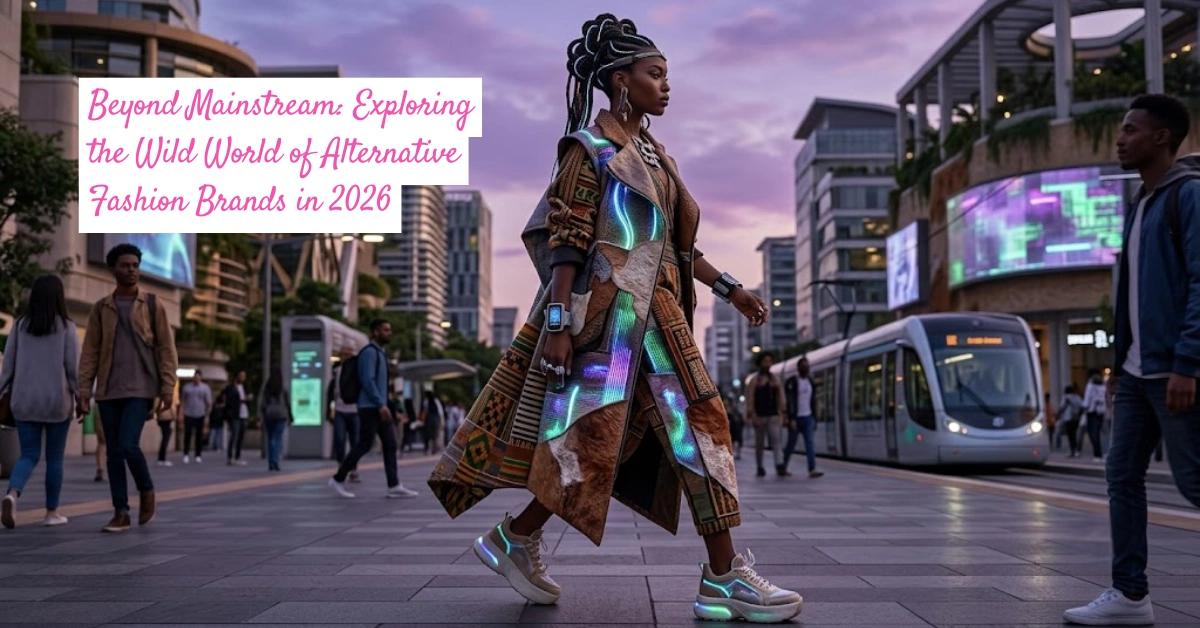
As content in social media feeds becomes increasingly uniform, finding and embracing your personal style voice is crucial. The alternative fashion brands have spearheaded the journey towards revolutionary fashion standard deviations, shifting rebellious self-expression from simple fashion changes to radical changes in fashion terrain.
On our journey, alternate fashion evolved into a blend of unconventional styles, sustainable practices and cultural reconstructions in 2026. It has grown up from its beginnings as counter-culture to being part of a generation that looks for their real selves and core values rather than fashion in clothing.
The Rise of Digital-Physical Fusion Brands
Now the lines between virtual and real were completely erased and new lines were made up of alternative fashion brands, which can now rule this refined mix of styles. The brand leaders today realize that our clothes are more than just physical items in a closet, they’re digital products with replaceable designs.
Many of the customers wear specially designed technological wear from the Berlin-based Numinous Collective. The “Metamorph” jackets enable users to realistically interact with their jackets via neural interface applications that activate embedded AR components. Cherry blossoms can be seen by passersby on a simple black jacket, which can then transform to electric blue wave patterns within a nightclub. Their 2026 line of collections makes wearers an audio responsive visualization of the ambient sound frequencies.
Oakland-based Phantom Grid’s name is synonymous with “Dual Realm” collections, which create virtual counterparts of physical outfits on metaverse networks. As users continue to browse the web, these versions are advanced, sending microscopic fabric changes back to the real garments.
It’s fashion that evolves with its users, says founder Maya Chen. Capsules of the 2026 collection are made with virtual experience patterns of the digital world, which are absorbed by the overcoats, creating unique patterns on each one.
Neo-Craftcore: The Handmade Renaissance
As AI takes over the design process, fashion connoisseurs have formed an anti-AI movement that celebrates unique and human-made imperfections in fashion, making these pieces look more beautiful by hand.
At his New Mexico atelier, Elijah Wolfe restores the traditional textile arts and crafts to create limited edition pieces that are produced over months. Hand-loomed natural dyes from the desert, woven with cuts that span the ages and sit in harmony with modern simplicity, make for an “Heritage Redux” series of fabrics. Even digital records of everyone involved are provided; everything from foraging for plants to stitching.
London based Stitch Witchery takes handcrafting to the next level. The collective will teach owners how to keep remodelling garments by means of current personal re-creation, according to its “Mending as Metaphor” doctrine, and each garment will arrive with a set of embroidery templates and materials. Nneka Okafor, founder of the brand, holds mending sessions every month, calling mending and transforming possessions a revolutionary act.
The 2026 Living Archives collection is based on storytelling textiles from West Africa, on which wearers embellish to record their personal experiences.
Biodesign Pioneers: Growing Fashion from Life
With Biodesign technology, designers can design sustainable fashion from living systems and create objects that can break down into the environment.
At the cellular level, mycelium fungi root systems created by Mycelium Dreams have transformed the world of leather alternatives. The leather feel of the “Second Skin” jacket series is preserved while the items are also breathable and temperature regulating.
In contrast to the way fixed materials are built, Lin mentions how the materials are obtained from living systems. The 2026 collection features a blend of several different mycelium to create variety in color and texture, and the “Living Closet” subscription allows customers to recycle old products as starter culture for new ones.
An atelier in Paris, called Chlorofil, has created textiles which harness the power of photosynthesis through algae. The “Breathable” collection contains a biopolymer to bind carbon and a microalgae, spirulina, that changes color in the light.
Fashion should be more active than maintaining, it should help the environment, believes the founder of Baptiste Rousseau. The “Symbiosis” line of 2026 is made from beneficial microbes that change their behavior in relation to the environment in which they are placed, and the “Climate Coat” is a cloth that also changes color to indicate air pollution, serving as an awareness device.
Techno-Tribal: Digital Communities Made Tangible
Many of the best 2026 brands began as virtual communities and evolved into real style tribes.
Glitch Couture started as a Discord channel for artists creating AI distorted artwork. Japanese textile expert Kaori Tanaka created ‘glitched’ digital art by transforming it into clothing, as the structures became distorted, there were encoding errors. The 2026 Corruption Archive materials simulate buffering and compression on screen, resulting in revenue going back to original digital artists.
NPC Rebel has emerged from the gaming community and the anti-mainstream fashion attitude. Esports interface elements are featured in clothing designed to be worn on the body, such as health bars and map displays, for the games, created by creator Rio Kim.Gamer interface elements are integrated into body-crunched garments, including wellbeing bars and maps, for the games, created by creator Rio Kim. The 2026 “Player Character” collection features AR elements, which can only be seen through special lenses, which produce common visual effects when the wearer comes into contact with another wearer. Kim calls the clothes digital keys to search for people in the real world.
Post-Geographic Design Collectives
Collectives today function beyond the standard framework of industry and are bound together by philosophy and values, not by place.
Diaspora Futurism brings designers from fifteen countries across the African continent and abroad together via a series of “convergence studios” in which clothing from various countries is brought together. The band, spearheaded by Amara Okafor, examines future societies in Africa, devoid of colonialism. The 2026 “Parallel Histories” collection comprises sounds elements that evoke an oral history, transforming clothing into a narrative system.
Borderless Atelier is not like that, though, because they have over a hundred members living all over the world. Ex-luxury designers have formed during the time of remote working, and the members join projects freely via virtual environments. For the 2026 “Timezone” collection, nine designers, from 27 locations around the world in 19 countries, worked together.
Afrofuturist Vanguards
Afrofuturist designers combine with heritage knowledge and imagined pictures of a liberated black future.
Led by Adebayo Adeyemi, Cosmic Yoruba is composed of classic West African patterns and futuristic space designs, weaving aso-oke and fibre optic strands together. The production of the 2026 “Mothership Connection” collection will be based in Lagos, London and Detroit and offers customization via interchangeable parts.
Sankofatech was founded in Brooklyn by Dr. Nzinga Reynolds to engineer Afrofuturism. Like the kente cloth used to carry information, the Griots collection contains data in disguise, which is unlocked with a special mobile app. The 2026 “Cellular Memory” pieces store microbial cultures, and need to be cared for from clothing maintenance to gardening.
Adaptive Wear Revolutionaries
The designers who are employing disability and neurodiversity as fundamental design concepts are leading one of the most authentic alternative fashion movements.
After the mainstream clothing caused her sensory distress, Sensory Sanctuary was formed by autistic designer Jamie Rivera. Fabrics are tested by neurodivergent consultants for comfort against hypersensitive skin without compromising on the aesthetics. Weighted tools, pressure panels and sound-dampening hoods are turned into design features in the 2026 Stim Collection, created by Elle Obermann and Erika Smith.
Designing from a seated body form instead of the standing body form, Maya Chen founded Kinetic Freedom, after being a wheelchair user and Paralympian. The brand embraces disability, rather than concealing it, and views mobility tools as design elements, says Chen. The 2026 Motion Architecture collection creates a seamless flow of design, both sitting and moving, with a team of disabled designers.
Fashion as Resistance, Fashion as Future
In 2026, our exploration of alternative fashion shows that innovation occurs in small, passionate creator spaces, not luxurious or fast fashion businesses.
As algorithms take over recommendations, it’s becoming difficult to ever wear something out of the ordinary without it being considered opposition. These brands aren’t just about products, they’re about new thoughts about a person’s relationship with the body and with the environment.
You’re not fully in the mainstream suggestions and you’re in the authentic look. The revolution will not be on the products shelves, but will be unforgettable fashion in the style.