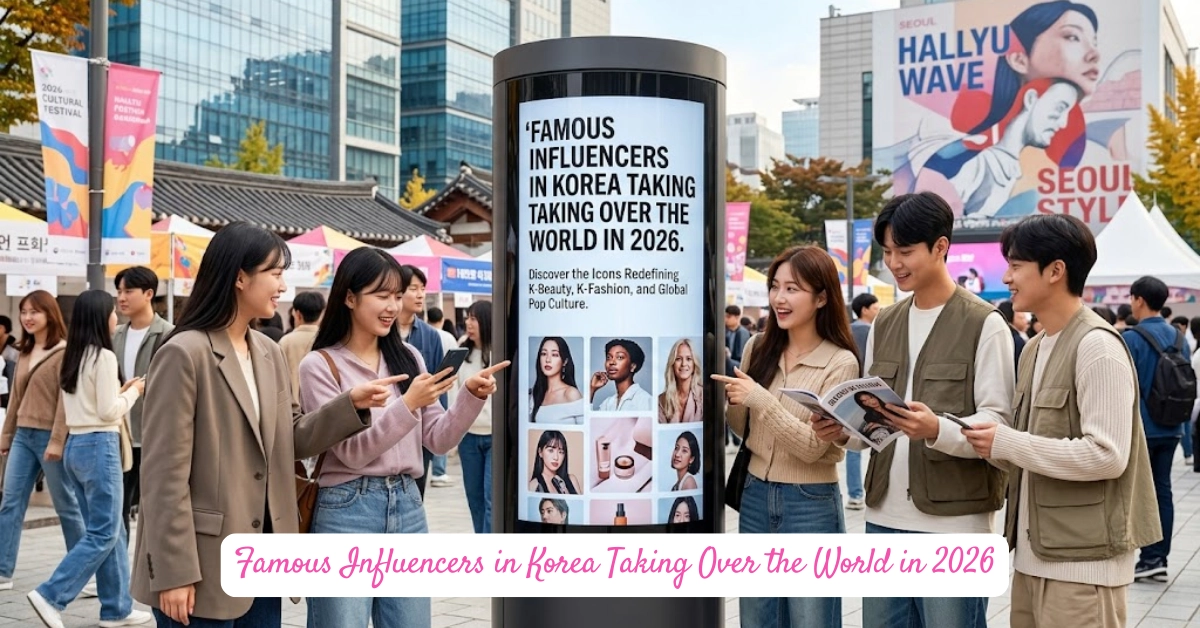
Korean culture is one of the biggest influences in the world of fashion, beauty, and pop culture right now, and, if you have been hiding from the world, you’ll see. K-beauty, K-fashion, K-pop: it is all seeping into the eyes of the rest of the world in terms of what they wear, what they buy, their spray they put on their face, and what they post on their feeds. Seoul is not a city, it’s a place. It is a feeling, a style, a lifestyle, something that everyone from LA to Lagos wants to emulate. At the heart of this cultural invasion? The Korean megastars that make their feeds into world trend forecasts on which everyone else follows like sheep – in the best way possible.
It’s not just about a passing fad on TikTok. It’s all about a cultural overhaul. Korean creators are altering the skincare industry, revolutionizing street style and truly redefining the term ‘influencer’ vs ‘icon’.Korean creators are truly doing what no one else is doing right now, to change the beauty industry, street style and the definition of ‘influencer’ vs ‘icon’. So who are these people, what are they doing, and why should you be following everyone of these people?
Why Korean Influencers Are Running the Internet in 2026
At this stage, your For You page shouldn’t have any video content but 60% of it should be Korean. Western creators don’t play by the same rules as the Koreans. They’re not creating “authentic” content in a chaotic manner to gain relatability, and they’re not churning out hyper-produced content that looks like a commercial. What these Korean influencers have learned is the perfect balance of aspirational yet attainable and polished yet personal. Their feeds are like the editorials but sound like your best friend’s Instagram.
That’s the Korean Wave, also known as the Hallyu wave, for those who aren’t familiar with the term, and it has finally transitioned from “niche interest” to “global default setting. It might seem like a no big deal, but Korean IG influencers typically maintain a cohesive aesthetic with high-quality photos, meaning their content actually looks better and thus makes a bigger impact as soon as it arrives on the platform. Throw in that and the K-pop machine, the Netflix drama factory, and Seoul’s status as one of the world’s cooler cities, and you have an influencer landscape that’s truly out of this world.
The other element that makes Korean creators stand out from the rest? There is no neat division here between the “beauty creator,” “fashion creator,” and “lifestyle creator. The most influential individuals have mastered all three and are able to seamlessly switch from a skincare reel to travel to an OOTD carousel to a serene visit to a cafè, all in the same week. By default, their content is multi-hyphenated which makes it so addictive.
The K-Beauty Royalty
PONY is known to anyone with an ounce of knowledge about Korean beauty influencers. With over 7.2 million followers, Pony (Park Hye-min) is considered Korea’s most famous beauty influencer and has her own cosmetics line. She has been doing this for more than 10 years and she still remains the blueprint. From full glam to plain and simple wearing looks, her YouTube tutorials are endless, and she manages to make every look look simple, when it clearly isn’t. PONY has worked with top K-pop celebrities and collaborated with brands around the world, not only is she shaping beauty trends, but she was also a key part of the development of the global framework of K-beauty content online!
What is it about her that is still going strong in 2026 when so many creators rise and fall? She keeps evolving. She’s not confined to remaking her best songs. Her content is always updated, her product knowledge is vast, and her production quality is studied and learned by other creators.
Risabae
Precise and transformative makeup artist, Risabae is a popular South Korean artist and influencer. Her editorial looks feature delicate gradients, glossy lips and flawless skin work. She rose to fame on YouTube and Instagram and is now a professional editor. She’s also this little bit weird: technically, she’s amazing, but you don’t feel like she’s a warren of a woman, you feel like she’s a woman who’s a little bit weird.
Korean cosmetics brands are now on the international stage: Pony and Risabae, for example, are Korean makeup artists working for international brands such as Fendi and Balmain. It’s no longer influencer business. That’s legacy.
Freezia (Song Jia)
Song Jia, better known as Freezia, is among the most interesting of the Korean influencer case studies. She rocked the world when she dropped on Netflix’s Single’s Inferno, and went on to become a breakout star for her high-end wardrobe and coldness. Then, one minute she became the party pooper who seemed to lack any sense of style and couldn’t pull it off. Then was the scandal, then were the cancelled brand deals, then the crazy fallout. The thing about Song Jia is that she rebuilt. She continues to represent 4.6 million Instagram followers and approximately a million viewers on her new-fangled channel on YouTube.
The celebrity is known for her glass skin and flawless foundation looks, and Freezia is setting its example. Her honest product reviews are always engaging. Despite the controversies, she is undoubtedly one of the most culturally important creators in Korea’s reality TV and influencer fusion era. And she’s still very much here.
K-Fashion Creators You Need on Your Feed
Irene Kim
International fashion icon and model Irene Kim (@ireneisgood) is known for her unique style and rainbow hair, and has 1.8 million+ followers. She’s the quintessential “Korean cool” personification distributed all over the world. All while also walking the catwalks, attending fashion shows and events across four continents, and collaborating with luxury brands, Irene has developed a personal style that is truly hers. She has skills to go minimal where Korean fashion goes maximalist, and she can go maximalist where others go minimalist, and she pulls it off every time.
Fusing high fashion with cutting edge k-beauty trends, Irene Kim is colorfully bold in the field of Korean skincare and makeup. She is a trendsetter and has a global influence and presence that makes her a top choice for a new product launch in the beauty industry. That’s Irene Kim in one: fashion and beauty came together as one with her.
Lee Jisu
Lee Jisu is a Seoul-based lifestyle and modelling influencer and the CEO of brand @khakipoint. Her Instagram is a lesson in layered tones, colour schemes that are not too bright or bold, and “Seoul Look” , Acubi-adjacent silhouettes, subtle makeup and subdued aesthetic environments. Whereas Korean fashion icon and queen Irene Kim has embodied the intense, fearless side, Lee Jisu is the quiet confident one. This is a really good post about how to wear clothes so that it looks like it is easy, yet it’s actually very thought out. Her “Seoul Look” (neutral, layered, targeted) is the one that Western creators have been trying to achieve for some time now, but not quite.
One of the stylists that Seoul goes to for lifestyle and modeling, Yoonseo Im uses soft-edged, film-photography-style feeds that are ideal for Korean minimalist aesthetics , pastel daily looks, café corners and slow lifestyle moments. Her “effortless cool” was a term that’s used quite a bit, but it’s certainly accurate here, as she became a favorite in the Korean fashion world. Visually speaking, she had herself photographed for a dedicated digital spread for Alo which attracted a viewership of over 300K on Vogue Korea. When you want to be both calm and stylish, you follow the person who is calm and stylish,who is that person other than Yoonseo?
K-Beauty Trends in 2026 and Who’s Driving Them
So, here’s the tea on what is actually going on in K-beauty these days, as it has come a long way from the past few years of obsessing over glass skin (which, you don’t hear this from me, is very much alive, too!).
The glass skin trend is one of the most significant changes in K-beauty trends of 2026. A new “cloud skin” look is now softer, blured and more natural. Provides soft matte shine without compromising the hydration. The skin is smooth but does not oily. It’s the time of skin that looks like skin but way better than Tuesday morning skin. This more dimensional and soft focus finish is being taken up by a generation of creators that are promoting the “your face but elevated” ethos and are therefore rejecting the ultra-glossy glass skin look.
It’s time for the heavy contour and full coverage makeup look to be swept aside with the soft blur trend. The preferred foundation shades are now tinted skin and light foundation shades, and soft blushes are now in vogue. Brows are natural. Eyes are simple. Furrows of lips are not sharply defined, but are soft and blurred. It’s all over the place and definitely Korean, this gradient soft diffused lip look is everywhere now.
2026 K-Beauty is a progression of the K-Beauty industry – from wet glass skin to dimensional cloudglow. Brands, products and routines that will shape this generation are intelligent, efficient, sustainable and not necessarily just about selling.
The two creators most linked to these particular changes are PONY and Freezia, with PONY leading the way with her detailed technical analyses of new formulas and techniques, and Freezia’s aspirational content, which helps the cloud skin appear desirable and not clinical. Meanwhile, creators such as Jihoon Kim are gaining momentum in the realm as they analyze products at the level of their ingredients, which the new generation of K-beauty consumers is looking for.
Where K-Pop Ends and Influencer Culture Begins
This truly is one of the most interesting questions in Korean content culture right now, as the line is becoming blurring all the time. Unlike regular influencers, k-pop idols have much bigger social media following and their fashion sense is a trend among millions of followers , and that’s not the kind of influencing behaviour, that’s closer to cultural command.
The new beauty icons are k-pop idols. Their flawless skin, elegant but playful looks, and groundbreaking ideas have moved an entire generation, not just Korean, but the world over. Whether it’s Lisa’s eyeliner, Jisoo’s blush, or Taehyung’s soft matte skin, the influence of the idols has now made an impact on everything from editorial shoots to campaign looks for western luxury brands.
The difference, though, is that while K-pop idols have to work within the confines of management, their content is also typically art-directed, curated, and approved. Traditional influencers are free to be creative. That said, it’s the autonomy that resonates with creators such as PONY, Irene Kim, and Freezia to make them feel different from idol content: they’re not getting an idol, they’re getting a person. The curious middle part of the zone is occupied by reality TV stars such as Song Jia, and breakout contestants from Single’s Inferno, etc., who enjoy the cultural dominance of being an idol, but the creative freedom of being an independent creator. It is that space which is getting the juicy Korean influencer stuff increasingly from.
Seoul Street Style and the Creators Documenting It
Sebin
Korean GRWM and Gen Z lifestyle creator, Cross-platform creator Sebin, is one of the busiest creators in the country. Her Instagram highlights photos of her getting ready, traveling days and sibling stage scenes with her brother Seungbin, the same style content that’s boosted her TikTok up to 800K followers. She is very authentic in her documentation of the city of Seoul and feels like a friend and not a nicely put together stranger on the internet. Her style is definitely Seoul style: playful, young, specific , and that energy is contagious, making you want to hop on the next plane to Hongdae.
Park Hee Sun
The biggest breakout star of Single’s Inferno 5, Park Hee Sun is a Carnegie Mellon Information Systems major and 1st runner-up of Miss Korea 2024. Her show has quickly grown past 1.2 million followers in a few weeks and has now passed 2 million followers, with her videos ranging from polished beauty queen shots to student life shots, divided between Korea and Pittsburgh. Her street style videos are interesting, for she’s going through two styles of street , Seoul it-girl and American campus reality , and somehow it seems she’s doing both. As a person, she is the embodiment of the Korean famous or influencer’s image in the global era of today: Korean culture with international eyes.
Dex (Kim Jin Young)
Dex is a former UDT (Underwater Demolition Team) soldier, content maker and actor, who rose to fame on Single’s Inferno 2 and My Name Is Gabriel. His Instagram postings include not only brand promotions and K-drama promotions, but also the laid-back, manly appeal that’s made him one of the most followed Korean male creators. His look is all business, no frills; looks like he got dressed in 30 seconds and looks a little better than all those who took an hour to get it together. He is part of a new wave of Korean male lifestyle creators that are transforming how Korean men look on the social media platform.
The Global Reach Is the Point
The difference about the Korean world of famous influencers is that their success does not come with their global audience, it’s actually part of the plan. In the media landscape of Korea, domestic and international audiences are constantly intertwined. With the Korean Wave (Hallyu) still spreading around the world, Korean influencers are more and more valuable for local and global brands alike.
Even global brands such as Chanel and MAC are using the same techniques that K has introduced in their beauty manuals on the cat walk, stating that their new look is skin-first. K-beauty signatures are now essential part of fashion week , minimal, natural and an impactful look. When Paris’s top designers are literally copying the backstage beauty guides created by Korean designers for years on, that’s no longer a trend. That’s a permanent change.
It’s especially the American Gen Z market that can’t get enough of it. In the United States, the K-beauty market is riding the wave of the Gen Z, with sales increasing by 53% since the pandemic, primarily because of trends on TikTok and an increasing demand for retail products. Products that Korean influencers promote on their pages, such as COSRX’s Snail Mucin, TirTir’s Cushion Compact and various rotating glass skin serums, sell out worldwide within a couple of days of the videos going viral. That Korean-to-consumer pipeline is one of the strongest product-to-market mechanisms in the beauty world, period.
Final Thoughts From Mandy
There’s a lot of countries, that are creating great content creators. However, Korea is doing something that feels truly unique,an entire ecosystem that merges beauty, fashion, pop culture and digital influence into a seamless, unified reality, rather than them being different categories. These are the Koreans who are well known for their big fan bases. They’re the cultural designers and they are making an active choice about what the rest of the world considers beautiful, stylish and worth the purchase.
If your algorithm is not already stuffed with Seoul, cloud skin, blurry lips and Hongdae street style pics, this is your kind invitation. You’re about to get some serious upgrades in your feed.