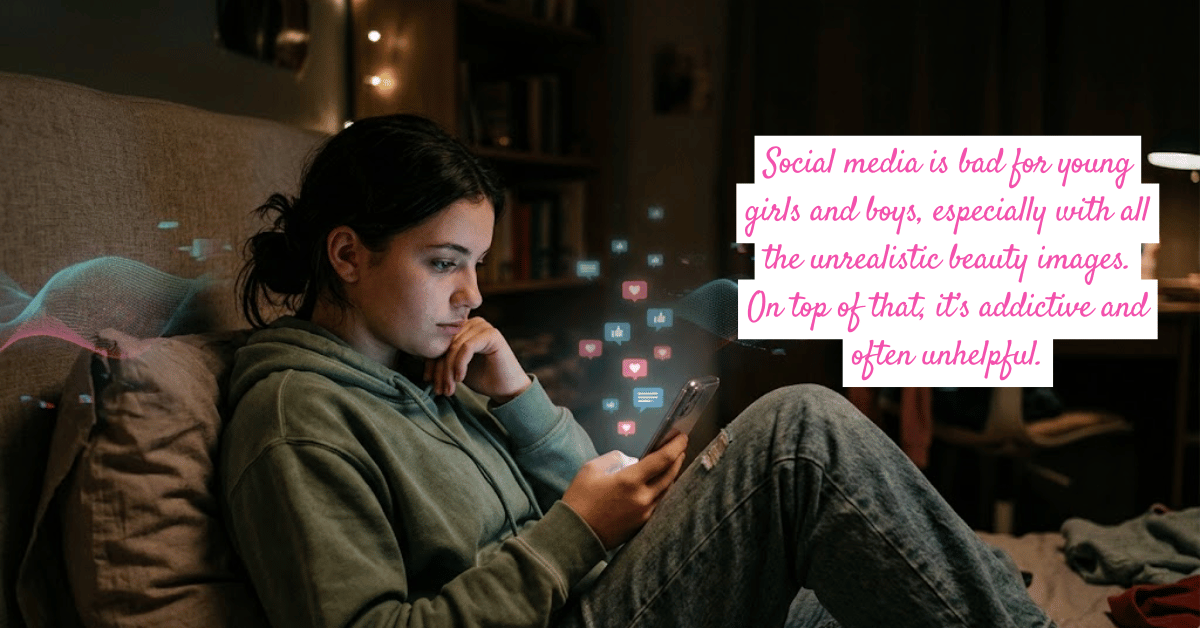
Recall the days of social media being presented as a means to bring people together? One large global chat in which no one will ever feel lonely again. Cute idea. For many of us, especially young people, it has done just the opposite, however. We are more connected than ever before in history but at the same time more lonely, more anxious and more confused about who we are. So let’s get a little honest and discuss what the research is actually reporting and what we can do to help youth without resorting to dumping their phones in the ocean (no jokes about that, I know).
I’m not here to preach at you! But sometimes I’ll log in to Instagram and be a good girl, and then I log out and feel like a potato in sweatpants. If you are familiar with the feeling, this is for you.
What the Research Actually Shows Right Now
In March 2026, a giant study of hundreds of long-term studies of children and adolescents over time was compiled in the Journal of the American Medical Association (JAMA) Pediatrics. Increased social media was consistently correlated with depression, self injurious thoughts, problematic internet use and decreased school performance. Most of us get our first accounts in the early adolescent age, and that is when the effects were most marked.
In another study from 2026 (based on annual surveys of youth from 2018 to 2025), young people who reported using social media for more than six hours a day were over 60% more likely to be experiencing anxiety and over 300% more likely to be thinking about suicide than those who reported less than an hour of social media use.
In Australia, scientists tracking the lives of 1,200 Melbourne teenagers over 10 years discovered that those who used social media the most were at risk of experiencing an additional six cases of depression and low wellbeing every 100 teenagers.
Nearly one in two U.S. teens reports a mostly negative impact on social media on people their own age, a finding of the Pew Research findings. Honestly? We know.
How Social Media Actually Gets Under Your Skin
It isn’t one thing. It’s a lot of covert mechanisms that are all working together.
The Comparison Trap
Your brain is designed to make comparisons with perhaps a hundred people in your village. Now it compares you to millions of the prettiest, richest, most “that girl” on the planet, before breakfast. You watch their highlights while they live their behind-the-scenes. The object of that game is to be lost by everyone.
The Dopamine Loop
Each like, comment and notification triggers a little release of the dopamine that is involved in gambling. Rewards arrive randomly so you continue to check. This is a kind of pocket-sized slot machine that not only knows your name, but also your face.
Cyberbullying That Follows You Home
It was once a common expression to stay at the school if you were told to do so. Now it is with you in your bedroom at midnight, it is screenshotted, and it lives forever in a groupchat you are not a part of! It can’t be turned off.
The Sleep Thief
It’s an overlooked gem. In a study of teens’ actual phone data in 2026, over half of them logged on to their phones for at least an hour at night on school nights, primarily on TikTok, Instagram, and YouTube. Not getting enough sleep is linked to a bad mood, increased anxiety and inability to handle the stress the app just inflicted on you.
The Algorithm Is Not Your Friend
The scroll you’re reading isn’t for your well-being. It’s created to keep you scrolling so that advertisers can sell you their attention.
Part of the reason why social media is bad for youth is that. Algorithms learn what has your eyes, and sadly it’s insecurity, outrage, and envy that have eyes. Stay on one “what I eat in a day” video and pretty soon, your entire feed is all about calorie counting and small waists.
It’s no longer my own opinion. The Los Angeles jury awarded the victim $6 million in a landmark case brought in March 2026 against Meta and YouTube for addiction. A day ago, a jury in New Mexico ordered Meta to pay a $375 million in damages. Instagram’s own CEO has said in a federal trial in August 2026 that only 1 or 2 percent of teen users were using a safety feature designed to curb addiction prior to its launch as a standard app feature.
Filters, Edits, and Impossible Bodies
I guess we should discuss body image as a fashion girl, this one is personal.
Filters regulate smooth skin, which has pores (all skin has pores babe). Edits pins buttocks, raises the cheekbones and removes the stretch marks in seconds with editing applications. Your brain begins to accept the face you’ve scrolled through as normal and your original face as the issue.
In a 2026 scoping review of 58 studies on appearance-focused social media, definite connections were established with decreases in body satisfaction and self-esteem in teen girls and young women. The only positive part of that research? The content that was most protective were the body-positive and the body neutral content. What you feed your feed really does feed you. There’s no one who looks like their filter, even the girl who posted it.
Why Girls Are Hit Harder
Studies continue to reveal the same trend, and there’s a reason for this. When Pew asked teens whether social media was bad for their mental health, 25 percent of the girls said yes, compared to 14 percent of the boys. 40 percent of boys reported that it negatively impacted their sleep, while half of the girls reported it did.
Girls are more likely to use online, appearance-based venues that have ratings of looks in the public eye. Having your name not included in a group chat or seeing a party you weren’t invited to really hurts a girl’s relationship and belonging. In addition, girls are more likely to be subjected to sexualized comments and appearance-based harassment. Girls’ bodies are already being pressured offline and social media is there to amplify the pressure.
While both genders have their own issues with money and muscles, the facts are that teen girls are getting the short end of the stick.
What Governments and Platforms Are Doing
The ban on children under 16 accessing platforms such as Instagram, TikTok, Snapchat, YouTube and X comes into effect in December 2025.
But is it working? I’m totally honest, not quite as good as expected. Australia’s eSafety Commissioner has found that the proportion of under-16s using an account has declined slightly from 52.4 per cent in the first three months to 42.1 per cent. However, over eight in ten young teens report using social media in some way.
The rest of the world is getting ready. The UK have plans of restrictions to be implemented in 2027, Canada has its own under-16 rules and the EU is expected to bring in a proposal.The UK have plans of restrictions expected in 2027, Canada has its own under-16 rules and the EU is expected to roll out a proposal. In the United States, a greater number of lawsuits against platforms are set to go to trial in 2027.
Parental controls, quiet modes, daily time limits and teen accounts have been introduced to platforms. It’s a step forward, but as that testimony in court demonstrated, safety features don’t do much if they aren’t turned on and used.
What You (and Your Parents) Can Actually Do
Curate Your Feed Like Your Closet
If you wouldn’t have them around if they made you uncomfortable, why have them around if they make you uncomfortable? To unfollow someone or turn off the sound who makes you feel smaller. Follow real people, real skin, real lives.
Set Boundaries That Stick
Take advantage of your phone’s screen time settings and stick to them! Don’t put your phone on the desk at night, or at least away from the bed. So preserve your sleep because it is skincare and therapy for free.
Go Offline on Purpose
Choose an item that isn’t related to likes. Thrifting, journaling, painting, dancing bad, within the room. When your joy is offline, your brain will get a lesson that your value is not a screen number.
Parents, Talk More Than You Ban
Rules work best in conjunction with real conversation with parents. Inquire about the impact the apps have on your child’s feelings, not duration. Set the example for what you want your children to do—including turning off your cell phone at dinner time.
The Good Side (Because There Is One)
Social media isn’t all bad. It’s where they find their people, particularly if they feel like the odd man out at school for a lot of young people. It’s the place where LGBTQ+ youth discover community, creative kids enjoy art, music and style and shy people discover their voice.
Initially, it was on social media that I found my style and developed this blog. The issue is when it uses you, rather than you using it.
Why itismandystyle Exists
So that’s why I created thatismandystyle. I wanted a place where young women can come in and feel good when they leave, not bad. No “cleaned up” perfection, no “fix yourself” energy. Real style, real talk and a reminder of the time that being yourself is in fashion.
If you’ve ever wondered, why is social media bad for youth? The reality is that many of its platforms were created not for your well-being, but for grabbing your attention. If you’re a parent that’s sitting there typing why is social media bad for youth at 2am, you’re not alone and your concern is justified. If you’re not one of those people, begin with small steps. Unfollow an account today. Place your phone outside the bedroom at least an hour before bedtime. Don’t look at her stories, send her a real friend text.
You are not a highlight reel. You’re a whole person, and a digital life should treat you that way.
Love always, Mandy