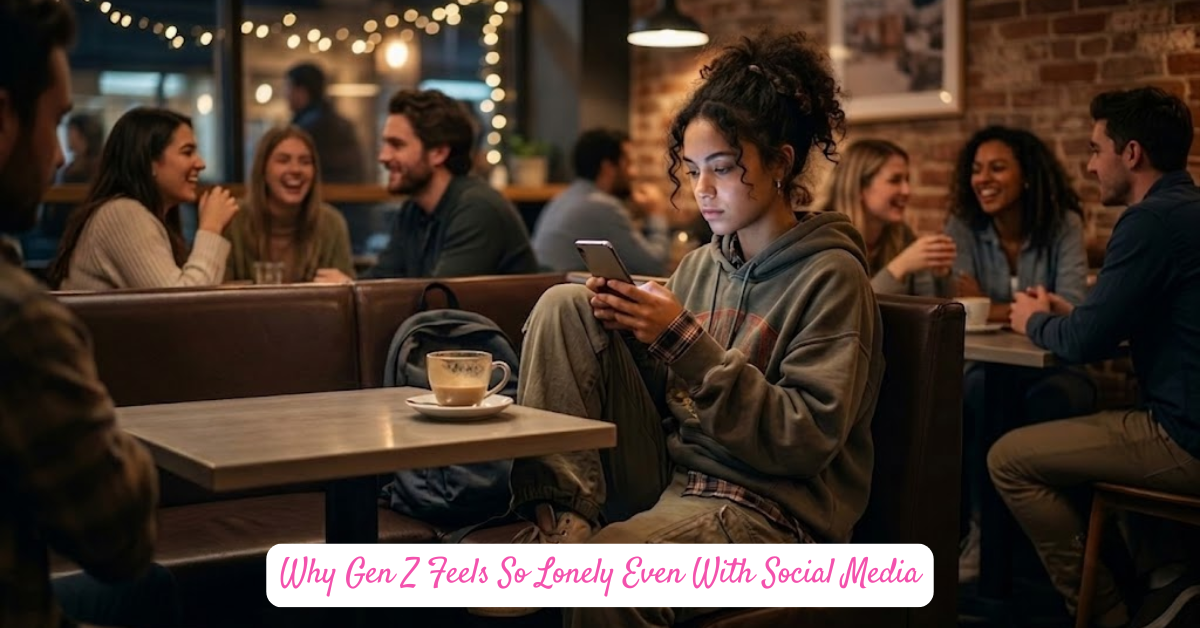
You have a phone with you that is able to reach almost anyone on earth in just a few seconds. You’ve got apps for texting, you’ve got apps for video calling, you’ve got apps for posting, you’ve got apps for doing things to other people’s posts, apps to watch strangers do things to strangers’ posts. You can communicate in more ways than any man, woman, or child could ever.
And you feel all alone somehow.
That is a question no one has a clean answer to – which is why Gen Z feels lonely even with social media. It’s not dramatic. It’s not ungrateful. It’s true, it’s verified and it’s occurring to millions who claim to be the most connected generation known to man. For anyone that has ever spent two hours surfing through their phone, leaving feeling emptier on the other end than you were at the beginning, this one is for you.
The Numbers Are Actually Shocking
Let’s get straight to the point. Research is not subtle.
A recent study by GWI from 2024 polled more than 1,800 Gen Zers around the world, revealing that 80% of them said they felt lonely in the last year, while 45% of the Baby Boomers said they felt the same. Let’s think on that one for a minute. It’s the generation that has always had smart phones who feel the most isolated in their world, as opposed to people who communicated with landline phones and handwritten letters.
Momentum Worldwide research shows that 73% of Gen Z feel lonely even when they have so many connections and 62% of people worldwide feel it is difficult to have meaningful relationships. The Cigna Group’s 2025 Loneliness in America report, based on a study of more than 7,500 U.S. adults, found that younger generations, such as Gen Z, are lonelier than older generations despite being more technologically connected.
Loneliness has been officially recognised as a public health crisis by the World Health Organization. Chronic loneliness, the former US Surgeon General said, can raise the likelihood of early death “to the level of smoking 15 cigarettes a day.” So this is NOT a vibe. It is a documented, measurable and medically serious situation.
But here we are, all posting Stories.
Why Social Media Connection Isn’t Actually Connection
The thing that the apps don’t promote: like doesn’t equal know.
It is all about passive scrolling and true interaction. A study in 2025 from Baylor University in the Personality and Social Psychology Bulletin found something every brand manager should be concerned about; both passive (scrolling, but not engaging on the platform) and active (posting/commenting) social media use is associated with growing loneliness over time. Digital interactions appear to not meet the social need of face-to-face conversations.
“There is a connection that happens through the phone, and it feels like they’re close, but it isn’t really interpersonal,” a physician told Crisis Text Line. It’s not a substitute for personal interaction.
This is why Gen Z still feels lonely, even with social media: The brain knows the difference. You can follow 800 people and yet have an apartment that feels like a waiting room. Social media isn’t the same as being seen by a person. The notifications only dampen the pain and don’t soak up the pain.
Things that a screen can’t offer: shared space, unscripted awkwardness, eye contact, the weird silences, the accidental moments. It requires presence. Social media is a carefully managed presentation of being there, and there’s a place at the base of your nervous system that knows it’s not.
The Passive Scroll Trap
Many people don’t interact with social media at all. It’s watching. You go in, you eat, you close and you feel slightly guilty. Passive use of social media has been consistently linked with mental ill health. It’s like looking through a window of a restaurant when you’re starving. You are watching others getting their meals served.Others are being served food. You don’t get fed.
Six in ten Gen Z feel social media makes them feel lonelier (68%) and 72% feel like it can make them feel lonely and bad at something. No, it’s not a small minority who has a complicated relationship with technology. That is about 90% of the generation.
The Comparison Trap Is Working Exactly As Designed
Lets talk about your own litany of highlights vs someone else’s reality… and you know it, and it hurts anyway.
Social media doesn’t make you think about the mundane Tuesday when the person chose to eat cereal for dinner, and cried a little bit for no reason. It demonstrates the journey to Mykonos, the birthday table adorned with balloon displays, and the seemingly spontaneous photo that took 40 minutes and 14 attempts. You know this. You’ve probably been through it! Once you know it’s built, it doesn’t seem to matter!
74% of Gen Z believe that it is hard to find authentic social connections, and part of that is because the social lives of others that we see online are fuller than real life. With everyone’s life looking fabulous, ordinary begins to feel like a personal failure.
That is why Gen Z is feeling lonely with social media in a very unique way: not because you’re alone, but because you’re not alone. It’s that, everyone else doesn’t seem lonely. Everybody else is having a blast, surrounded by people who love them, in awesome attire, looking like they look pretty darn good. You are… here.
The solitude becomes solitariness when there are onlookers.
Your Brain Can’t Fully Switch Off the Comparison
Even when you know on an intellectual level that social media is a performance, the emotional part doesn’t get that message. The comparison effect works in part unconsciously, as evidenced by numerous studies. You can still take forty minutes to make a decision if your photo is good enough or not and still be able to caption it to yourself, “comparison is the thief of joy. The awareness does not neutralise the mechanism. It’s just you feel a little bit worse that you are feeling bad.
The Post-Pandemic Social Hangover Nobody Talks About Enough
This is one aspect of it that is not discussed enough, and is too often shifted onto the shoulders of phones: much of Gen Z’s social development was derailed during a global pandemic at a bad time.
Developmental psychologists have always recognized 16 to 18 as one of the most formative periods in socializing the human person – the actual years in which one learns, through trial and error, how to be in a room with other people, and it’s often a very painful process. Interpretating a situation. How to handle feelings and actions. It was all at home during those years. Alone, or near-alone. In front of screens.
COVID hit in 2020. The oldest Gen Zers were in their late teens. The younger ones are still in their teens. It’s no minor detail. One year that wasn’t lived, five years later, you can find social isolation from the COVID-19 years everywhere.
Those folks in 2026 are in their early to mid twenties and are struggling to manage a life, a job, dating, friends, and community where the social skills most people don’t spell out clearly. The pandemic exacerbated the effort to live alone, as well as the growing trend of single-parent families and the weakening of community organization.
The outcome is a generation that is not only lonely due to their mobile phones but also due to other factors. They’re lonely, because a critical part of their social development was cancelled and they were given no script to play.
Parasocial Relationships: When Your Favourite Creator Feels Like a Friend
This is an unusual one, but it is true and it’s something that shouldn’t be judged.
Parasocial relationship is a real, emotional connection to a personality that is unknown to them. This is nothing new, as human beings have been developing the parasocial relationship with celebrities for years already, but in the case of social media, it’s more intimate and more persistent than ever before. If you’re following a creator who’s posting daily, sharing the breakfast they’re eating, their anxiety, their skincare routine, speaking directly to the camera as though it were you, there’s something in the brain that says, “Oh, this person is my friend/sister brother, because we’re really just like each other.”
In some respects, it makes up for some of that. Talking to an ear listener who feels the same makes it so comforting, especially when you feel lonely and isolated. It’s not something to be ashamed of. However, it’s not a solution either. It is only a painkiller, but not a cure. The warmth of a parasocial bond doesn’t translate to someone sitting next to you. Does not call when you are having a bad day. It is not familiar with you in any way.
It’s all around them — so much so, that sometimes it can get very confusing between the “person I watch online” and the “person who knows me. Then, when lonely feelings set in, it’s easier to stay in that parasocial world rather than do the more frightening, more difficult thing of creating a more authentic relationship with real people who can disappoint.
This is one of the pillars of the creator economy. The product being sold is Connection. It’s not evil, it is just that it is happening and it is important to know.
What Gen Z Is Actually Doing About It
This is where the real part of interesting and honestly part of kind of hopeful comes in, as this generation is not only accepting the loneliness as a permanent condition, they’re taking it upon themselves to make it better.
This is a measurable shift we’re seeing happen in real time to in-person community. Whether it’s through run clubs, innovative workshops, or specialized social events, social spaces are becoming a form of cultural capital. This is not about hating change, it’s about fatigue with digital. Culture is no longer entirely measurable and quantifiable. There are some experiences that are especially small, local, and embodied, and these are the most valuable experiences.
Eventbrite has also revealed a key change it is highlighting, dubbed the “Reset to Real” report, that highlights 79% of 18-35 year olds preparing to attend more in-person events in 2026. The “Instagrammable” phase is waning as 46% of Gen Zers acknowledge that they restrict screen time, and 74% believe that face-to-face experiences are more significant than digital.
According to data from Yelp, the number of searches for run clubs increased 82%, chess clubs 47%, social clubs 39% and book clubs 26%. According to a survey of Gen Zers conducted in 2025, 47% would rather meet a person at a book club than through a dating app, while over 75% of Gen Z users say they are feeling “burnt out” by swiping.
That’s why Gen Z is feeling like a lonely teenager even with social media and why many of them are beginning to do something about it. They’re showing up. They’re locating pockets in the community. They’re running club and pottery class and the local trivia night because they’ve learned, through trial and error, that a screen can’t provide for them what they require.
The Pushback Is Real
Gen Z is also more skeptical of the digital-first lifestyle they’ve been given. The public feed is becoming less culturally central as Gen Z increasingly moves away from mass social spaces to fragmented, niche, and private social spaces. Join together in public posts. Private communities beat the big boys of the airwaves. Smaller, more real, dirtier, more human.
That’s actually progress.
Fashion as Community: Finding Your People Through What You Wear
This may sound like a left turn, but it’s not.
Aesthetic, shared identity, shared style is one of the most consistent means of community for human beings. It isn’t only about clothes when it comes to your clothing. It’s all about who you are, who you belong to and who you’re trying to tell. Subcultures have existed since the dawn of time, and they’re a great way to connect people, whether it’s punk, goth, Y2K revivalists, cottagecore or whatever fad is blowing through TikTok this week. I am one of yours, I say with my words,
Personal style is a clear way for Gen Z to assert themselves when they feel like everything else is uncertain. One of the only creative languages which functions both in the real world and on the internet, which can begin a conversation at a thrift shop or a comment section, which can make you feel like yourself on a day when nothing else can.
At the heart of that’s itismandystyle is always the idea that it ought to be done in a style. Not to impose on you what you are to wear, in some authoritarian way. Just: Here’s what it’s like to be you, to be what you are, to express what you are, to feel great because you’re making yourself into what you are. Fashion isn’t frivolous. It can be one of the most fulfilling, relatable experiences you have as a member of the aesthetic community, the people who see what you’ve done with your outfit and immediately get it.
Always style has been a method to discover individuals. That is still the case in 2026.
You Are Not the Only One Feeling This Way
If there’s one thing that I hope you take away from this entire article, it’s that.
So when you feel lonely in your social circle online, you’re not weird. It’s not because you scroll for hours, and then feel empty afterward.It’s not you being empty after you scroll for hours. You’re not theatrical for being in need of actual, tangible, non-performative flesh-and-blood humanity in a world that has marketed a digital answer for you for years.
70% of Gen Z attribute their loneliness to being a big issue in their lives, and the majority of them feel as lonely in that sense as you may feel now. Loneliness is the paradox of being alone and believing that you are alone.
This blog has always been for those that feel a little out of things. Those who don’t really fit the glamour picture of themselves they’ve created for their own enjoyment. The ones who are figuring it out live, and trying to appear good while they try. You are not ignored here. And if the only community you can find these days is the comment section of a fashion blog that says the truth — well, that’s the start. Building community takes one truthful conversation at a time.
The phones won’t be moving. But one is not the very human need to be real known by some one. It can be both of these things. The first step to taking action is recognizing that there are two truths.
Go touch grass. Do it in something great.