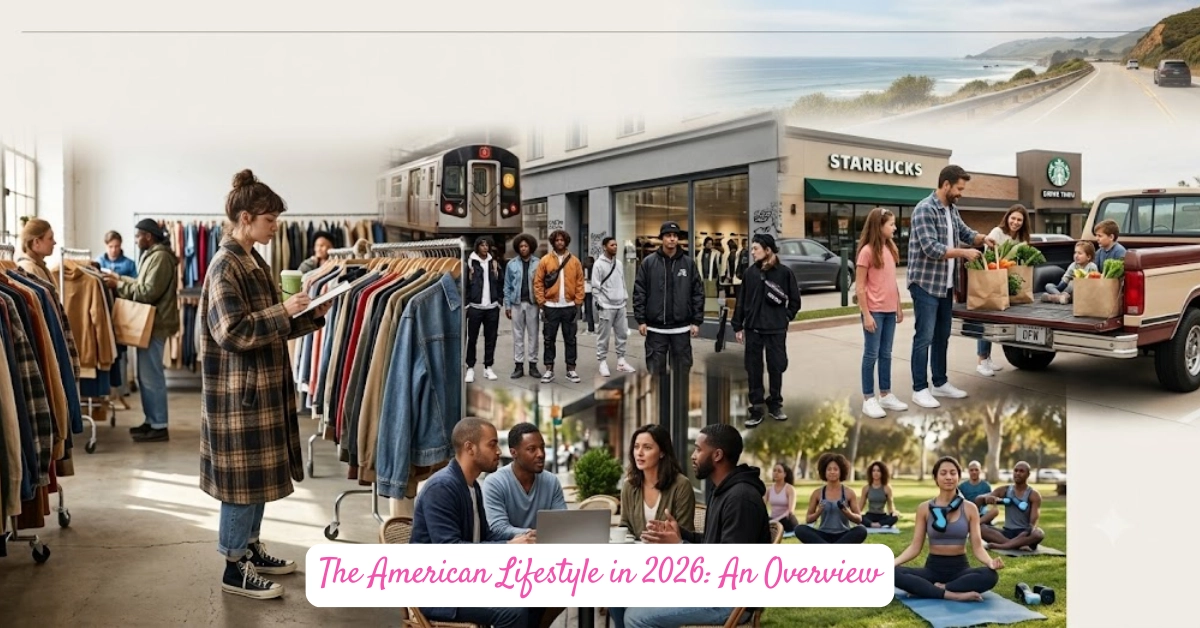
Let’s go through it quickly, okay? The American lifestyle must be one of the most exported, copied, dissected, and debated ideas on the planet. I was raised in Europe and definitely believed I knew what it was , large cars, larger portions, even larger confidence, a Starbucks cup always in someone’s hand, and everyone saying “have a blessed day” and it sounded a bit of a struggle for me, considering I was coming from the British-adjacent side of the Atlantic. The problem is that 2026 is a more complex, more paradoxical, more interesting American life than Hollywood has ever portrayed, and I mean Hollywood. It’s not a solid structure. It was never truly. Of course, the rest of the world is beginning to get the idea as well.
So, pick up your costlier-than-necessary matcha (which is now an American import) and here we go.
America Is Not One Vibe , It Never Was
The one thing people outside of America think about the American lifestyle is that it is one thing. It is by no means. The divide between a Brooklyn creative who wears thrifted vintage clothes and a Dallas suburbanite traveling in a pickup truck is likely to be even larger than the one between the Brooklyn creative and one of the East Londoners. The United States of 2026 is a place of great regional identity, and that diversity is what makes it interesting to observe up close from a distance.
The Regional Divide Is Real and It’s Delicious
The South has its own sensibility and practicality, its own tempo of life and own food culture, which is in turn very different from the Pacific Northwest, which is itself very different from the Midwest, which is a universe of its own. Few Europeans would be admitted to hospital for the speed with which New York operates. Wellness has become the whole person in Los Angeles. There’s a certain glamors, multilingual and tropical about Miami. Then there’s the in-between , the rural sections, the college towns, the rust belt cities that are in a process of reinvention , all of which have their own notions of what it means to be American in 2026.
The world tends to send off the shoreline, urban America. However, the story is more complex, more dimensional, and more interesting when it’s human.
American Fashion Culture in 2026: What’s Actually Trending
The world of fashion in America is in a very interesting state in 2026. Formerly, the fast fashion industry was the target of increasing scrutiny and the resale industry, which has long been huge, has grown larger. Secondhand and vintage buying platforms have made thrifting normalized, whereas my teen years buying something cool from a charity shop seem like a thing of the past. Now, it’s desirable to seek out something pre-loved, and it’s done a lot of things to Americans’ relationship with clothes.
The Brands Shaping Global Style
The American streetwear culture remains influential in the world of fashion in 2026. The sport, art and youth culture brands continue to be hugely influential, and that is not only in the US. European streetwear is truly Americanized. Enter any big city from Berlin all the way to Seoul, and you’ll find the imprint of American brand culture on the young people’s wear.
The concept that “workout wear can be worn to brunch, the supermarket, and maybe even a board meeting” , a very American one , has officially spread its wings around the world and looks like it can’t get enough of the idea. One of the truly wonderful things that American fashion brought to the world is that comfort and style are not in opposition.
There’s also been an unobtrusive Americanisation of luxury. Gradually, the old European luxury model was characterized by heritage, restraint and exclusivity. American concepts of hype, drop, limited edition and storytelling have been picked up by the new global luxury. Much of that cultural change is owed to the American street culture and the idea of scarcity as a desired element of what we call streetwear.
Food Culture: Loud, Proud, and Evolving
In 2026, America is experiencing a kind of renaissance in its food culture. On the other hand, the nation remains the land of portions that trigger Europeans’ emotions. But there is also a high-end food culture going on, throughout the cities, as competitive as anything found in Europe. The farm-to-table trend, which has been established for 10 years, is no longer a trend – it is a reality.
The Clean Eating Conversation Got Complicated
It’s been embraced by a community with a very simple, whole foods and less processing guide, but it’s a line that’s grown somewhat complicated. There is a backlash against diet culture occurring alongside an ongoing quest for the ‘cleanest’ foods and optimum ingredients in 2026. What came out is a little messy and definitely more on social media, but it’s also more truthful. Conversations about nutrition and food relationships are changing and they are happening around the world.
Work Culture: The Great Renegotiation Continues
The pandemic years were already causing a significant shift in American work culture, and a new round of renegotiation is far from over in 2026. Ten years ago, this was the American way of life: the 80-hour work week proudly displayed as a badge of honour, side hustles, constant optimisation of each waking hour.A decade ago, this was the way it was in America: The 80-hour work week proudly displayed as a badge of honour, side hustles, constant optimisation of each waking hour.
The changing landscape of the American workday for a large number of people is in part due to remote and hybrid working. There’s a lack of separation between the personal and professional in both directions: more freedom to choose how they spend their time, yet more pressure to be on call at all times. The ‘burnout’ conversation is louder than ever before.
Wellness Culture: The Good, The Intense, and The Wildly Expensive
No one does wellness like America. A compliment and a small warning. By 2026, American wellness culture is gigantic, powerful, and sometimes even totally bonkers in a good way. Gym culture is still alive and kicking , fitness aesthetics, tracking progress, and the social tradition of morning exercise are an integral part of the US identity.
Mental Health Finally Has a Seat at the Table
One of the most impactful cultural changes in the American wellness discussion in recent years has been the stampede of mental health on the calendar. Therapy was once a taboo topic, but it’s now being discussed, mentioned on social media and has even been part of brand communications. De-stigmatising has been a domino effect and has spread to younger Americans and the entire world. This is one of the things the world is really thankful that they are copying from America.
The other side of the coin is the wellness industrial complex, which is very real and very aggressive. Expensive recovery and health optimisation gadgets, supplements, and entire health identities can cost a lot of people out of the discussion. Inclusion is still a work in progress in the wellness world in 2026, and there is a long way to go.
What Europe Still Copies , And What It’s Quietly Rejecting
So, let’s have some European perspective in, okay Mandy. In 2026, there are certain aspects of American life that the world still loves: the relaxed manner of socializing, the positivity (seriously, Americans have more of that to give), the coffee-to-go culture, the “comfort first” attitude to clothing, the self-improvement and ambition attitude. These are the sorts of things that translate well. They are happy to get adopted.
The world is less into copying the extreme hustle culture, hustle until you break mentality, and the concept of value being directly proportional to output. It wasn’t something that was really seen with a positive light by European work cultures, but in 2026, even younger generations all across the world are rejecting the notion that being tired is a personality trait.
The size of all things , portions, cars, consumption , is also a concept that’s more at ease in a world that’s focused on sustainability. There is a complicated relationship with that conversation that America has and the rest of the world will be watching America play out that tension.
Social Media Culture: America’s Most Powerful Export
One aspect of American culture that in 2026 is entirely undeniable is social media. It was built on American soil and exported all over the world – the platforms, the content formats, the creator economy, the influencer culture. How we present ourselves, how we essentially look, how we are as a brand, all of that is a product of American internet culture.
The whole world has been influenced by American media, American humour and American references since Gen Z’s birth. It is not that they are all “American” or “American in politics,” but they are “American” in their culture, which wasn’t the case for earlier generations.
Final Thoughts from Mandy
It’s really interesting to observe 2026 American culture from the outside. It’s a culture that is talking to itself, challenging old myths, creating new ones, exporting what is universal and keeping what doesn’t.
The most interesting version of American culture is the one that Hollywood isn’t selling, from my vantage point. It’s the messy regional, wildly divergent, sometimes contradictory, deeply human version that shows up when you pay real attention. That one? This one was definitely one I could watch all day.
, Mandy