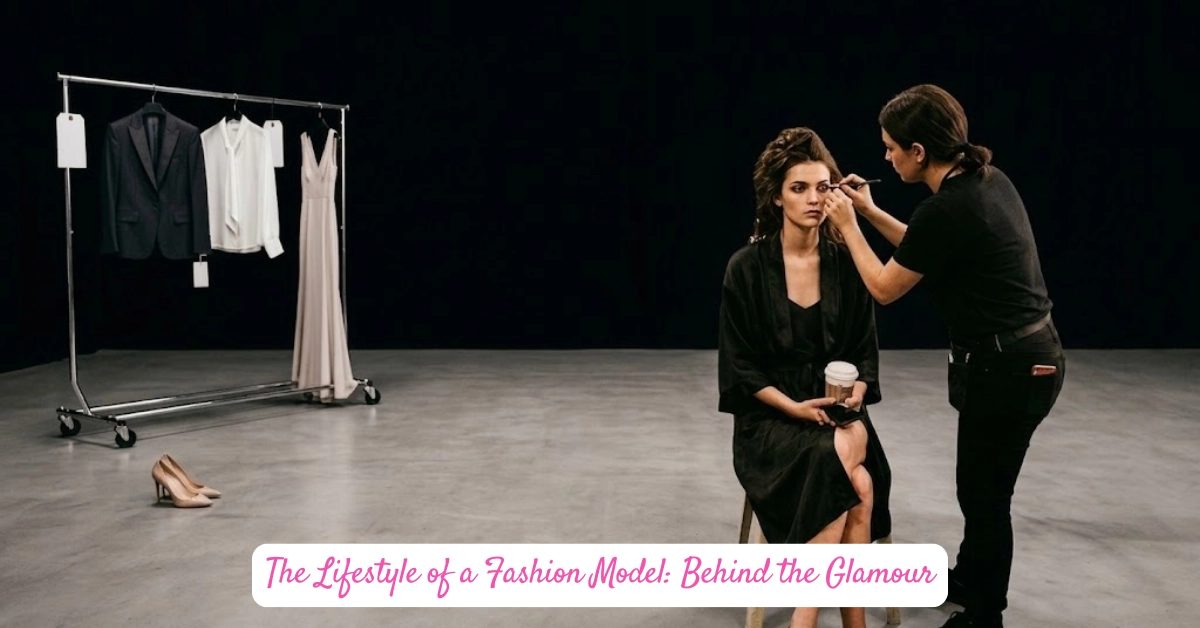
OK, let’s get honest. When we think of the life of a fashion model, we think of a lot of this. Most of us think of this when we think of the life of a fashion model: waking up in a Parisian hotel suite, getting your face beat by a glam team, then floating down a runway while editors gasp in black coffee in a silk robe. Cut to a designers and chauffeur home for a rooftop dinner. Glamorous? Absolutely. Accurate? Well, just on the best of days , and I can confidently say that those days are fewer than those where you’re eating a sad sandwich on a street corner and wondering if your agency remembered you exist. The fashion world of 2026 is wondrous, bizarre, changing and sometimes even downright cruel. So what does it really look like, who is doing well, who is not, and what should you be aware of if you want to get in?
What a Real Week Looks Like for a Working Model in 2026
Let’s get rid of the dream first, and then create the dream properly – the truth is more interesting than the dream.
Castings, Go-Sees, and the Endless Waiting Game
Despite the many castings that have transitioned to video submissions and digital portfolios uploaded via agency platforms, a lot of the work week of a working model still revolves around castings. If you are in a big fashion city like New York, Milan, Paris or London, you could possibly have anywhere from three to eight ‘go-sees’ in one day during the Fashion Week pre-season. Apart from those peaks it’s much more fragmented, a few castings a week, a few self tapes, a little brand DM that doesn’t do anything.
The sitting (and waiting) portion? Very real. Often times models will talk about showing up at a casting, signing in and then sitting in the hallway for the next hour and a half before they are walked on and shoot ninety seconds in front of a client. This you do several times a day. No glam is involved. However, it is a crash course in patience and taking rejection personally , both highly valuable life lessons.
Fittings, Shoots, and the Social Media Tax
On days of shooting, it can really be the dream experience! Perfumery, make-up, amazing outfits and a superb creative team, as well as the kind of energy that lets you feel like you’re important. The hours that are spent on shooting are long , but well within normal limits of twelve to sixteen hours for editorial or campaign work. You don’t have to use your shadows to shoot for 6 hours while the photographer is setting up their lighting, it’s something that’s done by real people.
Then there’s the social media responsibility and by 2026 it’s a second job. Brands and agencies today require models to have an active curated Instagram and TikTok presence at the very least. Even those who don’t fit the bill as “influencers” are required to post some behind-the-scenes, show what the campaign will look like, and style personal content on a regular basis. It has become a standard part of the contract at many agencies.
Travel: The Part That Sounds Amazing
When you’ve made three New York to Milan red-eyes in two months and your body thinks it’s in the vicinity of the North Pole, travel is very real and very cool. There’s also the financial burden of models booking overseas, where they pay the cost of travel upfront and receive the amount back through a reimbursement. Being on a long-haul shoot on a good-looking paycheck can get less interesting pretty fast when you add in jet lag, travel time and the price of meals in cities without a kitchen at home.
The Business Side Nobody Talks About Enough
To grasp the lifestyle of a fashion model in the right way means grasping the monetary aspect and that is indeed a bewildering one.
Agencies, Contracts, and Getting Paid
Agencies sign models and they collect a commission, which is usually from 15% to 20% in the U.S. and Europe. That’s before taxes. The agency will pay for your card (the actual portfolio book), the listing on your website, and in some instances may cover advances for the housing in a model apartment when you arrive in a new city. By the way, those advances are loans. They are derived from future income.
The pay ranges widely with type of work. The work you do on high fashion magazines, the magazines that look incredible in your portfolio can pay very little or even nothing. Advertising campaigns and ecommerce work pay much better. The rates for commercial mid-level models may start at $500 a day and climb to $5,000 a day, depending on the client and the usage. In 2026, the very best fashion runway models can make $2,000 to $10,000 per fashion show during fashion month. The Gigi Hadid, Bella Hadid, and Kendall Jenner tier are in a totally different economic world.
The payment process is also infamous. It is typical that every model has a 60 days or 90 days’ payment term, which means the model may shoot in January but not be paid until March or April. It’s a skill that every model must acquire quickly: cash flow.
The Model-Influencer Hybrid Economy
That’s where it has changed drastically. The models who combine classic modeling experience with real followers on social media will be the most commercially successful in 2026. All three women, Imaan Hammam, Paloma Elsesser and Precious Lee, have careers in the runway and have a strong digital presence that helps carry the value of their brand. Other, newer names such as Amelia Gray or Alex Consani have carved out a career that involves as much social media activity as it does editorial work.
Brands are openly considering follower numbers and engagement in booking decisions, particularly for campaigns that will be predominantly online. Many clients will prefer to work with a model who not only has a beautiful book but has a half million followers on TikTok, and can edit her content, too, rather than a traditional model who has a perfect book but no online presence.
The Mental Health Reality
This is the part you should read if you’re considering modeling or if you have a favourite model.
Body Image Pressure in 2026
The body-image discussion has truly changed in the realm of modeling. The introduction of plus-size and straight-size divisions and the presence of curve models like Paloma Elsesser and Ashley Graham by big brands have made a difference. However, the drive to keep a certain shape hasn’t gone away, it’s just its gotten more complex. There are different pressures on models in each tier of the fashion world, and although runways are becoming more diverse in size, there hasn’t been enough variety in the shows held in the top echelons of high fashion.
Still models are being instructed to lose or gain weight, change their hair, their skin, their brows. The feedback is frequently given in a casual manner, as if it isn’t a comment on your complete body. It really takes a toll on you after months and years.
Rejection Is the Job
There is no rejection in any profession like modelling. Anyone can walk into a casting and be objectively awesome, and then be told by the client in 30 seconds that the eyes are two millimeters too close together for the vision that season. It’s not logical and there’s no comfort in being told not to take it personally when of course, you do.
The most mentally strong guys in the business discuss the development of a personality that’s not tied to their bookings, friendships, interests, education, or other creative endeavours, but exists separately from them. It’s that foundation that prevents people from becoming a part of the evaluation feedback loop.
Instability and Loneliness
As a fashion model, you spend a lot of time by yourself in places you haven’t been before. Teenagers are often sent abroad as young models, with little support infrastructure, to work in markets such as Tokyo, Milan or Paris. You live in model apartments with strangers from other countries and the fast pace of the city doesn’t give you a chance to get used to it. Loneliness is a prevailing feeling among models, especially in the early years of their careers.
On top of this, the financial fragility of the system adds to the mix. Modelling’s feast-or-famine income is really challenging for planning purposes, whether it comes to housing, saving or healthcare. For the most part, models are considered independent contractors, which means there’s no employer to benefit, and there is no paid leave, and the tax obligations are quite simple and easy to mess up when you’re twenty and no one told you.
How Social Media Rewrote the Rules
Instagram and TikTok weren’t merely a shift in how models promote themselves; they generated a whole new category of models and a new category of models that are a direct competitor to the traditional agency modeling.
The Instagram Model vs. the Runway Model
These two archetypes continue to exist in parallel in 2026, but are becoming more and more intertwined. A runway model has three paths to success: representation with an agency, castings and editorial credits. Instagram models make a living by creating content, collaborating with brands, and engaging in affiliate marketing. What is clear is that the lines have become very blurry as runway models now demand social presence, while Instagram models are increasingly finding more editorial and campaigns jobs.
However, those who have a large following can actually earn more from their social media side than from traditional modeling. A creator with 2 million followers and a regular fashion output can land 5-figures brand deals, while a working model with 10 years of agency experience may not be able to pull it off on a commercial basis. This has turned the industry upside down.
Diversity in Modeling in 2026: The Real Talk
The situation is made a lot better. As it were, it’s worth saying that. Fashion in 2026 is much more diverse with more models of color, plus-size models, disabled models, and older models than the industry was just 5 years ago! The trailblazers, such as trans model Valentina Sampaio, who participated in big campaigns, helped to change the perception of visibility in ways that were unfathomable ten years ago.
The diversity push has also been commercially validated,the language brands respond to best. Consumers like to see real bodies, different skin tones and nontraditional beauty in the brands they’re buying and brands are doing so.
Still, there is some progress being made. Whereas diversity is more prominent in commercials such as fashion advertising campaigns, it has been less so on runways where traditional sizing has been slower to change. Still, there’s a concrete practice called ‘tokenism’ and it goes something like this: one Black model, one curve model, one Asian model, checked off a list, not a part of the culture of casting by a brand. It’s not the end of the world.
AI and Virtual Models: The Part That’s Actually Wild
Here is a secret no one in the career counseling office in the world will tell you: thanks to artificial intelligence, the lifestyle of a fashion model is now directly conversing with humans, and it’s getting louder.
Virtual models have existed since the late 2010s, such as the CGI model Lil Miquela, who has millions of followers on social media. However, in 2026, AI-generated model imagery is now a real business tool. Now, brands can make photorealistic images of their models wearing their products and without hiring any person. There have been some brands of fast fashion who have already made use of AI-generated photos for their internet products, minimizing the need to use traditional catalogue models substantially.
In models, it can be a genuine danger at the lowest levels of commercial shoots, such as catalogue and e-commerce. Some high-fashion editorial and runway photography isn’t as easily replaceable by AI, as it requires the physicality and movement of people, cultural gravitas, and the aspirational story-telling that only human beings can bring. However, the medium business work which feeds many working models is becoming more fragile.
The industry is in discussion at the moment on the rules and regulations to be taken into account for the use of AI-generated images, such as the need to disclose use of AI, consent to train AI on the likeness of a model, and setting up rights frameworks for models whose images have already been used without permission. It’s an enigma both legally and ethically, and it’s unsolved.
The itismandystyle Honest Take
Look, this is one of the most intriguing, creative, weirdest and most challenging job options in the world, man. The pitfalls are genuine , going in with something spectacular on, making great photos, traveling to different places that you wouldn’t normally go to, making a community around your image, your perspective. It is all correct.
What’s also true, however, is that it demands a lot of very young people who are often not ready to negotiate it on their own. Glamour is real, and a grind is real, and no one brings you both in one form that you can make choices on. Social media in particular has made the fantasy reel of the model life which is candidly edited to exclude the castings that didn’t work out, the contracts that were late and the comments on your body in a room where you should’ve felt good about your body.
When modeling 2026, come with your eyes closed. Understand the business. Know your rights. Try to create a financial buffer if possible. Have at least one identity that is unrelated to your appearance. Look for individuals in the industry that are truthful in their response, not simply flattery. If they feel your value is equal to your rate, they are wrong , and that’s the #1 thing I can tell you.
Fashion is a loveable industry. It’s simply better when it’s loved more than you love yourself.