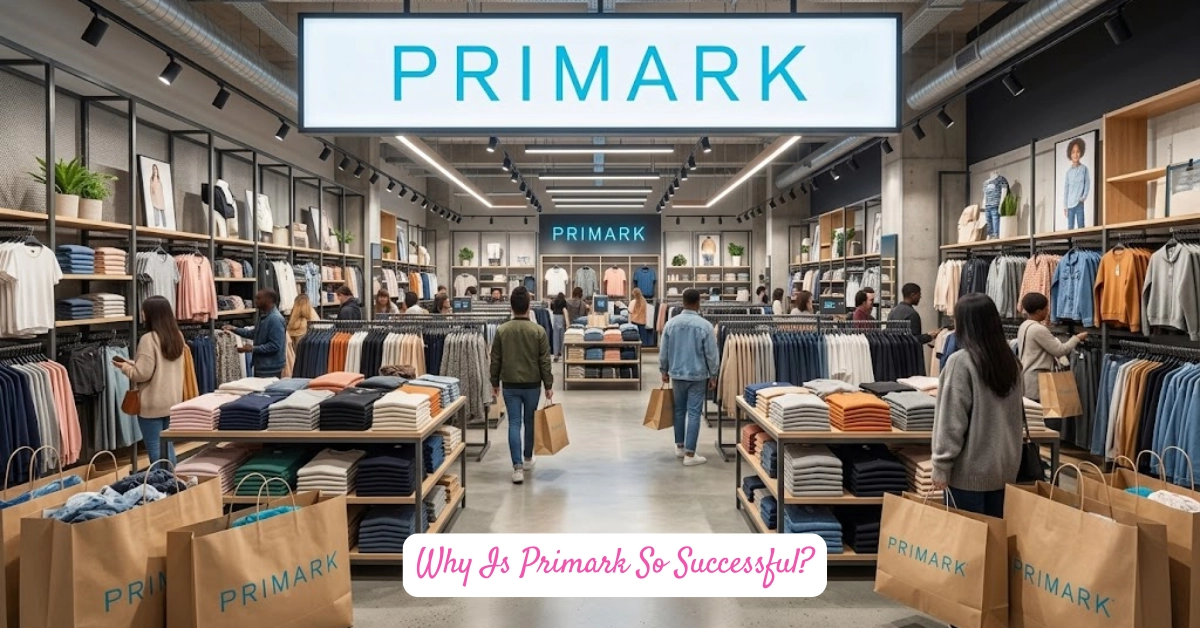
It’s a really interesting thing that’s going on down the high street and it’s going on for years and years. Other big brands are falling apart and closing down, making the transition to online, asking influencers to help, or even disappearing completely , but Primark is just quietly getting on with its business and succeeding. No place to purchase from. No delivery. No sponsored posts on Instagram that ask you to “swipe up. Just a lot of storefronts, low prices and a complete lack of logic in foot traffic. Then why is Primark so popular in a world that does everything online these days? That’s what we’re going to explore about today – and the truth, well, it’s more interesting than you’d think.
The Business Model That Shouldn’t Work (But Absolutely Does)
To begin with, the most important thing that makes every business school lecturer break into a cold sweat: Primark has a clear intention of never opening an ecommerce shop. In 2026. If everyone – and everyone’s nan – is ordering socks from Amazon.If all people and all people’s nanes are ordering socks from Amazon. One cannot get on the Internet and purchase a pair of £3 leggings from Primark. You need to go to a shop and purchase them there.
However , And yet , their fiscal year 2025 annual revenue was approximately £9.5 billion for Primark. That’s not a typo. Almost 10 billion pounds – all physically.
It’s actually a very clever idea when you analyze it. There’s no returns handling, no web-order warehouses, no costs on the last-mile route to customers, no packaging for single parcels and no costs associated with sending them home, in fact, costs for Primark are extremely tight. All overhead on every penny is spent on stocking up on enormous amounts of low-cost product. The margins are so thin but the volume is so huge. You sell a £4 t-shirt to about 17 million people and all of a sudden you’ve got a very healthy business.
It’s high volume, low price, in-store only and it’s working because Primark has made shopping a destination activity, instead of a chore. No one just comes to buy one thing , they shoplift, throw things in their cart they didn’t intend to purchase, and walk out with 4 bags of things they didn’t plan to buy. That, of course, is the “treasure hunt effect” and it is an entirely intentional part of Primark’s business.
Going Global: 486 Stores Across 19 Markets
One of the most obvious explanations as to why is Primark so successful is because it has not ceased to grow when times get tough. By early 2026, Primark has 486 stores in 19 markets and has over 83,000 employees around the world. A huge footprint for a retailer which still hasn’t sold one item online.
What is interesting about Primark’s journey into the US is one of the biggest chapters in the company’s history. The brand’s first U.S. location was opened in Boston in 2015 and the growth was slow going for years. At the end of fiscal 2025 however, Primark had 33 stores in the US and was expanding rapidly; US sales escalated by 20% that year from all new store openings. America is still on Primark’s agenda as the company announced in June 2026 that it will open its sixth store in the Dallas-Fort Worth region of the country.
Central and Eastern Europe has also been a major success story. It’s been aggressively targeting markets such as Poland, the Czech Republic, Romania and Hungary where the Primark mix of cheap fashion but with trendy appeal feels like a breath of fresh air. For the first time, the brand ventured beyond Europe and North America, signing a franchise agreement with Alshaya Group in Kuwait to open its first store in the country in late 2025, followed by stores in Dubai in 2026.
The Big 2026 News: Primark Is Going It Alone
There’s something truly huge that occurred in April 2026. Associated British Foods, the owner since 1969, confirmed it was separating Primark out into a totally standalone, publicly-listed entity. The split is expected to be finalised by the end of 2027 and will result in two separate FTSE 100 companies: Primark and a food company under the ABF brand name which will include brands such as Twinings and Patak’s.
The stand alone Primark will be headed by Eoin Tonge, who assumed the role of CEO after long-time boss Paul Marchant left. The rationale is simple , Primark has expanded so much that its investors had a problem arriving at an appropriate valuation when it was part of a food company. Primark is a separate listed entity, so it can fund itself, appeal to retail investors and implement its growth plan without having to compare it with sugar and breakfast cereals. The big move of a brand that began as a single shop in Dublin in 1969.
Topshop Is Gone. Primark Is Thriving. What’s Going On?
This is where it really hurts for those who have been raised to the altar of Topshop. Now it merely becomes a label, and a memory; it’s no longer a brand. For years, H&M has suffered from losses, shut down stores, reduced inventories and fretted over the expenses of running its online business. Zara’s parent Inditex is doing well, but even the company’s had to shut hundreds of stores around the world and significantly restructure.
If Primark had nothing special what would they be?
The answer is simple: discipline. Primark has no intention of being all things to all people. It is not a luxury or a premium positioning that it has sought out. It has not sought to create an elaborate omnichannel experience that, ultimately, equates to “we pay for returns that customers take advantage of. It found its niche (fashion for those who do not want to break the bank and do not want to spend a lot of money, but want the trend, and it remained on that track. Relentlessly.
When consumers began to cut back on their spending due to hard times from inflation, Primark actually benefited. Some customers who may have been used to a mid-market brand began to “trade down” and Primark was ready and waiting. So, when the energy bills were high, people still had to buy new school uniforms, gym kits and essentials , and Primark’s prices really make it affordable.
These were the costs of building out ecommerce infrastructure that proved to be too much when demand wanes. But Primark didn’t have that problem as there was no Primark ecommerce.
Primark and Gen Z: A Match Made in TikTok Heaven
Why, in particular, is Primark a hit with younger consumers? I can tell you exactly why because I am a young woman of the generation that was born to the 80s, which was the girlie era.
First: fashion is not a taboo topic when it comes to price. The anxiety that young people feel when they’re not well-off but still want to feel good and look confident is a very particular thing. Primark takes that worry away! It’s not uncommon for someone to be able to get a full new outfit (top, trousers, shoes) for less than £20. You can try trends, try out new styles and you don’t have to feel bad about it if they don’t work out for you.
Second: The trend turnaround is truly outstanding. Primark moves fast. So when something goes viral on TikTok, rest assured that Primark’s version will be available on the shelves within weeks. The brand’s sourcing and manufacturing processes are geared toward speed to market, so everything the brand is doing remains fresh and cutting-edge in-store.
Thirdly, the shopping environment is also a social activity of its own. Shopping together with your friends at Primark is one thing.Shopping with friends at Primark is something else. It is an event. Two hours passing through rails, holding things up, debating whether that sequined top is genius or a disaster (huh? both), and coming out with bags of stuff you didn’t plan on buying. It’s far from modern website scrolling.
The TikTok Effect: Free Marketing Worth Millions
Every quarter, a huge amount of free advertising is generated for Primark by users – and that’s something the brand’s finance team must surely be secretly smiling about. TikTok and YouTube’s most popular types of videos are Primark hauls. Just type in #primarkhaul on TikTok now and you’ll see literally hundreds of thousands of videos with billions of combined views.
Primark has 24 million followers on its social media, but more than that, it has a army of every day creators who film their Primark shops for free, try on hauls and styling videos for free. The videos are effective because they’re sincere , it’s an actual person who’s showing you an actual product that they purchased, for prices that feel real and not a flex. It makes people constantly walk through those doors with a sense of discovery and desire.
This is where Primark are being smart, with the launch of their Primania platform, which has enabled them to make customer content their organic marketing machine. The brand also works with big IPs and brands such as Disney, Marvel, NBA and Barbie, and has limited drops that create a social buzz and allows people to avoid waiting to visit the store.
The fact is that a brand that has no online store can be benefiting from social media more than the brands that have invested millions into their online marketing campaign. If your store is the product, then every bit of content online that a customer creates, either in-store or about their haul, is one more foot in the door.
Primark Cares: Real Progress, Real Questions
Okay. So here’s where Mandy must wear her honest hat as no article about Primark is complete without the elephant in the room, namely the fact that the shop is bad for the environment.
Primark has been and remains criticised heavily for the role it has played in the ultra fast fashion industry. But what was the true cost of that dress when you sold it for £5? Real challenges for the environment, for those who made it and for the planet that will have to deal with it six months later when it inevitably ends up in landfill.
To their credit, it’s been a project that Primark has been working on as part of its sustainability initiative Primark Cares, which began in 2021. In November 2025, the 2025 progress report actually contained some nuggets worth taking note of. There has been a 74% increase in recycled or more sustainable fibres used in clothes, compared to 66% the year before. Circular by design (EoL) rate is approximately 50% of the items. Total GHG emissions were reduced by approximately 5.7% from the 2019 baseline with a 71% reduction in operational emissions.
The brand has aimed to use recycled or even more sustainable material for all clothing by 2030. It’s to be hoped that Primark’s interim CEO Eoin Tonge was honest in his assessment of what still needs to be achieved, as he stated he wasn’t interested in being patted on the back for the strides his company has made and that the brand has a long way to go to prove low prices don’t mean low standards.
However, the truthful itismandystyle view is that the numbers are improvement, and improvement is important. However, the basic conflict remains. The whole reason for Primark’s success is that they sell a lot of cheap clothes. The amount of cotton fibre content in recycled rolls is immaterial, because the business is still one of volume. A £4 dress that is produced using sustainable resources is a £4 dress, and it will likely be worn five times after it is made before it rests in the back of a dresser. The affordability versus sustainability conundrum is something that is being grappled with across the entire fashion industry, and it’s something that Primark isn’t going to solve.
Things I’ll say: If you’re going to shop at a low-cost retailer, you are probably better off going to a retailer that’s investing in them than a retailer that isn’t. The Primark Cotton Project is truly the most extensive programme of its kind in fashion and teaches farmers how to farm in a sustainable way. That matters. The brand has also been taking steps to improve the wellbeing of workers in its supply chain, in over 300 supplier factories. These are genuine and impactful projects. They are simply part of a model, which remains fundamentally a volume model.
Choose your purchases wisely where possible. Purchase items that you will use. That’s the true opinion.
What 2026 Actually Looks Like for Primark
Why does Primark have such a success story to launch a listing for itself? Despite a seasonally tough first half of 2026 – with sales down 2.7% year-on-year, and margins squeezed from the discounts – the structural picture remains in place. The UK company is actually doing better, and expanding its market share in a shrinking clothing market. US expansion providing growth. The new European markets and franchise territories are slated for a store rollout initiative which is projected to drive 4-5% in sales per year.
Click & Collect roll out in the UK – where customers can shop online but pick-up offline, is an intelligent middle-ground that helps improve web traffic and footfall without the expense of home delivery. It’s the fact that Primark is recognizing that digital is going to play a part in bringing people to its stores, even if it’s not getting them in.
Primark is not a name that Gen Z doesn’t like, it’s not just because it’s a retailer that has 486 stores and generates £9.5 billion a year in sales, it’s because it’s a brand that’s now an independent company and the market is free of the marketing of millions of social media creators. The high street might be undergoing a makeover, but there’s not many left that have an actual good reason to get out of the house and go shopping.
The solution – you’ll get 17 items you didn’t plan for! Most of them will be very good.