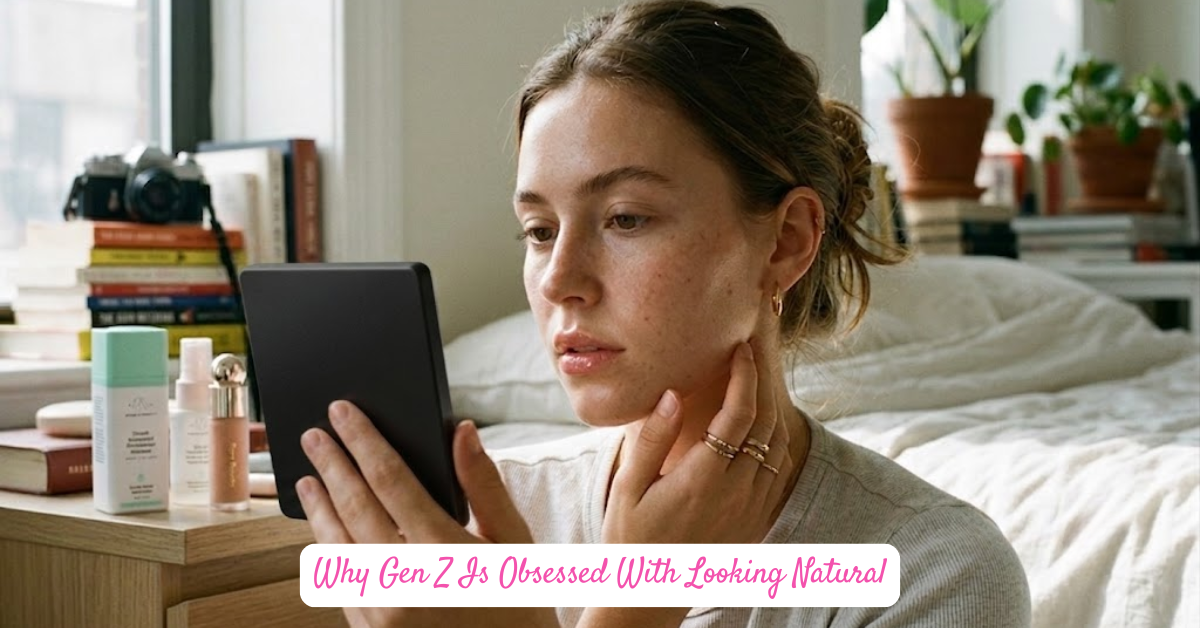
The weirdest thing that’s happening in beauty these days is this whole no-makeup-today-lol thing, where an entire generation of wakes up two hours early to do a full skin care routine, and then applying 6 different products to look like they woke up like that. And honestly? Respect. It’s all about the way you present yourself as if you have done nothing when you actually have done a lot. But the reasons behind why Gen Z is so enamored by looking natural is certainly a more interesting discussion than “they are all low maintenance nowadays.” It’s a cultural revolution, a psychological moment of reflection and an outright revolt all in a package of glazed skin and clean girl updos — and Mandy’s here to break it all down.
The Era They Were Reacting Against
Before you can grasp the natural beauty wave, you have to go back to where it all went wrong. Beauty standards were very off kilter in the late 2010s. This is a full contour at 8am. We are discussing FaceTune so much so that faces seemed to have been scraped with a spatula. Reminder: We’re talking filters that made everyone look like they had a sharp jawline, a tiny nose, and an enormous lip, so that everyone on your feed looked basically like a different version of the same digitally created human being.
It was the time of Instagram Faces, the time that writer Jia Tolentino captured pretty perfectly in 2019. The fashion was largely determined by a combination of Kardashian beauty, cosmetic procedure trends, and social media algorithms, which celebrated a specific look of a beauty that was all polished and filtered. Full coverage foundation, over-lined lips, baked highlight and a face that didn’t look like a face, it looked like someone had rendered a very high resolution face.
Why Gen Z Eventually Said No Thanks
Being a teenager at the peak of Instagram Face is the thing, it was really a head game. If you’re constantly exposed to a digitally manipulated version of every face without any natural flaws, pores or other texture, your brain begins to think that your own face, which still has imperfections, is somehow flawed or wrong. Scientists and counselors were sounding the alarm about the link between the highly-filtered images of beauty and increased anxiety, body dysmorphia, and low self-esteem among youth, especially teenage girls.
The phrase “Snapchat dysmorphia” had even gained traction in clinical discussion as a condition in which individuals approached cosmetic surgeons for surgeries to make them look like their “filtered selfies. That was as far as it went. For the filters, it no longer seemed like a digital accessory, but a blueprint for how you were supposed to look.
Gen Z learned all this first-hand. One by one, they began to reject it.
Enter the Clean Girl, the Glazed Donut, and the No-Makeup Makeup Look
The new look was making its way onto TikTok around 2021 and 2022. The clean girl look was minimal, slick, and somewhat unfashionable – from slicked-back hair to gold hoops, a dewy complexion to perhaps a tinted moisturizer. It seemed easy, not the Instagram Face’s easy, easy. It seemed like the real person that had good skin and good cheekbones and doesn’t have to do much to it.
Next up was Hailey Bieber’s glazed donut skin moment, and it had people half the internet trying to determine what products she was using to get that lit from the inside, wet looking effect. The “no-makeup makeup look” has historically had this moment, but not for decades, and now it was the most Googled makeup tutorial on Earth.
What These Trends Actually Have in Common
The unifying concept behind all these aesthetics is “skinficitism”: the skin must appear to be skin. Not a canvas. Not a filter. Not a poreless, smooth, and flat surface. Real skin, glowing and with texture and life. The focus became from covering to radiance. Seeking to conceal, enhance. From looking flawless to healthy.
That’s not a coincidence. It’s a reaction to 10 years of the opposite.
TikTok: The Platform That Made Raw Beautiful
The irony of social media comes in the fact that not only did it help bring about the issue, but it also did the same to resolve it — sort of. The TikTok format, featuring lo-fi videos and live filming, was the perfect opportunity for a more authentic visual culture to emerge as a by-product. If you are recording with your front-facing camera in the harsh afternoon sun without any filters, you either don’t create content or you simply… get used to how you look.
Many Gen Z selected the second choice. Makeup tutorials on bathroom mirrors.Beauty tips in the bathroom mirror. Morning face vlogs. Get ready with me videos – people who openly discussed their skin texture struggles. What went from messy and unfiltered to being the norm isn’t due to the fact that TikTok is some morally superior platform — it isn’t — it’s because creating business perfection all the time is getting easier on the platform.
However, filtered content has not disappeared! It is still a tense situation. However, the cultural norm to simply look like yourself began to grow in scope, and why Gen Z is fixated with natural-looking appearance begins to make more sense when you consider the amount that came from seeing other real people on screen.
The Beauty Icons Who Embody the Shift
One reason why a trend gets picked up is that there’s a cool guy doing it. The natural beauty aesthetic is a key element of what Gen Z has been attracted to in the 2020s in the form of beauty icons.
Hailey Bieber practically built an empire on the glazed skin look. Her Rhode brand was released in 2022 and went from strength to strength — not because it was much more revolutionary than it actually was, but because it just resonated with the “your skin but better” vibe that Gen Z was desperately searching for.
Sabrina Carpenter, who has been unmissable since circa 2024, rocks a more classic look for natural beauty—from soft skin to just a little mascara to a kissed lips. She somehow conveys a sense of professionalism and friendliness, making it difficult to tell, but that is what she does.
But on the man side too, all those guys like Barry Keoghan have emerged as unexpected style and beauty touchpoints for Gen Z just because they embrace a non-conforming and non-retouched form of beauty. The hyper-chiseled, hyper-filtered, hyper-symmetrical male beauty rule is also getting a quiet reckoning.
Skincare Is the New Makeup — And Gen Z Invests Accordingly
One of the most tangible examples of the Gen Z obsession with “looking natural,” is where they are putting their money. Gen Z is investing in skin care at a level that other generations just didn’t do at their age. The reasoning is simple; if you’re going for the look of looking good without makeup, then your skin needs to be in good condition. The glazed donut appearance won’t occur on skin that hasn’t been taken care of. If you have got active acne you would not be able to go with the no-makeup makeup look.
So as a group, they chose to invest at the source. Serums, SPF, barrier repair, retinol, acids – the jargon of skin care suddenly became a truly mainstream topic. Drunk Elephant capitalized on this trend by creating a cult following of its clean-ingredient, results-oriented products, which are now a status symbol in their own right. Rare Beauty, Selena Gomez’s line, took off by concentrating on blurring, skin-like formulations which prioritized natural finish over full coverage. Basically, Rhode is at the intersection of skin care and make-up, and the products they create are right on the border of both.
The Brands That Read the Room
These brands weren’t the ones that started the trend, they just perceived it and developed to it. They are looking for that natural flush from within, and Rare Beauty’s soft pinch blush is that—along with being good, of course—so that’s why it went viral. People started using Rhode’s peptide lip treatments as a whole person and now a glossy, full, natural looking lip is the vibe. Drunk Elephant’s philosophy of layering, mixing and customizing in skin care provided a ritual that was personal and effective, not heavy and cosmetic.
The brands that failed during this period were those that still dominated with the filters and finishes that are ready for transformation, and they are still covered with a high level.The brands that failed in this period were the brands that still dominated with filters and finishes that can be transformed and covered with a high level. The market was very active.
The Mandy Take: Is This Actually Liberation or Just a New Pressure?
All right, I’m being truthful here, this is itismandystyle and we don’t do the surface level stuff.
It’s a very interesting cultural question why Gen Z is obsessed with looking natural, but there should be some critical thinking involved. The thing is, the “natural look” still requires you to look a certain way. Upon closer inspection, the clean girl aesthetic isn’t the same for everyone. It focuses on a specific body shape, skin tone, set of features. The ideal skin in the ideal still is relatively clear, even-toned skin. The no-makeup make-up style is most easily accomplished if your natural appearance is in harmony with traditional beauty ideals.
The question of “natural” also arises when it is something curated into an aesthetic. The clean girl didn’t get out of bed looking like that. She has a 12 step routine, a specific blush placement technique and has seen 17 tutorials on how to do brow lamination at home. The labor is still there; it’s just camouflaged, and in some ways more pressure comes, in some ways less. At least in the old days, where makeup was extreme, it was apparent. Its effort is entirely natural looking, so it’s harder to distinguish the look from the person wearing it.
So is liberating? Yes, in many respects. Permission to display real skin; permission to not wear a ton of foundation; permission to not pursue the Instagram Face, that’s what matters. If you aren’t using a filter, that’s a real and good thing for your mental health. This is a good thing about the normalisation of freckles/dark circles/regular human faces on social media.
However, it’s not a get-out-of-shape clause. It’s another type of beauty. One that occurs to be less blatantly manufactured, but requires you to conform — merely to a different ideal.
The most extreme, but possible, thing you can do is be willing to say to yourself, “Faces don’t have to be that way, natural or otherwise.” If you want to wear it, wear it all the way around. If you enjoy wearing nothing, then do it! It was never the intention to be natural. The aim was always to be yourself. Those aren’t the same things.
Where This Is All Heading in 2026
I think the natural beauty movement has come of age, and has become more than a fad; it’s a cultural value for our generation as of now. There’s no need to say all this — the hyper-filtered look is not gone, but it’s no longer the sole standard of “beautiful” in the online world. More space available now. Additional texture, additional tones, additional faces, additional approaches.
The “skin care first” mindset is not about to disappear. In fact, it is expanding and with Gen Z, they are going deeper and deeper into more advanced ingredient research and a discussion on the skin barrier and thinking about skin health rather than just looking good. The brands centered on that philosophy are continuing to expand.
The all-important discussion is growing louder as well: “Is any beauty standard, natural or otherwise, really liberating? Which feels right. The greatest Gen Z thing to do is to question the thing you’re doing too. Suspicious, somewhat paradoxical but unafraid.
Welcome to the “feel”.