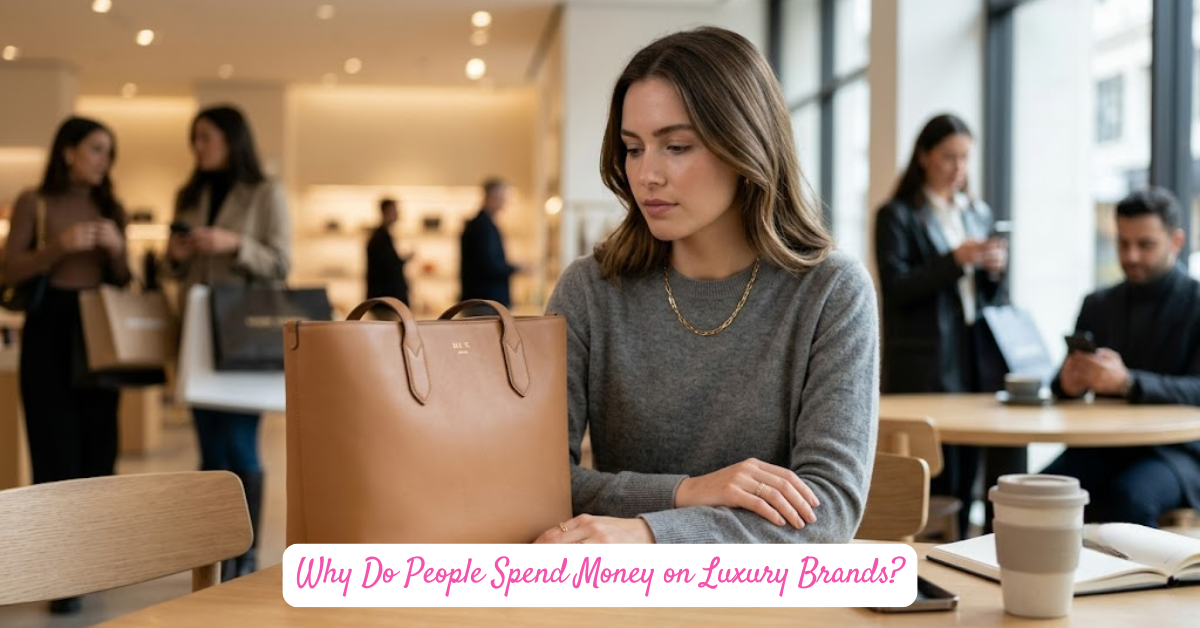
Okay, real talk. A perfectly intelligent person who knows how to file taxes and parallel park somewhere out there is giving away the same amount of food as three months as is a leather bag and a Tote at Target. And they’re happy about it. They are coming out of that store with a smile on their faces. My questions about people buying luxury brands besides “did I leave my straightener on” is this: when people pay a thousand percent premium for a logo, why do they? Spoiler — it’s not due to their stupidity. It’s because our brains are programmed to think that the logo is worthwhile. Just in all honesty, once you get the psychology it is never the same checkout page.
Let’s get into it.
The Brain Stuff Nobody Tells You About
Here’s the thing. We like to say that we purchase items because they serve a function.We like to believe that we buy items because they serve a function. We do not. We purchase things because we feel good about it and it helps us to define who we are and what we are and luxury items are simply feelings with a price tag.
Psychologists are on the hunt for some key drivers, and most luxury goods are a mix of these. Then there’s “status signaling” – the more dignified way of saying “I want you to know I’m doing well.” In fact, there’s the self-reward, the classic, “I had a tough year, I deserve this. There’s identity construction, where the object purchased becomes part of the self-image. Then there’s belonging — the secret, sincerely human necessity for being part of a group, even “people who own the same sneakers.”
There is no evil in these. They are indeed very human Luxury is seldom the luxury object. It’s about the story it tells you before you speak.
Status Signaling: The Silent Brag
Status signaling is an age-old tactic in the human arsenal. People flexed with feathers and gold and ridiculously funny hats—long before logos. The modern feather is the bag.
He or she is providing information, but not through words, but through the act of carrying around a very costly object, “I have resources, I have taste, I belong in certain rooms”. The wild part is that you don’t have to be conscious of doing it, it works. He really does mean that people react differently to the same person when he’s carrying different things. That’s a bit morbid, but it is so.
Self-Reward: Treat Yourself, But Make It Expensive
Then there’s the “I earned this” purchase. You have the job, you’ve graduated, you went through a breakup without texting your ex. The posh product becomes a trophy. It’s physical evidence that something good took place in your life.
This nifty one is a stealth item because it tastes so good. Not always, but sometimes it is! However, there is a distinction to note: sometimes “self-reward” is simply “I’m sad, I’m shopping, it doesn’t last.” I’ll leave you to ponder on that disaster later.
What an Old Economist Figured Out Over 100 Years Ago
I have a friend named Thorstein Veblen. Dead but smart, a little judgy. It was back in the year 1899 that he invented the term “conspicuous consumption”, which describes the notion that people don’t really purchase something just because it’s costly — they purchase the thing because other people know that they can afford it.
Now that’s his whole argument – the price isn’t a bug, it’s a feature. If something is too pricey then it’s an indicator of status. If everyone had the money, it wouldn’t be a proof. Hence the reason that some goods become more desirable as they become more expensive — in fact, economists call these goods “Veblen goods,” which is a flex of a name, if I ever heard one.
That’s why, when you ask yourself why people spend money on luxury brands even when they get more and more expensive, Veblen would simply shrug his shoulders and mutter, “Yeah, the price is the point. Doing the emotional work is costly.
Social Media Turned the Whole Game Up to 100
TikTok would’ve been an unexpected outcome for Veblen, and he would be better off if he hadn’t seen it.
What social media did was it gave conspicuous consumption, which worked on your face-to-face audience, a bigger audience: millions. Flex culture exploded. A genre of hauling videos emerged. People unboxing products, like luxury products, with an insane pace of watching while the guy barely talks to himself for nine minutes, earns a ton of views.
And it affected their behavior in a measurable way. For the generation of Z, it wouldn’t be considered luxurious if it couldn’t go online. The act of possessing the thing and demonstrating the thing has inextricably become a single act. No bag is truly complete until it’s captured in portrait format and with proper lighting.
So, there’s a pretty vicious circle here. When you see a person’s “everyday luxury” content, you hear it in a way that makes you think, “Well, that seems like what I should be doing, rather than what I’m doing.When you see a person’s “everyday luxury” content, you hear it in a way that makes you think, “Well, that seems like what I should be doing, rather than what I’m doing. It’s really just a status-anxiety machine and we’re all plugged in.
The Dopamine of It All
So let’s get to the chemistry: This is where the eleven minutes of happiness comes in.
Your brain releases a feel-good “I want, I got” chemical (dopamine) when you purchase something that you are craving. The hard part is, though, that the greatest release of “feel good” chemicals is generally when you’re expecting the experience, and when you’re making the purchase itself. The unboxing is electric and the bag is just a bag in the closet two weeks later.
A luxury can give someone a sense of power, a sense of being even, a sense of being a good person, a sense of being worth looking at, even a sense that they have “made it.” Those feelings are not imaginary and they are very important. However, they’re also fleeting – and that is the cycle that drives repeat customers to buy the next one. It’s not weakness. Brain wiring and a billion-dollar marketing industry that knows exactly which buttons to press.
Why do people spend money on luxury brands that they can’t really afford? Well, sometimes it’s just because it feels great for a brief time, and we are mammals who seek out that feeling.
Gen Z Is Doing Luxury Completely Differently in 2026
This is where things get really interesting, as it’s no longer the same game that the children are playing as their parents’ generation.
Gen Z in 2026 is extremely discerning and extremely unloving towards brands; I’m being serious. Rather than putting together a big fast fashion collection that does not last beyond three washings, many young people are saving money for a truly exceptional item. Even, there is been a shift towards “loud budgeting”, talking about saving money and skipping the splurge is a flex in itself. Now imagine being able to boast that you didn’t purchase something. Iconic, honestly.
Pre-owned luxury is also major — a significant portion of Gen Z prefers to purchase second-hand and avoid the harshest depreciation that follows the first buyer, which, come to think of it, is more of an effective financial strategy than any I’ve had offered! That’s what makes brands such as Coach, Cartier and Ralph Lauren appeal to younger shoppers—it’s the moment they’re in the right place at the right time.
The tone of the discussion changed from “more” to “fast,” to “cheap” to “less,” “considered,” and “lasts. Not perfect — it’s still very much a flex to the Gen Z, but it’s no longer just about volume.
Are You Buying for Quality or for Status? (An Honest Quiz)
I think everyone should ask himself at the cashier, so here’s the easy answer.
That is a quality buy if you’d still want the logo completely gone — and if you adore leather, stitching, how it lasts for 15 years. You are purchasing craftsmanship, and that may be a valid and also potentially affordable option in the long term.
If it’s the logo, and not a simple version of the same logo, then it’s a status purchase. Then there is nothing wrong with that either! Be honest with yourself, but when the dopamine wears off and people have forgotten about you, the ones you spent money on will bring the most buyer’s remorse.
Most of us are a combination of the two. The intention is not to be a virgin. The idea is to not lie to oneself while the card is in mid-swipe.
Real Examples, Because Theory Is Boring
The Hermès Birkin is the ultimate expression of luxury psychology. There are very few bags that are actually considered an investment — it’s been found that this type of bag can grow in value by about 14% each year over decades, outperforming the stock market and gold, and Jane Birkin’s original bag was sold for more than a tenth of a million in 2025. A Birkin 30 sells for about $14,900 this year, but it is resold for much more. So is it the case that Birkin buyers are irrational? Not really. A play that is about quality and scarcity tatted into a status costume.
Then there’s the Louis Vuitton monogram — the ultimate status symbol. Print has a purpose to be acknowledged. It’s logo-as-language and it does its work with a loud voice and a proud chest.
Then there’s the quiet luxury flip in which folks went the other route and began to shell out a lot to look like they didn’t spend anything. No logos, plenty of cashmere and a satisfied little “if you know, you know” attitude. Ironically, even that’s a status move — it’s just status for those who want you to do something to acquire it. Even something as simple as a luxury became loud by 2026, since trends are like a circle and we’re all just running around it.
Mandy’s Honest Take: Is It Ever Actually Worth It?
Now you’re here to get the real opinion, so here it is.
As far as I’m concerned, buying luxury isn’t necessarily a bad thing, or shallow, or a sin. If you save up and create something that you will use for years, it can be a worthwhile endeavor, and it’s not a crime to indulge yourself. There are things that I have stored up, and they give me joy each time.
But I believe there is always a little bit of ego involved — and this is where I’m about to die! Even the “good buy” one, the investment Birkin, even the “I just love craftsmanship” flex has a “and I want people to know” thread in it. That’s not shameful. It’s only a name to be mentioned. Next time you find yourself asking yourself why people pay for luxury brands (and why you pay for luxury brands), it’s usually because of the real value, real emotion and real human, slightly needy, urge to be seen. Three parts heart, 1 part EGO, served over ice.
If you’re in love with the thing, buy that thing. Just ensure it is something that you truly love, not the version that the algorithm is selling back to you. That girl’s expensive. She’s not real, and she’s not even my sister.