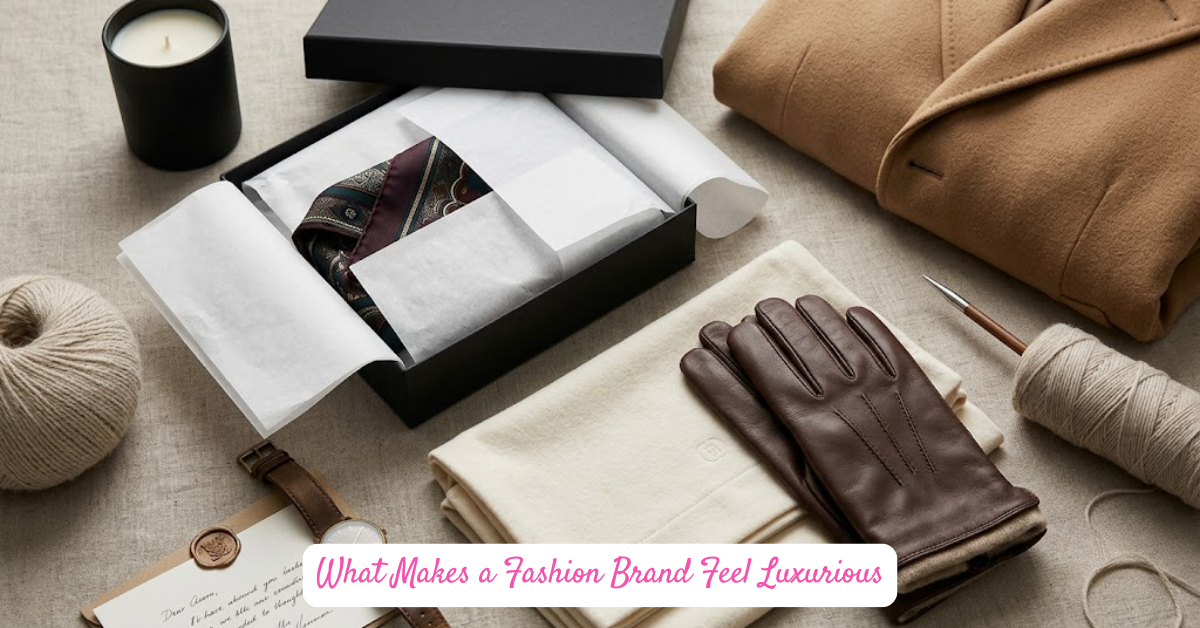
Okay, real talk. Ever spent money on something that you didn’t get any feeling for? You bought it for a pretty penny, you opened up the box, it just felt “fine”? Forgettable? In the meantime, your friend must remove a £40 candle from a matte black vessel covered by a piece of tissue paper, and it feels like she has just been handed a gift from the universe itself? Yeah. This disconnect is the one we need to discuss today.
But Luxury fashion brands are more than just expensive. Never it’s the price tag. Some of the most costly brands around sound like they’re just bratty plastic that’s too much work. So, some brands that don’t give you the feeling of a total financial disaster, are somehow cool, cultured, and even somewhat aspirational for a single hoodie. But what’s really happening? Let’s take it apart.
The Real Ingredients of Perceived Luxury
Craftsmanship Is the Foundation
The first thing to understand about luxury is that it is related to the way things are created. Not only does it last (and it must) but you can feel its purpose. The weight of well structured coat. The flatness of a seam, without puckering. Stitching that doesn’t fall off after 3 washes. What makes you pick up something up, turn it inside out, and then be impressed? Craftsmanship.The thing that makes you pick up a garment, turn it inside out, and be impressed? Craftsmanship.
When you see brands such as Loro Piana and Brunello Cucinelli you do that thing that makes you do the inside-out-inspection thing. With such exactness, it is clear that there’s care involved in the construction, before you even read the label. The caring factor, the one that knows someone, somewhere, making conscious decisions about every millimetre of a garment, is just irreplaceable. It’s not something that can be faked and if you do not have it once then you will always recognize when you don’t have it.
Materials That Actually Matter
Low quality materials will destroy everything. The illusion is over if the fabric is scratchy, thin or pilled after two wears, even if you have the most beautiful silhouette in the world. What luxury fabrics can’t do is drape right, age beautifully, and feel good on your skin: they’re real cashmere, heavyweight silk, full grain leather, dense wool.
As sustainability and slow fashion discuss fill the air in 2026, the importance of material quality is even more at the heart of the luxury discussion. Owning up the product is a growing issue for consumers. They are able to identify a genuine suede from a polyurethane copy. They are not fooled by luxury pricing of fast fashion fabrics. Materials are not only functional, they are communicative. They let you know what a brand believes about you, as a customer.
Storytelling Gives It All Meaning
A brand that is told comes more alive than a brand that isn’t. The difference between buying a jacket, and buying ajacket, with context, with history, with a reason to exist beyond filling a gap in the market.
It is known that the founder of Chanel was a woman who didn’t wear corsets. A hundred years’ history of Barbour’s ties to rural England. Levi’s and the gold rush. These are not marketing campaigns, but actual myths which can make a product feel more substantial than it is. If a brand has a true story, it’s as if you were wearing it when you’re wearing it. This is a strong emotional pull and is extremely difficult to create.
Packaging and the Unboxing Feeling
This may seem superficial but stay with me, it is really psychologically deep. The brand’s packaging reveals much about the brand’s attitudes towards you as a customer and the brand’s attitudes towards itself.
Imagine being rewarded with something from a really upscale brand. Typically, there is a box, large, mat, heavy. In the inside, a kind of ceremony in which tissue paper is folded. Maybe a ribbon. Perhaps a dust bag that you will never consider getting rid of, even though you may think it is foolish to feel attached to a dust bag. Perhaps a small card with a handwritten note or a statement of the artisan’s name.
All of those touches say something. The message reads: In our minds we considered this. We’d like to imagine what you’d feel if you opened this. We wanted the process of receiving this product to be more of a process than a transaction.
That’s compared to a product that comes in a poly mailer, falls into itself, and has a receipt inside—no other ceremony. If what is in the bottle is similar in quality to the actual product, it’s still a different experience. Packaging isn’t something you can do superficially. It’s the first place that customers will find out who the brand is.
Scarcity and Exclusivity: The Hermès Effect
A good indicator of luxury is when you feel like you could miss out on something. When you say it out loud it’s a bit manipulative — and it is — but it’s also true of psychology. We want what we can’t get easily. We give value to that which is not freely available to all.
This has been the basis for the entire Hermès empire. One can’t just show up at a Hermès shop and purchase a Birkin. The brand connection you create first is the bond.The bond is created with the brand first. You purchase other items. You’re entering as a known customer. Only then, perhaps, does a sales associate come up to you regarding a bag that is on the shelf but that is reserved for those who have earned it. It’s not a bug in the system, it’s the system! The exclusivity is the result.
This concept was repeated in various ways throughout fashion in 2025 and into 2026. Only a few drops from brands such as Bottega Veneta that sell out before most people have seen them. Wait lists for sneakers, perfumes, small leather goods. The drop model that streetwear has introduced is an interesting influence into traditional luxury: it’s not just the look that’s different, it’s that it’s based on the same concept of scarcity. Luxury is a concept that is deliciously created by the public’s perception that others want it and can’t have it.
Heritage: Why History Actually Matters
Brands with true heritage are different than brands that were created 3 years ago and are just doing a great job of being old on Instagram. It’s not possible to fake history. It can be cited, looked at and admired, but it can never be copied.
A hundred years is a time of survival when it came to some brand. It has been put through the paces from different time periods, fit for different cultural eras, worn by different generations. That longevity means quality and relevance that is not short-cutted by a marketing budget. It’s a sign that the brand was not just here when trends were here, it was here when they were not.
It is definitely one of the most challenging aspects of newer luxury brands. It’s possible to have a great product and vision, and still think you’re missing something that you can only achieve with time. Some brands attempt to address this issue by emphasizing on the founder’s personal history, or reference craft traditions in particular areas. It’s nice, but not like it really happened. The brands being established today in 2026 are playing a long game – and most know it.
Affordable Brands That Have Cracked the Code
This is where things start getting interesting. It is actually what makes a fashion brand luxurious is something that can be done without the price tag to match, and a few brands have successfully proved this beautifully.
COS, Arket, and the H&M Group Paradox
COS is a company in the hands of the H&M Group. H&M Group is the owner of Arket. Despite this, when you enter either of those stores, the whole experience feels like it’s elevated. Clean architectural spaces. Think about using neutral colours as colour palettes. Clothing displayed in space and not stacked on racks. Well informed, not pressured staff. It’s a bit fancy, generally, for a parent company.
What COS and Arket have realised is that luxury is an aesthetic and experiential language – and that this language can be utilised at the lower price points if the commitment is 100%. The minimalism isn’t lazy, it’s on purpose. It’s really better than expected for its price. The stores are like galleries. The end result is that wearing a COS coat is not a compromise! It seems like a thoughtful selection.
Muji and the Philosophy of Nothing Extra
Muji takes this even further. Muji has created a whole brand image based on an intentional lack of branding. No logo. No unnecessary embellishment. The product itself, done well, sold at a nominal price. This anti-luxury attitude somehow turns out to be a lot of luxury in a world that is so full of logos and noise.
The message Muji sends is this: If we built it, we believe that it is good, so much so that you don’t need a logo to know it’s good. That confidence was quiet luxury before quiet luxury was coined.
Celebrity and Cultural Association
No discussion of what makes a brand feel luxurious will be complete without talking about who’s wearing it. The link between celebrity association and brand perceptions has always been a key factor, and although the mechanisms have changed markedly.
The old formula was straightforward: Place a well-known name in your brand, place the ad and watch your perception change. The 2026 comes across as much more subtle. The most effective brand association now occurs from a very real organic convergence. If someone who already has a certain cachet decides to wear something regularly, not in a paid campaign or, at least, not in an obvious way, then it’s a statement that the brand is the type of thing that he or she gravites towards.
It’s a perfect example of the cultural trend that has been growing since approximately 2022 and remains very much alive in 2026, that of quiet luxury and old money aesthetics. It’s about the way some people culturally feel the aesthetic, not that they’re shouting about it, but that they’re just feeling it, that they’ve inherited it, without having to work for it. Brands that were linked to the moment felt their own luxury level increased drastically, without any changes to their product.
The In-Store Experience and the Power of Being Treated Well
Walk into a true luxury boutique, and it’s orchestrated. Someone greets you. Water, coffee, champagne are offered, depending on the level of the house. The area is serene. No background noises that induce worry. The product is presented so that you can touch it, taste it, experiment with it, take the time. Everyone feels welcome and not a customer.
Now step into a struggling middle market store and see what’s different. The lighting is likely to be too intense or too focused. The tracks are congested. Staff’s attention is diverted or away. The entire experience is like a transaction that needs to be made, not an experience to be enjoyed.
The in-store experience is a reflection of a brand’s faith in its product, and in the people it is selling to. The feeling of luxury in a physical retail store is all about feeling valued: appreciated, desired, special, respected, unique, and cared for. That’s why so many luxury brands have call centers that are very attentive to their customers. It’s not a coincidence. It is the point.
The Digital Equivalent in 2026
In 2026 in particular, the in-store logic gets transferred onto the digital world. Luxury firms have realised that their online presence, mobile applications, and packaging for online orders, must also have the same vibe as the physical luxury boutique. The tissue-wrapping inside the shipping box is a digital “glass of champagne.” Your personalised note is like the sales associate who remembered what you purchased the last time you were in their store. The ceremony travels.
The Itismandystyle Take: Can You Actually Manufacture Luxury?
So, I have to admit that I do think about this a lot, okay?
There’s certainly a luxurious feeling to it that can be created. Packaging may be raised. Experiences can be designed for their store. Scarcity is a created condition. Storytelling can be constructed, even if the history is thin. The whole thing can be approached as a set of codes to be deployed — and brands do this all the time.
I’m not sure how to put this, but I believe that the most luxurious quality a fashion brand can have is something that can’t be fake forever. It is the feeling that there is sincerity and caring behind the object and the experience. To me, the brands that feel the most luxurious are the ones where I feel it’s being cared for – where I feel like the people creating it care about the people using it.
If it is all packaging, and no product, all scarcity mechanics, and no actual quality, all story, and no craft, it will fall apart. Typically, and openly. Consumers are becoming more discerning with each passing year, especially Gen-Z consumers who have been inundated with information and are able to see through the mask of a brand’s image and understand what is actually true.
Yes, you can create luxury feeling, though! Can work on any touch point. You can learn code, and deploy it wisely. But it is those brands that earn it – not simulate it – that last. When it comes to luxury, let alone real luxury, one must realize that it isn’t about what a brand tells you it is, but rather what it makes you feel without telling you. That’s the most intangible, and most palpable, feeling you can’t fake is the feeling of being in the company of something that is actually thought of. The only way to get there is to care.
Which, honestly? When I am kind, it makes me feel good. That’s the definition of brands that are thinking of you before you even realise you need them, and the ones you should spend your money on are the ones that were thinking of you! That is why, for me, it’s the only thing.