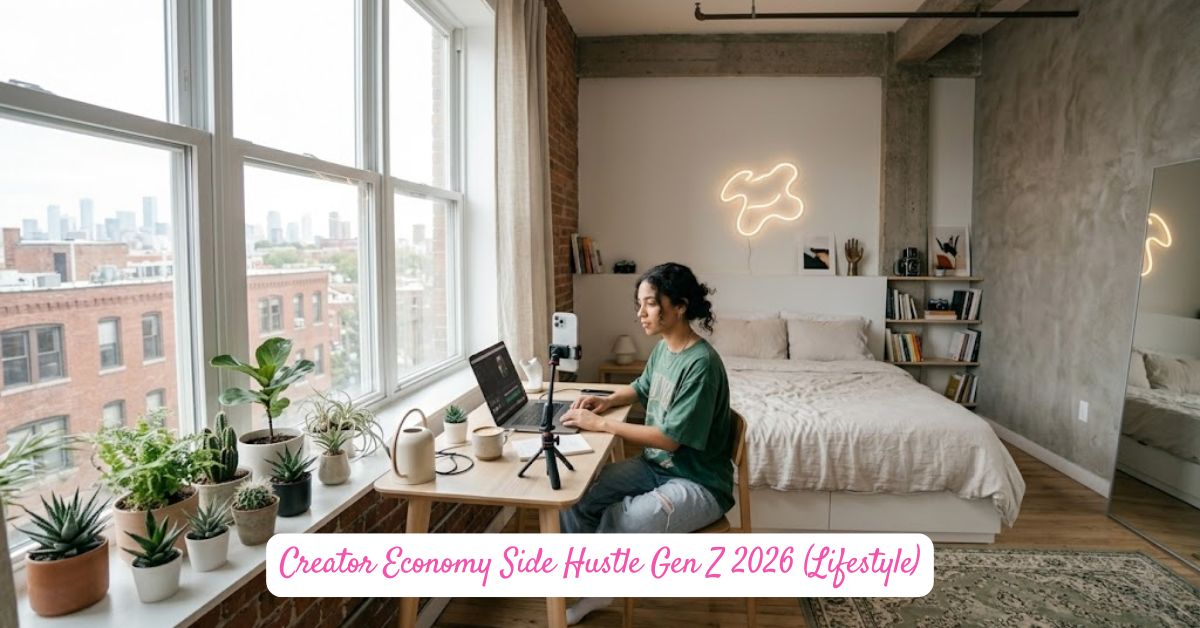
Money-making rules have changed; Gen Z created a new set of laws about making money; they follow different guidelines. Boomers/followers were told to get a job that pays well, work long hours, and retire at age 40, with a watch from your employer as a reward for your 40 years of service. Generation Z looks at this path and says no way! The creator economy side hustle Gen Z lifestyle is not a trend anymore. Today’s generations are determining how to secure their financial futures through their own desires, from their homes, on mobile devices, and by using their own thoughts and inspiration.
This is evidenced by data. According to statistics, approximately 48% of Gen Z adults (aged 18-24) have a secondary source of income, which is more than any generation before it. According to estimates, the total amount of gig economy revenue globally will top $556 billion in 2024 and reach $2.15 trillion by 2033. This suggests that a gig economy does not refer simply to an alternative source of income; rather it also represents an entirely new model and definition of an economy.
The 9-to-5 Was Never the Plan
Gen Z has really had a rough time at work coming out on a boom with massive inflation increases and rising home prices before they could even get started in the working world. For this generation, the minimum wage did not keep pace with rental rates. They also discovered that a degree is no guarantee of getting a job that pays enough to cover your living costs. Watching someone your age from TikTok create a very successful brand with their bedroom and make money from doing so really changes your perspective on going to an office every day and being part of someone else’s dream. Instead of just complaining about this situation, as they could do, they were innovative and creative. The creator economy side hustle is not just about making money. It is about owning your time, your platform, and your narrative. It is financial survival dressed up as content.
Why the Creator Economy Actually Makes Sense in 2026
In the year of 2025, the influencer industry reached $250 billion in sales, and it’s projected that they will see double the amount at $500 billion by the year of 2027. Goldman Sachs estimates that by 2030 there will be approximately 107 million creators; currently, there are approximately 67 million. Those are not merely motivational quotes/figures found on a motivational poster. This is the future of this economy.
Gen Z specifically, are looking to start a business beginning in 2026; not dreaming of doing so, but truly planning to initiate their business start-ups by the year of 2026. Many of them are smart enough not to be reckless in starting their businesses and in fact are working many hours at their 9-5 jobs, while developing their side hustle, so that eventually their side hustle can pare down their operating costs of running their side hustle before the owner of that side hustle goes full-time with it as his/her business.
What the Creator Economy Side Hustle Actually Looks Like
Here is where people get confused. The creator economy side hustle does not mean dancing on TikTok and hoping a brand emails you. That is one lane. There are many.
The primary one you can think of for creating content is on YouTube, TikTok, or Instagram, creating an audience around a particular niche and then monetizing through brand partnerships, advertisement revenue, affiliate marketing, or subscriptions. Average Gen Z earner makes between $958 a month off different side hustles, and as a creator, is creating approximately $733 a month during the early stages of their creative journey. It will only continue.
In addition to creating content, there are also many ways to earn income through freelance graphic design, video editing, social media management, digital goods such as presets or template designs, online courses, print-on-demand products, and writing niche newsletters. There are more tools than ever in 2026 that can easily connect you with the audience for the skill you have.
The AI Factor No One Is Talking About Enough
The playing field is changing dramatically with the help of AI technology, which gives opportunities for Gen Z creators. The tools that previously required a production team and/or budget or years of expertise can now be found by anybody using a computer and a little curiosity. Whether it’s editing/creating/making graphics, scripting, doing research/SEO, and doing email marketing, etc., AI will do the boring stuff so that you can concentrate on the fun part of being human. AI doesn’t have the ability of replicating the most valuable assets in creating, your ability to connect with others through your story, personality, and point of view.
Gen Z has the digital experience. There are tools available, there is an audience across the globe, and barriers to entry have never been lower, meaning that competition is extremely high (which also means that opportunities to create will be available to everyone).
The Creators Who Proved It Was Possible
Talking about the creator economy side hustle without mentioning the people who built the map would be incomplete.
Jimmy Donaldson began posting YouTube videos from his bedroom in North Carolina and, at 27, he has become the world’s wealthiest Gen Z creator with an estimated value of $5 billion due to his company Beast Industries, which includes Feastables, MrBeast Burger, and a philanthropic organization, all created via content. His business model wasn’t just based on views but rather on reinvesting, diversifying, and thinking on a larger scale than simply being a creator using the YouTube platform.
Charli D’Amelio began sharing her dance videos on TikTok during the year 2019. Currently, she is only 21 years old, has a following of over 155 million people, and brings in roughly $17.5 million each year from her various sources of income, which include but are not limited to brand partnerships with Valentino, Prada, Lancôme; an episodic reality show on Hulu; performing in & Juliet (the Broadway revival); and even launching her own production company (to create multimedia content). She accomplished all this through building her audience by evolving with them and evolving her content while also not being constrained by the algorithm as the primary source of success. Dunkin’ created a drink for her – this is how you can measure one person’s brand equity!
From a bedroom, an artist created a unique identity as an award-winning musician, and became one of only a few artists with three multi-platinum albums (with four more to come), nine Grammys, and a visual brand that is so recognizable, it transcends generations.
The artist did not follow the traditional route to success in the music business; instead, she has created her own path and was able to accomplish each of these things through consistent hard work, as well as some talent behind the work she produced. These are not rare instances; they are representative of the synergy that can occur when talent meets consistency and the knowledge base to maximize the creator economy.
The Real Talk: It Is Not Overnight
Many people focus on the glamorous image of the creator economy, but what they fail to mention is that many creators spend sometimes months posting without receiving any real engagement at all; lots of creators will launch their first products with little success; sometimes creators will see their reach diminish significantly for no reason whatsoever, causing them to question the entire direction of their life for at least three days.
However, there is a huge difference in average revenue generation for solopreneurs within the Gen Z demographic, with most solopreneurs generating less than $10,000 in revenue in their first year of business and generating more than $60,000 in revenue on average by their fifth year of business. The curve is there. The growth is there. But everyone hates to hear that the only way to achieve this growth is by constantly working hard, even when it doesn’t appear that anything is working.
In the creator economy, the people who are rewarded are those who consistently show up to create content to share and not simply those who post once; the successful creators are the ones who treat their side hustle as a business long before they have seen any successful results.
Diversification Is Not Optional
What distinguishes the lasting creators from those who fade away due to algorithm updates is their strategy of not depending solely on one platform for their livelihood, nor having one stream of income. For example, Charli D’Amelio is not just a TikToker; she is a media business. MrBeast is not simply a YouTuber; he is a commercial business.
For average creators establishing a side hustle, you must envision beyond just posting to the feed in the beginning. Build an email database. Develop a digital product. Think about producing merchandise. Start a Substack or a Patreon. To survive, you need to diversify your income; and members of Generation Z, more than any previous generation, have the ability to do this.
What 2026 and Beyond Looks Like
The creator middle class is on the rise. No longer do all wealthy creators fall into either extreme, there are millions of creators existing between those two extremes on an income continuum. Creators who generate revenue by creating unique, original or branded content and/or digital products will find that they’re not famous yet but are able to establish their trust through their niche with their audience and generate a sustainable income without relying solely on millions of followers will find themselves in this middle class.
The future of the creator economy side hustle Gen Z landscape is not about chasing virality. It’s all about creating a community, product or brand that has significance for the people who create it and who continue to return again and again. Generation Z is not going to wait for someone to give them the opportunity to build wealth. They will create products, post them, and launch them online without waiting for a company to provide funding for them. They are doing this with real-time feedback, and as a result, the economy is literally evolving to support them throughout their lives.
The bedroom is now the new boardroom. This has been true for quite some time.