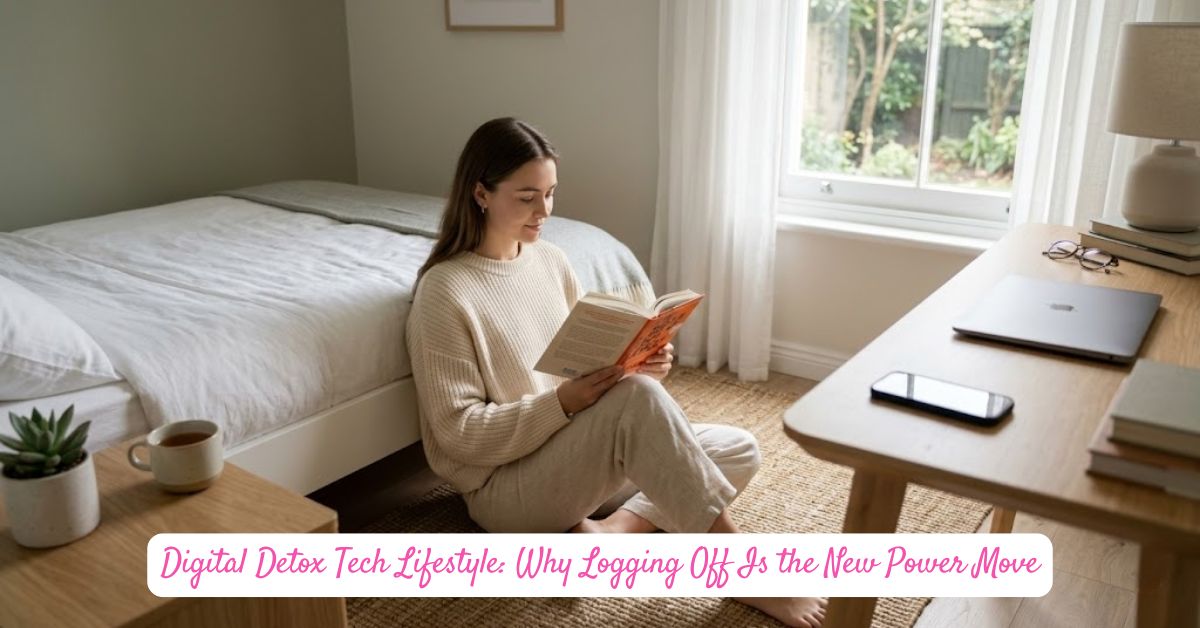
Let’s be honest for a moment – you’re reading this (likely) on a screen while also (probably) having at least three other browser tabs open, there’s at least one notification bouncing off the edge of the screen, and your (probably) within arm’s reach of your cellphone. I’m not making a dig, I’m simply stating a fact. This is how “Tuesday” looks in 2026. But in the middle of all the doom scrolling, and the 2:00 am tiktok spiral, many of us have begun to sense that we are experiencing: chronic fatigue that no amount of sleep can remedy; an odd sense of anxiety that arises immediately upon shutting our phones down; and the pervasive sense of being in ‘life’ yet never being there. That’s exactly why the digital detox tech lifestyle is not just a wellness trend anymore, it’s becoming the most relevant conversation of our generation.
This isn’t about disposing of or abandoning technology completely, but rather a realization of the benefits of technology can affect both your mind and body. Understanding the impact of technology on your life will allow you to reclaim your time without removing the benefits of an online existence.
Your Brain on Notifications: The Science Nobody Told You In School
This is an area where we really need to do more explaining. Each little vibration of your phone stimulates a small burst of dopamine in your brain. Dopamine is what makes you feel good after you eat your favourite food or get praise from someone you admire. When you receive a notification or ‘like’ on social media, or whenever you scroll through your feed, you are producing more dopamine in your brain, your brain’s pleasure pathway or ‘reward’ pathway. As a result, over time, your brain develops a need to be constantly stimulated. You’re not showing weakness when you can’t stop checking your phone, you’re being a human being. You’re literally working against an addictive design.
The average person unlocks their phone 96 times every day without even realising how much attention has been diverted to other activities. Ninety-six times) That’s 96 times a day and, yes, that is more than the average number of times each person drinks. What we do with our phones also causes us mental distractions and have many more detrimental effects on our lives, including the overall level of anxiety we experience because of our incessant access to communication through electronic devices.
When “Being Online” Becomes a Personality
Constantly being connected can lead to a unique kind of fatigue. Your body reactively experiences many forms of physical discomfort, such as tech neck, visual fatigue, nomophobia (anxiety when not in a phone’s presence) and sometimes “phantom ringing”, when the nervous system is over-stimulated and reacts as if a notification has been received when there are no messages. If your body has reacted this way (for example, you think you heard your phone buzz but when you check, it was just a false alarm) you are literally being told by your body that it needs to relax.
The good news is that these symptoms are reversible. The digital detox tech lifestyle isn’t about shame or discipline, it’s about giving your brain the rest it was never designed to go without.
What a Digital Detox Actually Looks Like in 2026
Dramatic declarations to delete Instagram and use it for three days are leaving the scene in 2026 as the digital detoxing movement becomes something more than simply temporary challenges; it will change how we view the use of technology.
While many people cannot imagine taking a break from or rejecting technology entirely, the focus of this movement to digital detox is about controlling the “when,” “how,” and “why” that we access and use technology. Examples include setting screen-free times during specific hours, limits on social media use, and establishing tech-free zones in their homes to regain focus and balance. For example: no phone at the dinner table; no scrolling for the first 30 minutes/exemption of screen use after waking up; moving the phone to the other side of the bedroom while you sleep. Neither of these choices is a significant loss for the user; both are individual choices in achieving an aggregate result.
The Dumb Phone Era Is Real
The rise of the dumb phone, which is a mobile phone that no longer has any social media applications installed, has quickly become one of the most interesting trends in technology culture today. The purpose of these devices is to allow users to make phone calls, send text messages, or perform other basic tasks without falling into the trap of being too distracted. Users are opting for these devices in favor of e-ink tablets, or other smart devices that limit any distractions so they can concentrate and have better mental health. Companies like Light Phone and Boring Phone have created loyal followings based on this philosophy. This might sound strange at first glance, but it actually resonates with the Gen Z generation, it is counter to everything else that is happening and is, therefore, intentional in nature.
You may not need to purchase a new cell phone to follow this philosophy, but it speaks volumes about people’s willingness to do so.
Selena Gomez and the Artists Who Got There First
For some time, there have been discussions surrounding social media and how it influences mental health. Selena Gomez was one of the first high-profile celebrities to speak about her experiences with social media impacting her mental health. She noted that she made the conscious decision to have her management team help her manage her social media accounts, as she’d find herself inundated with everyone’s opinions and expectations about who she’d be as a human being. She eventually developed a healthy balance between her use of social media and the way she supports the responsible use of social media. Although Selena has moved away from the internet completely, she has not vanished from our lives; rather, she’s stopped allowing social media to absorb every moment of her life, and we can now see a side of her that we have never experienced before!
Likewise, Ed Sheeran also stepped away from social media, as it became evident that he had begun relying more on his phone to observe the world around him than to experience all that is available via his own two eyes. He resonated this idea so well that there are thousands of people who echo his statements. How many times have you attended a concert, watched a sunset, or enjoyed dinner and instead of experiencing the event in the moment, documented it with your phone?
Neither of these celebrities are running from their success or trying to remain current; both are discovering who they really are outside of their identities – those being New Artists via the Use of Social Media. They’re people who learned that the digital detox tech lifestyle isn’t a retreat from life. It’s actually a return to it.
Gen Z Is Leading the Charge (Even If the Feed Doesn’t Show It)
This is something hard for the algorithm to be aware of but interesting. The generation that spends the most time on the Internet, WANTS to spend time away from the Internet. Gen Z is an example of this current trend of digital detoxification, youth are prioritizing their mental well-being by rediscovering ways to spend time off screens and therefore are demonstrating a greater desire for hands-on experiences, tactile hobbies and simplicity as a culture.
Some examples of how to reconnect with the world through offline activities include: Pottery, Journaling, Film Photography, Reading real books, and Hiking. Although many seekers of these activities are posting pictures of their involvement, it should be noted and understood that for many of these individuals, it is an effort of establishing connections to things that exist solely without the use of Wi-Fi.
Digital detoxification is no longer accomplished through an occasional cleanse; it is becoming the norm as part of an individual’s lifestyle by creating specific digital detoxification habits that maintain the time of day, identity and emotional reserve for themselves.
JOMO Is Having a Moment
Feeling joy from not doing something is called JOMO, and it’s become an increasingly popular way of thinking in the past couple of years. There are several trends highlighting JOMO (Joy of Missing Out) or tech-free retreats because people are searching for experiences that provide them with a deeper sense of purpose than being distracted by technology. Many cultures are creating space for unplugging so that individuals won’t feel as if they are missing out by unplugging but, instead of enjoying their present presence.
The act of deciding not to be online has power. When you decide to keep your Saturday morning for yourself and not look at how many followers you have, you are not being lazy. You are possessing self.
How to Actually Start Without Spiralling
Nobody said you needed to quit cold turkey. That’s not how sustainable change is done and that’s not how this will work. What you should do:
Begin with your morning routine. Please keep your phone out of your bedroom or at least kindly do not touch it for the first 30 minutes after waking up. Use the time that you are awake in order to be present to yourself before other people have their opinions of you for the day.
The most significant way to decrease compulsively checking your phone is by disabling notifications on everything but direct communications, such as via text message, from people you know in real life. By disabling all other forms of notifications, you will significantly reduce the frequency of compulsively checking your phone. Additionally, creating designated screens-free times, especially for the morning and evening hours, will help retrain your brain to feel comfortable with being without multiple sources of stimulation throughout the day.
Designate one specific room or one small area in your home as a no phone zone. The no phone zone does not have to be a very large area. Keeping a phone out of your bathroom, for example, or off of the dining room table could also be considered a no phone zone. Even a small designated no phone zone will contribute toward creating a significant amount of thoughtful offline time.
Replace the Scroll With Something Real
Intentional activities such as reading, walking, or journaling can help you create room for your focus and creativity, rather than using time on low-value activities like scrolling through your phone or computer. Even when you make a conscious decision to replace low-value activity with another activity, you will not necessarily be productive all the time. Replacing the activity can also mean sitting in a café having your first cup of coffee and doing nothing. Your intention is to be without any external input for a period of time and then remember that you are okay without significant inspiration.
The Bigger Picture: Offline Is the New Luxury
Tech executives have a reason to send their children to schools without technology, and people are beginning to understand why silent retreats are selling out many months ahead of time. On the other hand, in airports, coffee shops, and open-plan offices, there is a new status symbol emerging: a person’s ability to ignore their device.
When someone was constantly reachable via technology, they were perceived to be successful or important to the rest of society. That has shifted, however, to 2026, where the person who has the ability to put their phone away, focus on and develop relationships with others, and create boundaries around his/her time and attention now has something the majority of people do not have: boundaries.
2026 will represent a return to what is real. That is, people are enjoying activities away from technology such as hiking, traveling, and spending weekends with people they enjoy to increase the value of their lives by spending time with others in person. The digital detox tech lifestyle is not a rejection of who we are as a generation. It’s a improvement.
Your entire identity has been created through your online presence. Now you can create the version of you that exists without an audience; and this person does not require notifications to see how well she is doing.