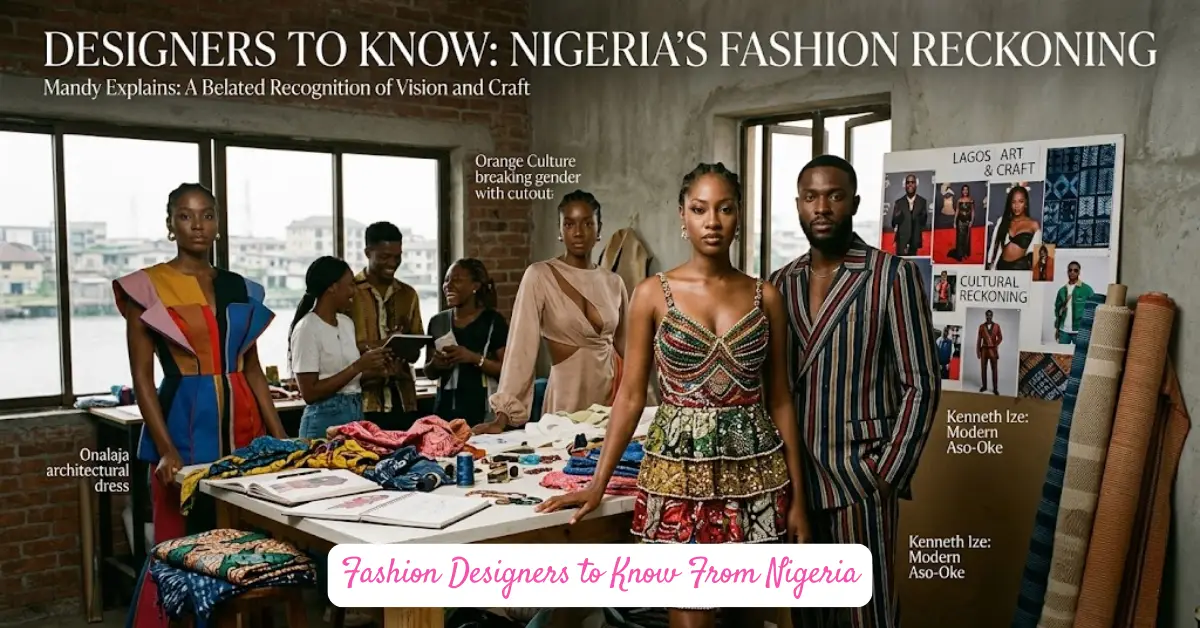
All right, let’s take a breath. While the rest of the world have been going on a Paris, Milan or New York fashion show for the past decade, Nigerian designers have been at work and did work, but not so distraquently, and have been building something amazing. The runways of the city of Lagos have caught fire. There’s been some work done at the ateliers. The cloths are speaking. Then, finally, everyone is listening! The world of fashion is just starting to realize what Nigerians have always believed: that the world’s hottest, most colorful, most culturally rich fashion design activity has always been in Nigeria. Let’s not have the fad version of this discussion here. Now, we’re here to celebrate the fashion designers you need to know — the aesthetics you need to understand — the stories behind the clothes that are changing what fashion is all about in 2026.
It is not a “discover Africa” moment. This is a belated recognition of craft, creativity and vision which has long been established. Sit up, because Mandy is about to explain the designers that are not only dressing out Nigeria, they’re dressing out the world.
The Context: Why Nigerian Fashion Is Having Its Moment (And Why It’s Not Really a “Moment”)
Let’s first address the question of why this is all happening now before we dive into the names. The event, which has been organized for more than 10 years now, has become one of the most significant fashion weeks in the continent and has gained importance in the international fashion calendar. It’s a site that, above all, celebrates sustainability, the rise of new talent and the work of seasoned designers that is truly innovative. Now international press is beginning to come out. They’re all coming. The facilities are in place.
There’s the Afrobeats effect, too. If there’s a genre of music that’s the number one hit in the world, then your culture follows. Artists such as Burna Boy, Wizkid, Davido, Tems, and Ayra Starr are rocking Nigerian designers at international awards shows, in their music videos, on the red carpet at the Grammys and the BRIT awards. It’s not nothing that has that visibility. The whole thing, that is.
Nollywood is the Nigerian film industry that makes more films annually than practically anywhere else on earth and has its own fashion language. What has become a conversation in itself in contemporary Nollywood productions is the fact that the costume design is such that the actors wear clothes which are Nigerian, “niche” and “modern”. If you add all of this together, you begin to realize that it isn’t a fad when it comes to fashion in Nigeria. It’s a reckoning.
Lisa Folawiyo
Lisa Folawiyo is the name that has been synonymous to the elevation of fashion design in Nigeria, all over the world. Since 2005, her label, Jewel by Lisa, has been changing the game with Ankara fabric and 20 years later she is still the main attraction in the room.
Folawiyo’s work is unique as she uses Ankara as a canvas rather than a surface. She embellishes. She layers. She embellishes classic wax print textile with beading, sequins, and hand embroidery to create something “couture-like”. The outcome is clothing that is so distinctly African in terms of textiles and yet so completely contemporary in terms of its construction and silhouette.
Her collections have been sold to international clients, displayed at Matchesfashion, and worn by women throughout Lagos, London and New York, who know that this is not merely beautiful clothing, it is an embrace of the complexity and sophistication of African design. She has created outfits for Nigerian celebrities to international fashion editors that fell in love with her. The blueprint is Lisa Folawiyo. Full stop.
Kenneth Ize
When it comes to designers who have gotten the most critical attention in recent years, chances are good that Kenneth Ize is one of them, and the attention he’s garnered is well earned. Ize was born and raised in Nigeria and studied in Vienna, working with the traditional Yoruba textile, aso-oke, and using it to create contemporary ready-to-wear and tailoring, fitting any international runway.
His work is joyful. It’s only fair to say so. The colours are strong, the stripes are graphic and the fit is tight but not rigid. His suits, especially, are cultural artifacts — they immediately convey modernity and are an homage to the craft traditions of the Yoruba people.
In 2019, Kenneth Ize was shortlisted for the LVMH Prize, making his name known in the international fashion world. He’s since worked with Karl Lagerfeld, appeared in shows worldwide and has had a long line of clients that appreciate wearing his work. Naomi Campbell has been the wearer of Kenneth Ize. That’s enough to say that we’re in a very good state of service.
Orange Culture by Adebayo Oke-Lawal
Orange Culture is one of the most emotionally charged brands in Nigeria today and the designer of the brand, Adebayo Oke-Lawal is one of the most thoughtful designer of any country in the world. The brand made its debut in Lagos in 2011, with a clear objective: to challenge fixed concepts of gender and masculinity, with clothing.
Oke-Lawal creates for the “African man” but the African man that he sees is soft, emotive, romantic and fearless. His collections are composed of smooth cuts and Nigerian craft references that harmonize with a sense of vision that is extraordinary. This isn’t a trendy brand. Orange Culture has a point of view, but it’s a very strong one.
The brand has been exhibited globally, published in top international media and gained a following beyond Nigeria. Moreover, it has been an essential catalyst for discussions around gender expression within the Nigerian fashion narrative, which were much needed. Adebayo Oke-Lawal isn’t just creating outfits. He is working on a new sight.
Tokyo James
Tokyo James is a designer to make you reconsider all you know about men’s fashion. The brand, created by Iniye Tokyo James, is Nigerian-British, and it manifests in the work in the best possible way.
He has great taste. Architectural. Deeply luxurious. He tailors in a sculptural manner and the use of texture, whether it’s velvet, leather or rich wovens, gives the clothes weight and presence that really arrests. There are some interesting proportions in the silhouettes that don’t sound like a gimmick.
Tokyo James has clothed some of the most prominent men in music and entertainment. His work has been featured on artists and celebrities who know that they have a message they’re sending through their clothes, and what Tokyo James is saying is “power, sophistication, a global sensibility with a very specific Nigerian confidence. The brand has been a feature at high-end stores worldwide and is steadily gaining a foothold in the international market. When it comes to menswear, he is undoubtedly one of the fashion designers to know in Nigeria.
Bubu Ogisi of IAMISIGO
Bubu Ogisi and her fashion label IAMISIGO are in a totally different realm of Nigerian fashion. While the other designers on this list are working to bridge a gap between the craft in Nigeria and luxury fashion, Ogisi is taking a different approach: she’s creating her own world.
The basis of IAMISIGO is African philosophies and spiritual traditions, and textiles from around the continent. Ogisi uses handmade fabrics, natural dyes and methods from communities all over West Africa. The garments not only look breathtaking, but they’re also prehistoric. It’s like wearing a memory hat.
The brand has built up a fan base worldwide and captured a passion that’s unrivalled by any other fashion brand and a passion that has been described in the kind of publications and exhibitions that are fashion and art. Ogisi herself is a storyteller at heart and a designer at heart and every collection is no exception to this rule, it’s an extra level of intention that most fashion brands simply cannot match. IAMISIGO is a type of label that when you find it, you’re changed forever.
Onalaja
Onalaja, launched by Andrew Okudu, is the brand for those who wish to know how one can capture the essence of Nigeria’s heritage for today’s ready-to-wear, without sacrificing any of its power. The brand continues to be known for its impeccable fit, luxurious materials and colors that are bold, but not obnoxious.
Onalaja’s appeal lies in the focus on detail and the dedication to a very precise concept of Nigerian elegance. It’s not shouting fashion. It’s authoritative. The quality of construction is outstanding, fabrications are thoughtfully considered, and the lines are timeless, giving the pieces a sense of investing rather than impulsively buying.
Onalaja has proven its worth, successfully establishing the brand with international buyers who appreciate quality. This is a label that anyone who is creating a wardrobe with purpose should be aware of.
Amaka Osakwe of Maki Oh
Maki Oh is one of the most celebrated Nigerian fashion brands in the international circles and it’s founder Amaka Osakwe has been giving the much needed exposure to the sophistication of Nigerian fashion design for over 10 years now. The brand is famous for its hand dyed, hand made process – the traditional Yoruba tie dye process is at the heart of the brand’s work, adire.
Feminine clothes with a romantic flair but not in the wrong sense. There is always something precise that’s going on in the construction, something that will say this is a designer who thinks of how the garment moves, how it sits on the woman’s body, what it tells of the woman wearing it.
The celebrity of Maki Oh who has been donned by Michelle Obama is as important as it sounds. It’s prestigious when a former First Lady picks your brand. That was when Maki Oh was catapulted onto a global stage and global audience was introduced to what Nigerian fashion design could look like at its best and most beautiful.
The Celebrity Effect: Nigerian Fashion on the Global Stage
In recent years, Nigeria’s fashion designers have been featuring a who’s who of international celebrities and artists. Beyoncé has talked about African design aesthetics in her visual. Rihanna has been helping African designers on her platforms. Tems’ designer outfit has graced the Grammys and the Oscars. Wizkid’s style has also propelled Lagos streetwear and tailoring culture to worldwide recognition.
This is not a coincidental result. Wearing Nigerian fashion on the world’s largest stages by the biggest artists in the world says something. This is where the creative energy is, it says. It claims that Lagos is not a place to pick up inspiration from; it’s a place where fashion belongs.
Where to Find and Follow Nigerian Designers
The bright side of it was that there were no better times to be getting into access in 2026. The majority of the designers named here have their own e-commerce website, and it’s always the best idea to shop direct as it helps the designers and their communities best.
Lisa Folawiyo is an international shipper based out of her Lagos Atelier. Kenneth Ize has sold at prestigious stores around the world. Orange Culture has an online presence and provides worldwide shipping. IAMISIGO pieces are sold via the brand’s website and via a limited number of carefully selected stockholders around the world. Just being on Instagram with all these brands and having notifications on is the best way to always be on top of the latest collections, drops, and announces.
Lagos Fashion Week official channels are also a great way to discover emerging designers that have yet to get to the international level, but will any day.
The Future of Nigerian Fashion: 2026 and Beyond
Nigeria’s next generation of fashion designers has arrived. There is a new generation of designers out of Lagos, and they are confident, where the generation before them had to work harder. They are developing brands that are digital, global and very Nigerian.
The infrastructure is continually being upgraded. Lagos Fashion Week is becoming a growing and increasing event annually. Investment in the creative industries is growing in Nigeria. Demand for work which is not produced in the fashion capitals of the world is not going anywhere, and this demand is accompanied by real cultural specificity.
The exciting thing about 2026 is that Nigerian fashion will not ask for a seat at the table anymore. It’s creating its own table, establishing its own standards, inviting the world to come play at its table. It’s one of the biggest changes in fashion dynamics that are happening across the world right now — from getting validated to getting recognized.
The rest of the world is following suit. And honestly? It’s about time.