Everyone does the mirror test eventually. You rest your fingertips at your temples or along your jaw, pull back gently, and watch a slightly younger version of your face appear for a second before you let go. It’s oddly satisfying, and it feels like proof that the fix is simple: just pull everything a bit tighter.
In Portland and everywhere else, that mirror test is exactly where people misread what a facelift does. The real work isn’t about tightening skin like a bedsheet. Understanding the gap between lifting and tightening completely changes what you expect from the procedure, so before you assume it’s all about pulling things taut, here’s how a surgeon actually makes that call.
Lifting and Tightening Are Not the Same Thing
These two words get used interchangeably, but they describe different actions. Tightening is about the skin, taking up slack on the surface. Lifting is about the structures underneath, repositioning deeper tissue that has slid downward over the years. One works on the cover; the other works on what’s beneath it.
This distinction is the heart of a modern facelift, a procedure that’s more common than people assume. The American Society of Plastic Surgeons reports more than 1.5 million cosmetic surgical procedures a year, with facial rejuvenation among the most sought-after categories. The facelifts that age well almost always got the balance between lifting and tightening right, which is precisely the judgment a surgeon is paid to make.
Why Tightening Skin Alone Falls Short
Picture what happens if a surgeon only pulls the skin taut and trims the extra. At first it looks smoother, sure. But skin is stretchy by nature, so it gradually relaxes again, and meanwhile the overpulled look, that tight, wind-tunnel appearance nobody wants, can set in almost immediately.
That telltale operated-on look usually comes from exactly this mistake: treating a deep problem as a surface one. The sagging wasn’t really about loose skin in the first place. It was about everything underneath drifting south, and no amount of skin-tightening reaches that. The fix never lasts either, because it was aimed at the wrong layer from the start.
What Actually Sags: The Deeper Layers
Under your skin sits a layer of muscle and connective tissue, often called the SMAS, along with pads of fat that give a youthful face its fullness. Over time, these deeper layers loosen and descend, which is what creates jowls and that tired, deflated look around the midface.
Because the real sagging lives at this level, the real fix does too. A surgeon lifts and resuspends those deeper structures back toward where they used to sit, then redrapes the skin over the restored foundation without yanking it. The skin goes along for the ride rather than doing all the work.
This is also why a well-done lift looks so natural. When the foundation is restored and the skin is simply allowed to settle over it, nothing looks stretched. The face reads the way it did years ago rather than tight like a drum. All the heavy lifting, quite literally, happened underneath, where no one will ever see it.
How a Surgeon Reads Your Face
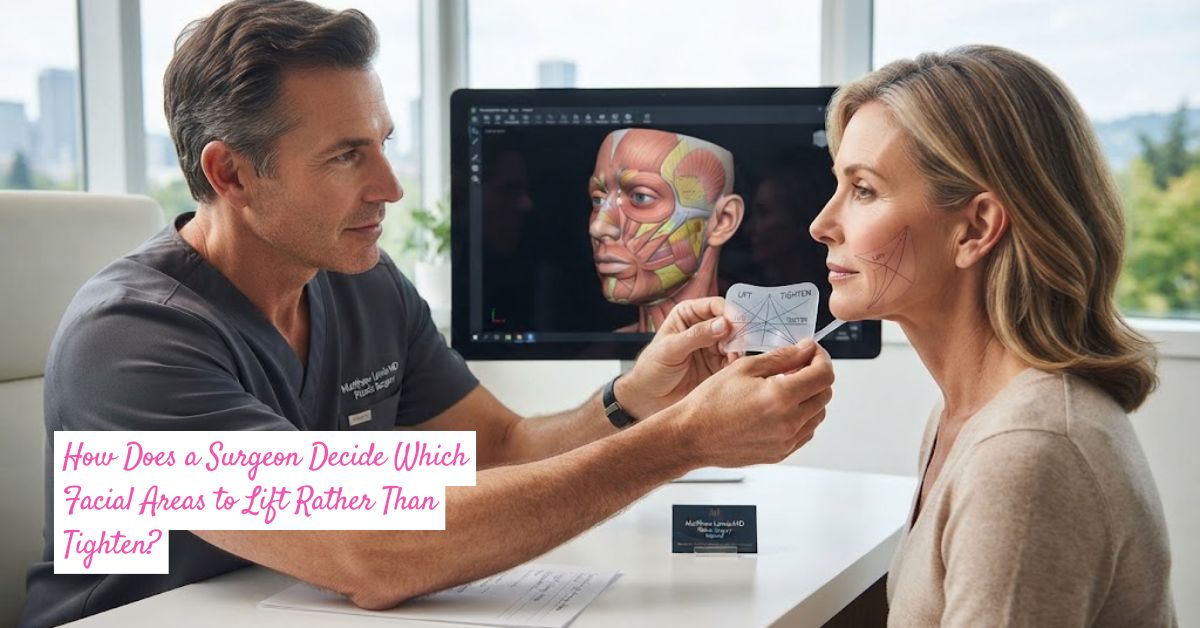
Deciding what to lift versus tighten is a hands-on assessment, not a formula. A surgeon checks how your deeper tissues have shifted, how much true skin laxity you have, where your fat pads have settled, and how your skin behaves when moved. Every face maps differently.
A facelift in Portland with someone like Matthew Lewis MD starts with that kind of reading, identifying which zones need their foundation lifted and which simply need the skin eased back into place. The surgeon treats it as a custom problem, because a plan built for one face rarely transfers cleanly to another.
Different Areas Call for Different Approaches
A face isn’t one uniform surface, so a good result rarely uses one uniform technique. The midface and jowls often need genuine lifting of the deeper layers, while other zones may mostly need the skin redraped and lightly tightened. The neck frequently has its own separate needs on top of all that.
This is why the best results look cohesive rather than pulled. The surgeon is making dozens of small, area-by-area decisions about depth and tension, blending them so the whole face moves together naturally. Get that mix right and nobody can point to what you had done. They just see you, rested. That seamless, area-by-area blending is the real craft of the whole procedure.
The Bottom Line
A facelift isn’t a single act of tightening. It’s a series of judgment calls about which parts of your face need their deeper foundation lifted and which need the skin gently redraped, all balanced so the result looks natural.
That balance can’t be read off a chart, which is why the in-person assessment matters so much. A skilled surgeon earns the result in the planning, long before the first incision, by deciding exactly what to lift and what to leave alone.