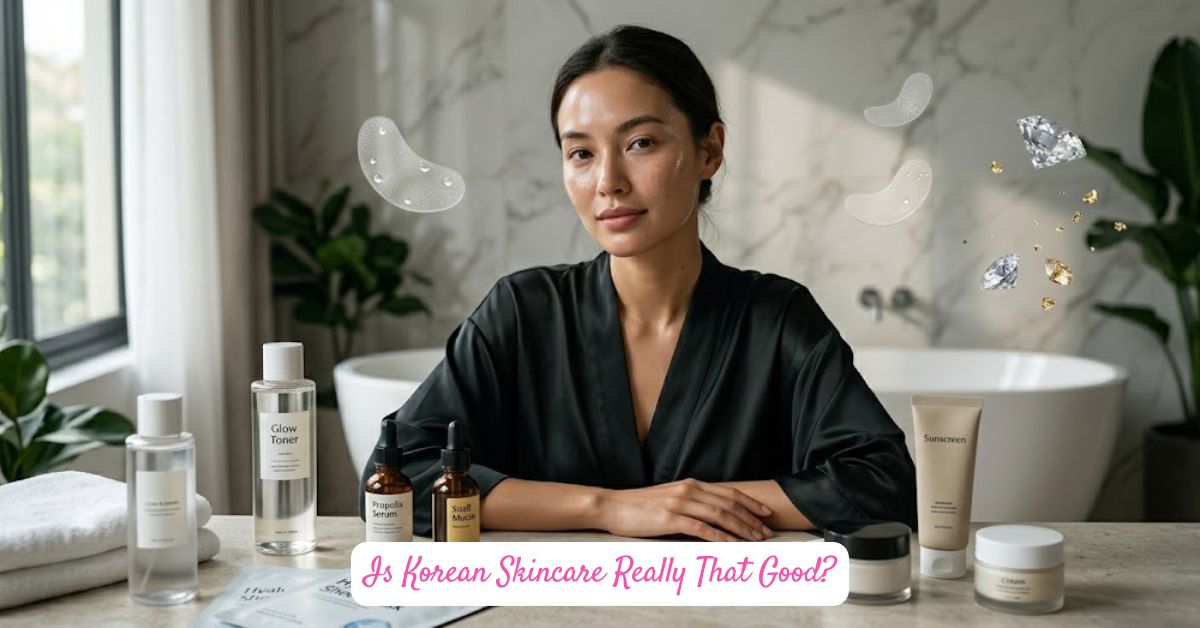
Okay, I will tell you the truth as it is since that is how we do things at itismandystyle. All people and their mamma have been rubbing Korean skincare products as they are liquid gold, and, frankly speaking, I have been riding the wave. However, in the recent past, I started wondering: is Korean skincare really that good, or have we all just fallen for some seriously effective marketing? Thing is that I have spent the past few years trying snail mucin, fermented rice water, and I have a few thoughts. Real thoughts. None of that which you find on those Instagram posts where everything is life changing and miraculous and all is the way it should be. I’m talking about the messy, honest truth about whether Korean skincare really that good or if we’ve all been collectively gaslit into a 10-step routine we don’t actually need.
The Hype Machine That Never Stops
Let’s rewind for a second. Korean skincare has become known to the Western beauty industry around the mid-2010s, and it promised ideas that sounded almost too good to be true. Glass skin. Poreless complexion. That fresh light that causes you to always appear like you are always being shone through by golden hour light. Famous people, such as Emma Stone or Alicia Keys, began discussing their K-beauty products, and overnight everyone was searching Google at 2 AM to find out what the essence was versus a serum. But here’s what nobody talks about: the reason Korean skincare really that good became the reason why such a question is so common is that the industry excels at the art of desire creation. I do not mean that the products do not work, many of them do in fact, but the genius behind the marketing of K-beauty is working on an entirely new level. They have made skincare a ritual, a way of life, close to a religion. And we bought it. Literally.
What Actually Makes Korean Skincare Different
Ok, I should give credit where credit was due. The Korean skincare producers have indeed been innovative in a manner that the western skincare companies took years to follow suit. They pioneered on various fronts, and that is something to consider.
The Ingredient Innovation Game
Korean beauty companies have not been afraid of using weird ingredients that are weird to hear but in reality, they are scientifically supported. When Western skincare remained fixated on the use of retinol and vitamin C (which is not a bad thing), Korean skincare was developing centella asiatica, propolis, birch sap, and, lastly, snail secretion filtrate. Scientific output of South Korean universities and laboratories has been rightfully impressive. However, my critical opinion is as follows: because an ingredient sounds exotic does not necessarily mean that it is better. I have tried items with glitzy fermented ingredients which did not do anything to my skin and I have also tried simple Korean items with simple ingredients which have changed my complexion. The innovation itself is a fact, and it cannot guarantee outcomes.
The Texture Revolution
The one area, which I will unambiguously award Korean skincare, is the texture. These are products that are unbelievable on your skin. It is the lightfulness of the essences, the springy gel creams, the silky serums, Korean brands comprehend that skincare must be something one enjoys, not an obligation. This is not only luxury but it is actually intelligent making, since when you are using products that are feeling good then there is more likely an increase in the use of the products on a regular basis. Western brands, by no means, have left notes. By 2026, there will be much more American and European companies emulating these kinds of textures, but Korea was doing it first and in most cases, doing it better.
The 10-Step Routine: Necessary or Nonsense?
We should mention the elephant in the room the notorious 10-step Korean skincare procedure that left everyone feeling inferior in their cleanse-and-moisturize scenario. You are aware of the one: oil cleanser, water-based cleanser, exfoliator, toner, essence, serum, sheet mask, eye cream, moisturizer and sunscreen. I’ve tried it. I’ve lived it. And I’m here to tell you that is Korean skincare really that good often depends on whether you’re willing to commit to this level of complexity.
The Reality Check
Majority of the dermatologists will inform you that you do not need 10 steps. Dr. Sandra Lee (no, it is Dr. Pimple Popper) has already indicated more than once that a basic routine using good products is superior to an elaborate routine using mediocre ones. And with true reason, I say, after years of trial, I agree. My skin feels the best when I reduced my steps to five or six steps which actually suit my issues. However, there is a twist here: Korean technique of piling light products, in fact, may be rather productive than coating one heavy cream and closing the case. Not the amount of steps but rather the knowledge of what you need in your skin and what you do to satisfy those needs in a systematic way.
The Price Point Paradox
Accessibility has been considered as one of the largest attractions of Korean skincare. You can see a complete routine that you would spend on one La Mer moisturizer. The brands such as COSRX, Some By Mi, and Isntree produce efficient products with prices that do not demand selling a kidney. This has been a real revolution in the democratization of good skincare. Nevertheless, and this is significant, the luxury Korean skincare market has gone on a blast. Sulwhasoo, Whoo and Amorepacific all have brands that are priced just as much as any luxury brand in the west. So when people ask is Korean skincare really that good, the response to this is in part dependent on the level of products we are talking about. The snail cream may be wonderful at 15 dollars, however, this does not make the 300 dollar ginseng serum ten times better.
The Cultural Context We’re Missing
One thing that is not discussed enough here is that Korean skincare is in a certain cultural framework which focuses on skincare not simply as a cosmetic but also as a form of preventive care. To Koreans, it is common to begin having serious skincare routines when one is in teens. Skin issues are destigmatized to a smaller degree and more focus on maintenance and less on drastic change. When we import such goods without having that context we fail to get the point. Korean skincare really that good when used as part of a consistent, prevention of skin health in the long term. It is not as efficient when you are hoping to see miracle results overnight or when you are not taking it regularly.
What’s Actually Worth The Hype in 2026
I would like to decompose what is actually good about Korean skincare vs. what is hyped, both on personal experience and science at large.
The Winners
The definite triumph of Korean skincare is sunscreens. It is light-years superior to most of the Western formulations–no white cast, no piling, graceful textures that do not make you feel as though you were in armor. The brands such as Beauty of Joseon, Isntree and Round Lab are competing with it to death. Take the sunscreen strategy, should you borrow nothing more of K-beauty. The other category in which Korean products are top performing is hydrating toners and essences. The hydration layers preceding moisturization have indeed led to the enhancement of the appearance and feeling of skin of many individuals. Good products with such ingredients as hyaluronic acid, beta-glucan, and rice extract have been developed.
The Overhyped
I am sorry to say that sheet masks are, in fact, predominately marketing. They are awesome, they are entertaining, good selfies, however, the long-term advantage is only a minor one in comparison to leave-on products. It is better to invest in a good serum. The technology of cushion foundations was also revolutionary at the time of launch, however, in 2026 the technology has been replicated by Western brands, and most people are discovering that cushions are not necessarily more hygienic than regular compacts, when they are not being replaced as frequently.
The Sustainability Question Nobody’s Asking
Continuing well into 2026, we must discuss something that the K-beauty community has not been eager to discuss, namely, sustainability. The volume of packaging that is linked to a standard Korean skincare routine is appalling. Single sheet masks in plastic wrappings, adorable but wasteful packaging of products, the frequent introduction of limited-edition products that set off a sense of overconsumption, it is a problem. It is something that some Korean brands are beginning to deal with. Such brands as Round Lab and I’m From are working towards the direction of sustainability, but it is not the industry standard yet. So when considering is Korean skincare really that good, we might need to expand our definition of “good” to include environmental impact.
My Honest Verdict After Years of Testing
So after all this, is Korean skincare really that good? The truth is not cut and dry, as it is not appealing but it is the truth. It is true that Korean skincare has brought positive change to the industry. It is its emphasis on mild ingredients, its innovation in the formula, its emphasis on prevention and not correction, all these are useful additions. A lot of the products that are available in Korea can be of great quality and at affordable prices and other formulations are really better than the Western versions. However, it is not magic and not always better than any other skincare. Certain Korean products are hypermarketed. Others are also composed using fragrances and essential oils which are irritating. And the cultural fixation on the quest to be finding perfect skin via expensive and intricate practices may be tiring and even counterproductive.
Building Your Actually Good Routine
My suggestion to 2026 would be to cherry pick what works. I do not mean that you should become an all-Korean person and apply all of the steps of your routine with some K-beauty standards and products, but some principles and products can actually do a great job on your skin. Begin with sunscreen – trust me Korean sunscreens are worth the money. Added hydrating toner in case your skin is tight and dry. You can have a well-met essence in case you need the additional boost of hydration. However, also do not be pressured to completely change your routine or purchase items simply because it is fashionable. Hear yourself, not Instagram. The skin of some people is fond of snail mucin; of others it breaks out. There are those individuals who require the 10-step routine, and there are those who perform better with four products. The most effective skincare is the one that you will engage in regularly. When we ask is Korean skincare really that good, this may be the wrong question to ask. We need to be posing the question instead as: what Korean skincare products are best able to address my particular skin concerns, and how do these perform in comparison to other options that I can have? It is far better as a framework than accepting generalized statements on the beauty industry of a whole country. The Korean skincare wave has in a way permanently altered the way we think of skin care, and that is mostly a good thing. However, how about taking some critical thought and cushion compacts and essences with us in the future. Your skin is worth better than the fashionable merchandise.