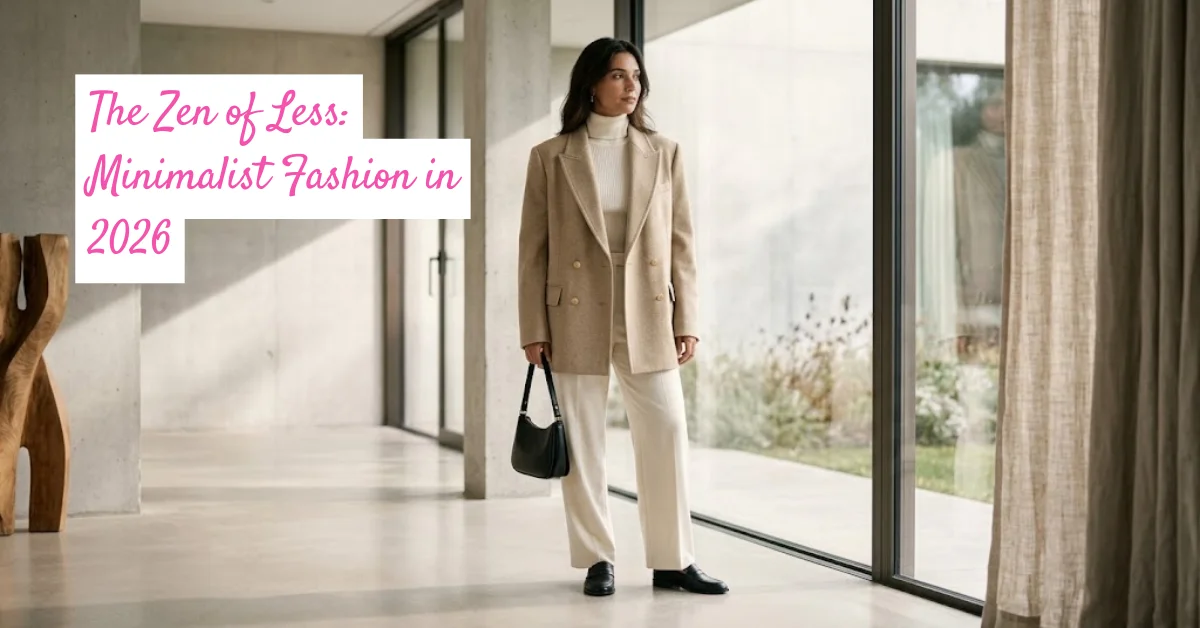
Where Simplicity Meets Sustainability: The Ultimate Guide to Minimalist Style in 2026
Minimalist fashion establishes its presence during times when everything else in the world keeps spinning. It breathes. It whispers rather than shouts.
In 2026 minimalist fashion moves from receiving occasional moments to initiating a true movement. The previous era of minimalism consisted mainly of unappealing beige designs and blank storage spaces. The modern minimalist aesthetic is both deep in meaning and dense in material texture along with personal design elements.
The purpose of minimalism is not to own nothing but to own everything that holds value. Closets today are more than storage spaces because they present a masterful selection of items that share significant meaning while needing no words for interpretation.
Minimalism started as an opposition to extravagance but evolved into an elegant approach which unites the art of presentation with responsible choices. The modern landscape of mindful buying decisions asks people to move away from simple trend inquiries but rather “What will endure?” The luxury of our time emerges from the combination between enduring design elements and innovative approaches which can be found both in Parisian runway fashion developments and Tokyo streetwear.
The Neo-Minimalist Palette: Beyond Beige
The color spectrum of minimalist fashion in 2026 has undergone considerable evolution in a wise manner. The unifying components of minimalist clothing consist of neutrals yet the color spectrum now moves past usual shades of white, black, and beige. Designers now describe sophisticated neutrals as “complex neutrals” which combine evasive color classification with the defining flexibility of minimalist style.
Aesence takes the lead through their color collections which combine muted jewel shades with basic neutral items. The “Depth of Field” collection from the brand features “midnight navy” alongside the rich green shade “forest floor.” COS maintains their minimalist aesthetic with their “architectural colors,” which give new depth to their minimalistic designs.
Complex neutrals develop magic by producing monochromatic outfits which remain interesting through their depth of subtle variations while avoiding visual chaos.
The Art of the Perfect Cut: Silhouettes That Speak
Minimalist fashion styles of 2026 rely on perfect construction techniques along with original cut designs. The main interest now lies in building structures rather than dressing for ornament. A single precise placement of seams or darts manipulates the total character of contemporary minimalist costumes today.
UNIQLO U showcases “Constructed Simplicity” through a collection led by designer Christophe Lemaire that displays ingenious design only after specific body movement reveals it. The label creates elegant shirt drapes with subtle shoulder drops using large poplin cotton shirts, and implements elastic elements within wool-blend pants to achieve comfort and clean line maintenance.
The new label Bonded gained attention through its minimalist outerwear concept, which utilizes technical fabric materials to maintain elegant natural forms without requiring any hardware. Their “Winter Light” puffer jackets maintain heat without extra bulk by using air chambers which naturally mold to the body shape.
Tactile Minimalism: The Importance of Texture
In 2026 minimalist design has overcome the sleek yet sterile design elements which characterized past interpretations. Textural innovation within the fashion industry led to the development of “sensory minimalism,” which integrates clothing touch details with visual appeal.
The Row implements this concept by uniting diverse weights of the same material to produce soft texture transitions across a single garment. Their cashmere collection includes ribbed sleeves applied to otherwise plain knitted sweaters to create visual effect through material structure.
Filippa K introduced their “textile landscapes” through which they combine different fabric textures in unified-color patchwork designs. Their best-selling “Terrain” coat uses matte and glossy panels of single navy wool to generate textural illumination through movement.
Everlane focused on texture through their “Touch First” program, making fabric quality equal to visual presentation. Their waffle-knit cotton pieces and sanded silk tops show how textural minimalist design can become affordable at multiple price points.
Smart Investment: The Economics of Minimalist Wardrobes
The 2026 minimalist fashion revolution exposes deep transformations in people’s approaches to buying consumer goods. The changing market dynamics created what economists label the “high-value, low-volume” fashion buying system, since consumers focus their spending on fewer, higher-quality pieces.
Statistics reveal that the typical American bought about 68 garments annually in 2020, yet minimalist purchasers in 2026 consume only 15 items per year while maintaining similar financial expenditure levels.
Cuyana follows their “Fewer Better Things” philosophy to build their entire business model around enduring, versatile clothes. Their “System Dress” illustrates minimalist fashion value by allowing one piece to transform into seven different looks. Vetta reshaped the capsule wardrobe sector through five-piece collections that generate 30 possible outfits, reducing cost-per-wear to unprecedented numbers.
Jil Sander demonstrates luxury adaptation by launching “Investment Pieces,” which provides lifetime repairs for their core collection items, because 2026 luxury stands for enduring quality instead of perpetual replacement.
Suitcase Minimalism: The Rise of the Integrated Wardrobe
Minimalist fashion has migrated toward integrating all types of clothing within a singular cohesive collection heading into 2026. The “integrated wardrobe” philosophy emerges from the disappearance of traditional categorization into workwear, weekend clothing, formal outfits, and travel garments.
Away from Home developed the “Anywhere” collection, which provides clothing for various environmental conditions and settings. The Transit Trouser stands out through technical materials that stay smooth and regulate temperature, fitting business events alongside leisure exploration.
Aday built their brand identity around “technical clothing for everyday adventures.” Their Something Borrowed shirt functions as a work-ready piece that becomes suitable for dinner dates and yoga practice, thanks to stretchy, breathable fabric that stays crisp through wear and washing.
The 2026 consumer approaches clothing selection through performance-based criteria before worrying about specific use events, seeking actual fashion unicorns that work anywhere.
Digital Detox: Minimalism as Visual Rest
Minimalist fashion in 2026 functions unexpectedly as a sight-saving mechanism against digital screen overload and social media bombardment. Fashion psychologists observe an increasing relationship between screen usage and people choosing minimal, streamlined designs — what they’ve labeled “visual rest.”
Deiji Studios developed their brand to function as sanctuary-based attire, using natural materials and clean shapes that deliver nervous system relaxation both visually and through physical contact. Their “Digital Sabbath” collection combines natural fabrics with basic shapes to relax viewers’ visual perceptions.
Studio Nicholson has adopted “reduction as luxury,” removing every element from their designs that fails to enhance function or comfort. Their White Space concept emphasizes breathing room and emptiness through a monochromatic approach with generous cuts.
Technological Minimalism: Innovation Without Distraction
The new technological minimalism doesn’t push wearable tech forward through gadget features. Instead it integrates sophisticated capabilities directly into clothing through designs that preserve a clean, unfussy appearance — sometimes called “quiet tech.”
Ministry of Supply’s Invisible Performance collection utilizes NASA-derived temperature-controlling features, allowing lightweight wool blazers to maintain comfort without visible ventilation. Lululemon’s “Tech Minimalism” series integrates compression features while retaining a minimalist appearance. Universal Standard’s “Responsive Fabric” modifies insulation level depending on body heat and external factors, keeping people comfortable without additional layers.
The New Face of Luxury: Minimalism at the Highest End
The luxury fashion industry of 2026 has transformed through minimalist concepts, promoting self-restraint and craftsmanship over brand visibility. Industry experts term this the “maturation of luxury,” where exclusivity is communicated through product quality, durability, and refined details that only an educated consumer notices.
Hermès’s “Essential Luxury” collection elevates the brand’s fundamentals through perfectly made basics using rare materials with no ostentatious detail. Their double-faced cashmere coats depend entirely on perfect drape and nearly invisible seams.
Bottega Veneta’s creative director Matthieu Blazy has maintained a “quiet luxury” direction, designing clothing that expresses itself without shouting for attention. Peter Do’s entry into the category proves that restrained design can deliver luxury appeal equal to grand-scale display, through perfect proportions and expert fabric development instead of decoration.
Minimalism for All: Democratizing Simplified Style
Minimalist fashion in 2026 has become accessible across price ranges and body types — what sociologists now call “inclusive minimalism.”
H&M’s “Everyday Edition” line provides well-designed minimalist basics for body types from XXS to 4XL. Universal Standard’s “Foundation” collection features architectural designs across sizes 00-40 with equal attention to detail regardless of size. Reformation’s “Considered Design” program shows sustainability-focused fashion can match minimal aesthetics with affordable pricing.
These interpretations maintain a shared commitment to quality over quantity and purposeful buying while applying it across different budgets, making minimalism a flexible framework rather than a single standard style.
Cultivating the Minimalist Mindset: Beyond Clothing
Minimalist fashion in 2026 represents a broader shift in how people think about buying behavior and identity. Lifestyle philosophers describe this “minimalist mindset” as decision-making through intention rather than impulse, choosing quality over quantity, and expressing personality instead of following trends.
The Thoughtful Dresser produces educational content about “wardrobe intelligence,” training consumers to understand their needs and assess quality and value. Vestibule Collective, er, Vestaire Collective features minimalist thought leaders through their “Wardrobe Wisdom” series. Nordstrom’s “Considered Shop” program selects products with improved lifecycles and offers repairs to extend garment life.
As one consultant summarized it, minimalism goes beyond deprivation to become an art of assembling appropriate items. Not emptiness, but clarity.
Minimalism’s Next Chapter: Looking Forward
Minimalist fashion shows no signs of disappearing, since it continuously adapts to cultural, environmental, and technological shifts. Fashion futurists see hybrid aesthetics ahead, combining essential concepts with emerging needs and values.
Christy Dawn leads through regenerative design, applying regenerative farming and circular production to create apparel that benefits ecosystems while limiting environmental damage. Their “Farm-to-Closet” program lets farmers grow fiber crops that enhance soil health while creating minimalist wardrobe essentials.
Modern Meadow uses bio-technology to make adaptive leathers and textiles, potentially enabling garments that shift to fit multiple environments, reducing the need for diversified closets. Meanwhile, identity expression shifting to digital spaces may produce a “post-statement” fashion trend, where physical clothing turns increasingly minimalist while experimental digital fashion carries the statement-making instead.
As one design philosopher put it, minimalism exists beyond trends because it addresses basic human needs for clarity and purpose during times of global chaos.