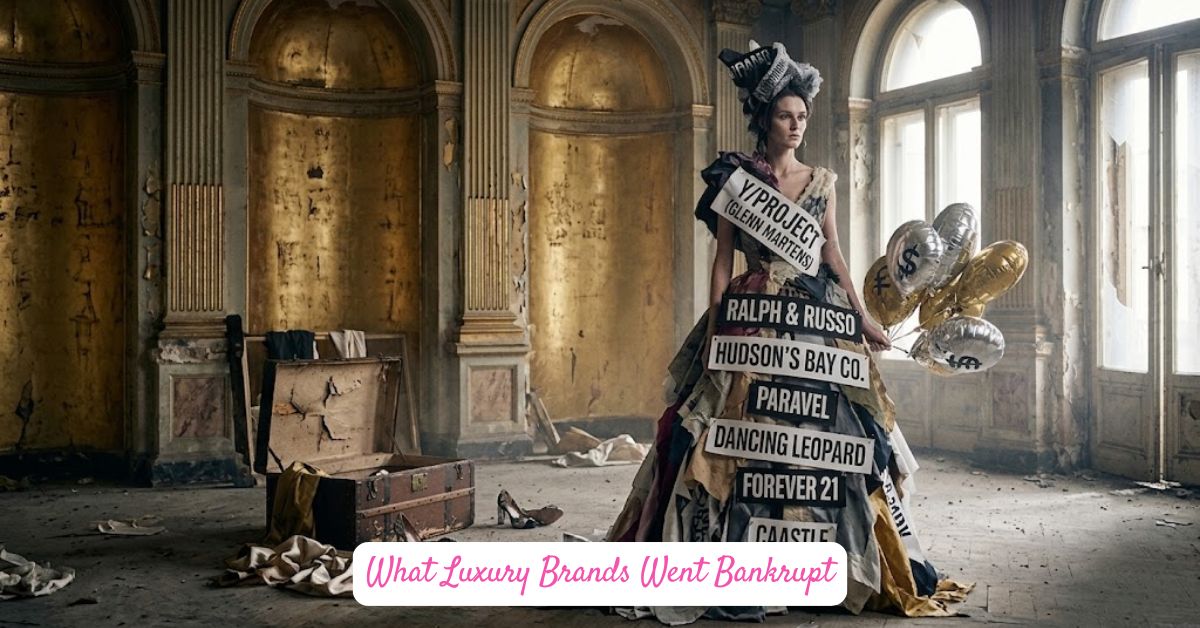
To begin with, let’s set the record straight; money cannot buy you immortality, either in life or in fashion, and especially not by putting your name on a $900 leather card case; the fashion and beauty industries have spent decades creating a myth that luxury has no boundaries; a brand with enough history, prestige, or advertising budgets automatically cannot fail. But 2024 happened, then 2025 really happened and finally 2026 walked in like it knew something we did not. There are a number of luxury brands that have gone bankrupt over the last two years, and
So, this is not an article written purely for gloating, but rather provides an in-depth analysis of how and why the luxury market has collapsed, which provides us with insight into what the future holds for luxury.
The Luxury World Was Already Cracking Before the Avalanche
Before we begin discussing who the various players in the luxury market are, let’s first establish a bit of backstory. The global luxury market has continued to grow for several years due in part to aggressive price increases, aspirational marketing to millennials and Gen-Z, and the post-pandemic’s “Revenge Spending Boom” which led people to feel they could engage in spending sprees until the end of time. Spoiler alert- they couldn’t. By 2024 and on into 2025, Chinese consumers, who have comprised the vast majority of global luxury sales, all of a sudden decided not to spend money on luxury goods.As American consumers feel the strain of inflation along with shrinking savings they are beginning to reconsider if spending $1200 on a tote bag is worth it or if it would be an expensive mistake? European consumers are also being more cautious about their purchases too.
So where we started to see cracks in the marketplace? The reasons include: Too many places trying to sell luxury goods, the amount of debt which has been added to retail through leveraged buyouts by private equity firms, weak sales at traditional brick and mortar retailers, and the rise of online resale of luxury items due to a generation of consumers who can see right through the fakes. All these reasons led us to the point where we can see many luxury brands begin to fall.
Matchesfashion , 2024
Matchesfashion At one point, if you were a “fashionista” on the internet during the early 2010’s you would have purchased all your designer items from Matchesfashion, an online luxury retailer that was originally acquired by Apax Partners in 2017. After being acquired, the company began to aggressively expand its product categories, international presence, and open its first physical location (townhouse concept) in London. This expansion was occurring as the company continued to lose money on a monthly basis, with no end in sight.
Unfortunately, dependant on the acquisition under Apax Partners, Matchesfashion was placed into administration in late 2023 due to lack of working capital. Shortly thereafter, Frasers Group (Mike Ashley) purchased Matchesfashion from administration while hoping to revive the business. A month later in March 2024 Frasers Group shut down Matchesfashion entirely. The website was no longer active with the only communication to brand partners being the company going out of business. Hundreds of designers that had designers that had inventory on hand were left in shock and scrambling to find answers with their respective administrators. For example, one of Matchesfashion’s designers (Cecilie Bahnsen) expressed publicly how difficult it was to retrieve her product and other outstanding payments.
Ted Baker , 2024
So what led to this demise? The “classic” private equity playbook – an acquisition with too much debt, scaling before solidifying the company, not having a clear plan to become profitable and their plan to exit was more of a “wish” rather than a plan.
Since Ted Baker had once been the brand to wear to graduation by way of your super cool older relative, many witty British people had grown to love the brand; it had a very loyal customer base, even with its somewhat unconventional pero polished look. However, it all started to come undone over time in the manner of all great disasters.
As of March 2024, Ted Baker’s operations within the UK entered into administration. As of April 2024, Ted Baker Canada filed for bankruptcy protection through the Canadian Companies’ Creditors Arrangement Act and the US arm had filed for Chapter 15 protection. As a result, all retail outlets in North America were closed. The company incurred a net loss of approximately $11.3 million in the prior 11 months leading into its US filing, with a negative cash flow of more than $5 million only in the first two months of 2024.
In 2022, Authentic Brands Group acquired Ted Baker for approximately $253.5 million; the firm owns its intellectual property.There are no more stores, no magic, only a name that has little chance to avoid the land of the forgotten through licensing in the coming years.
Y/Project , 2025
One of the biggest shocks of 2025 was Y/Project, founded in Paris by Glenn Martens. This was truly one of the most innovative and exciting brands in both menswear and womenswear. The brand specialized in denim manipulation and deconstructed tailoring to such an extent that it was creating excitement for design students everywhere. After 14 years of being in business, Y/Project announced in early 2025 that it could not find new ownership and would cease operations. The brand’s official statement stated that they had to make the “difficult decision to stop operations” as the company was unable to locate new owners.
There was no dramatic bankruptcy announcement; instead, Y/Project had a very quiet, painful exit from the fashion world. The brand had many A-list celebrities on its roster and received a great deal of critical acclaim. The company’s demise came not with a boom but with an Instagram post and silence. This highlights an important point: it takes more than creativity to create and maintain a business. Creating solid designs are two separate things, and the fashion industry continues to struggle to tie them together.
Ralph & Russo , 2025 (Second Insolvency)
Ralph & Russo also filed for insolvency for the second time in three years in April 2025. The London-based haute couture house is perhaps best known as the brand Meghan Markle wore to her engagement announcement.The first brand to suffer was Elie Saab when COVID all but obliterated the desire to buy couture dresses or tuxedos to wear while attending black-tie events. By then, the creative assets had been acquired, and the brand was on a path to relaunch. However, by five years later (2025), the relaunch had failed, and the company found itself right back where it started, metaphorically speaking , at the courthouse and undergoing bankruptcy proceedings again.
There is something almost poetic yet quite tragic about a company that has outfitted royals being unable to create an economically viable business for a second time. It demonstrates to us that while prestige is plentiful, that alone does not equate to a sound financial model; rather it is simply a very expensive stage performance.
SSENSE , 2025
ssense was expected to be the “Next Big Thing.” Located in Montreal, Canada, the small luxury ecommerce retailer started by the Atallah brothers has been estimated to be valued at over $3.6 billion following a $57 million investment from Sequoia Capital (2021). It was positioned as a provider of “cool,” thoughtfully curated, completely digital-first merchandise for the fashion-savvy consumer who wanted immediate access to “real” designer brands without ever stepping foot inside a department store. Then came 2025 with a myriad of chaos that’s typically associated with wealth , or lack thereof , and you have a situation that ultimately led to the demise of ssense.
On August 3, 2025, ssense filed for protection under Canada’s Companies’ Creditors Arrangement Act for the purpose of restructuring its operations and avoiding immediate liquidation of assets. Many of the emerging indie brands that had forged a true relationship with the ssense platform experienced significant negative financial consequences as they absorbed far more costs than they could reasonably sustain.
Pat McGrath Labs , 2026
This is the situation that rocked the world and rightly so. The makeup artist who arguably possesses the most creative genius of anyone in the industry and whose products fundamentally altered how we look at beauty was involved in this bankruptcy filing. Pat McGrath launched her brand in 2015; however, her established marketing strategy using social media created such excitement for her products that Gen-Xers could hardly wait to buy them. It is an example of where a brilliant person could turn their passion into a lasting and viable business.
However, on January 22, 2026, Pat McGrath Labs filed for Chapter 11 bankruptcy protection in the US Bankruptcy Court in South Florida and has more than $50 million in liabilities after representing that $10 million in debtor in possession finance from GDA LUMA was already secured to allow for restructuring. Also by 2026, GDA LUMA had promised at least $20 million in additional post-emergence working capital for Pat McGrath Labs after it successfully completed its Chapter 11 exit. At the conclusion of the bankruptcy case, Pat McGrath will become GDA LUMA’s controlling share of the company while still remaining Chief Creative Officer of her brand and one of its largest shareholders.
Saks Global , 2026
On January 14,2026, Saks Global, the parent company of Saks Fifth Avenue, Neiman Marcus and Bergdorf Goodman, filed for Chapter 11 (bankruptcy protection), resulting in a lot of shock and awe through all of the retailing community since these are NOT your normal “niche” brand companies, these are all large-scale businesses recognized all across America as official types of luxury retailers (culturally synonymous with luxury retail in the USA for over 100 years). The fact that Saks has gone bankrupt is indicative of how severely large retailers are failing when they get overly leveraged by way of debt, and being that Neiman Marcus’s $2.7 billion purchase by Saks was dangerously leveraged at best (particularly considering both stores were already struggling), it’s simply not surprising that it came to this point as both stores would not likely produce any profit after combining neither one alone was producing any profits before they combined.
Boris Bidjan Saberi , 2025
Less known to mainstream audiences but iconic in avant-garde fashion circles, the German designer Boris Bidjan Saberi shuttered his label in 2025. His brand was associated with a deeply technical, almost ritualistic approach to garment construction , the kind of design that attracted a cult following but struggled to scale commercially. The closure was quiet, as many of these are in the independent designer space. No dramatic press releases, just the slow disappearance of a name that had meant something real to a specific corner of the fashion world.
What Does All of This Actually Mean?
Boris Bidjan Saberi, a major player in avant-garde fashion, is unfortunately just one more high-profile designer and brand that shut his business down in 2025, having been well-known in the more experimental and creative side of fashion but not all that mainstream to date unfortunately.The founder’s label was recognised as having an extreme connection to the deeper technicality of the way that clothing was produced. His designs became known for their almost ritualistic methodologies which would attract many for their uniqueness but could not be readily or easily emulated on a greater scale in the commercial marketplace. The brand went out of business with very little press, as most independent designers do when they stop selling. That it no longer exists is not the loss of a landmark designer label; rather, the brand had carved itself out as a particular niche part of the greater fashion industry but is now done with.
The Real Verdict
Luxury brands that have declared bankruptcy over the last couple of years did not go bankrupt solely due to economic factors. The way these brands’ businesses were run by their owners demonstrated that they could no longer show adequate regard for the basic rules of running a business. Debts are debts whether they are incurred through the production of runway shows or from the opening of retail locations. A consumer’s obligation to support the brands that created their loyalty has been eliminated. An Instagram aesthetic is not an adequate substitute for a functioning supply chain.
While there are positives to be found in the current marketplace, the reality is that opportunities are being created where independent designers that have unique perspectives, sustainable models of production, and communities that genuinely believe in what they are building now exist , these brands should receive the inheritances from the bankrupt luxury brands. The myth of luxury is not over; rather it needs to be rebuilt through people who understand that exclusive brands with lack of integrity are expensive, mediocre products.
Honest truth? I have had enough.