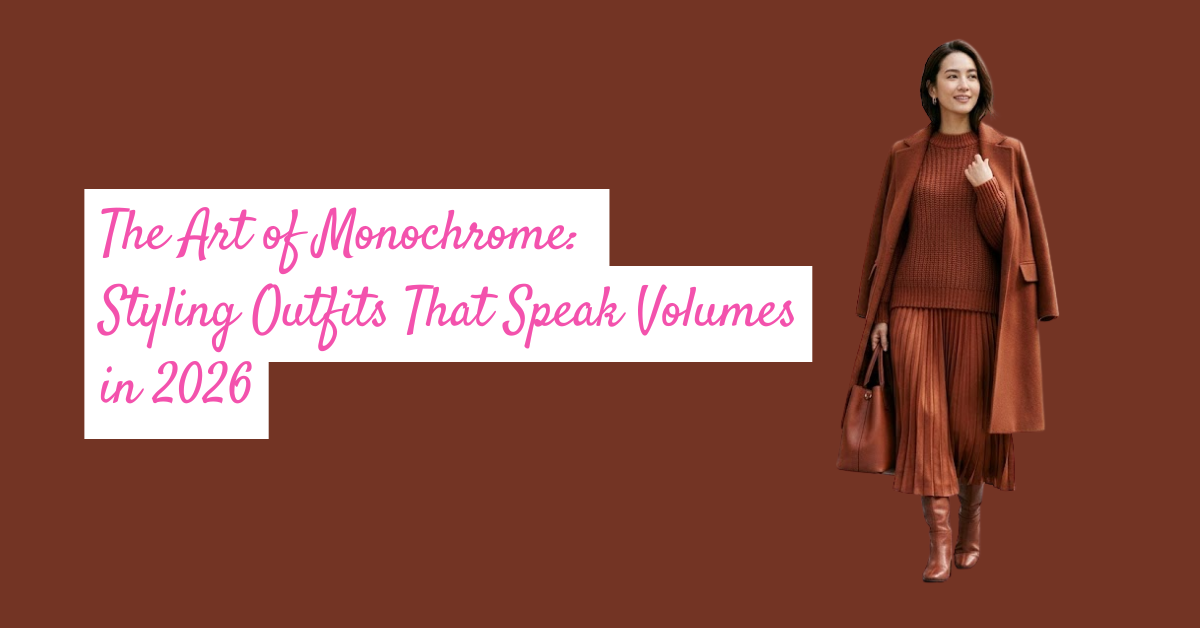
In a world bursting with color, sometimes it’s the absence of it that makes the boldest statement. Monochrome outfits have transcended from being a minimalist choice to becoming a powerful expression of sophisticated style consciousness.
As we navigate through 2026, the monochromatic trend has evolved into something more nuanced, more intentional, and infinitely more versatile than ever before. Gone are the days when wearing one color meant playing it safe today, it’s about making a deliberate choice to stand out by embracing uniformity with a twist.
The beauty of monochrome lies in its deceptive simplicity. What appears straightforward at first glance reveals itself to be a masterclass in texture, proportion, and subtle variation.
Understanding the Monochrome Philosophy in 2026
Monochrome dressing in 2026 has evolved beyond the basic concept of wearing a single color from head to toe. Today’s approach embraces a more nuanced understanding of color theory, where monochrome encompasses not just identical shades but a thoughtful gradient within the same color family.
The neo-monochrome philosophy celebrates the subtle differences between a powder blue button-up and a navy tailored trouser, recognizing that these variations create depth while maintaining harmony.
The Psychology Behind It
The psychological impact of monochrome has gained newfound appreciation in our hyper-stimulated digital age. This science-backed approach to wardrobe building has resonated with the wellness-conscious consumer, making monochrome dressing not just an aesthetic choice but a mindful practice.
The Foundations: Building Your Monochrome Wardrobe
Creating a monochrome wardrobe begins with understanding your personal color affinities, those shades that not only complement your skin tone but also resonate with your emotional landscape. The foundation of your monochrome collection should begin with these signature colors, with most style consultants recommending at least three distinct color families to rotate through based on your mood, the occasion, or even environmental factors like season and air quality.
Core Wardrobe Pieces
The core pieces of a versatile monochrome wardrobe balance timelessness with current silhouettes. Your foundation should include a precisely tailored outer layer, versatile bottoms in your chosen color, and layering pieces with varied textures.
Playing with Texture: The Secret Dimension of Monochrome
In the monochromatic landscape of 2026, texture has emerged as the defining element that transforms single-color dressing from flat to fascinating. The juxtaposition of different tactile experiences within the same color family creates visual interest through shadow and light interaction, giving monochrome outfits their distinctive depth.
The rise of multi-sensory fashion has introduced fabrics with unprecedented textural complexity from Loewe’s liquid metal silk that appears to ripple with movement while maintaining its matte green finish, to Issey Miyake’s further evolution of their pleating techniques, now incorporating programmable micro-pleats that can change their pattern throughout the day.
The most successful monochrome styling combines at least three distinct textures to create a complete sensory narrative.
The Shade Spectrum: Mastering Tonal Variations
The evolution of monochrome dressing in 2026 has embraced the subtle art of tonal variation working with different intensities of the same hue to create dimension and movement within a single-color outfit. This approach has been perfected by luxury houses like Valentino, whose “Tonal Immersion” technique layers up to seven distinct shades within the same color family to create outfits with remarkable visual depth.
The modern approach typically follows the 60-30-10 rule: 60% in your anchor shade, 30% in a complementary intensity, and 10% in an accent intensity that draws attention to carefully chosen details.
Accessories: The Monochrome Multipliers
In the monochrome universe of 2026, accessories have transcended their supporting role to become critical storytellers within your single-color narrative. The current approach to monochrome accessorizing follows two distinct philosophies: the “perfect match” school, which seeks accessories in the exact shade as clothing to create a seamless color immersion, and the “intentional break” approach, which uses carefully selected contrasts to create focal points within the monochrome palette.
Brands like Bottega Veneta have embraced the former with their “Color Continuity” service, which uses spectrophotometer technology to match their leather goods precisely to fabric swatches from your garments. Meanwhile, Jacquemus has pioneered the latter with their “Punctuation” accessories small, sculptural pieces designed specifically to create deliberate interruptions in monochrome outfits.
Breaking the Rules: Strategic Color Disruption
While pure monochrome creates a powerful statement, 2026’s most sophisticated stylists understand the strategic value of intentional disruption within the single-color framework. The “calculated break” technique introduces a precisely considered contrast to create focal points and guide the viewer’s eye to specific aspects of your look, following the 90/10 principle: maintaining 90% commitment to your primary color while introducing 10% of a strategic accent.
Monochrome for Every Body: Inclusive Approaches
The democratization of monochrome styling has been one of the most welcome developments of 2026, with the fashion industry finally acknowledging that single-color dressing requires thoughtful adaptation across different body types and presentations. Size-inclusive brands like Universal Standard have pioneered this approach with their “Monochrome for All” system, which subtly adjusts color placement on garments based on size to ensure the most flattering expression of single-color dressing regardless of body type.
The fluidity of contemporary fashion has embraced monochrome as a unifying approach that transcends traditional gender categories, with brands like Telfar and Eckhaus Latta creating color stories that prioritize emotional resonance over gendered associations.
Seasonal Monochrome: Adapting Single-Color Strategies Year-Round
Summer monochrome has embraced the challenge of maintaining color consistency in natural light variations, with technical innovations like Everlane’s “SunTrue” fabrics that resist the color-shifting effects of direct sunlight.
The summer monochrome palette has expanded beyond traditional whites and pastels to include saturated mid-tones that provide adequate sun protection while making a visual impact ochres, terracottas, and sage greens dominate the warm-weather monochrome landscape.
Winter monochrome has moved beyond the expected all-black ensembles to embrace rich, saturated colors that stand out against gray urban landscapes and complement the indoor lighting environments where we spend most cold-weather days.
The Future of Monochrome: Emerging Trends and Technologies
As we look beyond 2026, the evolution of monochrome styling continues to be shaped by technological innovation and shifting cultural values. The emergence of programmable pigments nano-engineered color particles that can change their light reflection properties in response to external stimuli promises to revolutionize monochrome dressing by allowing a single garment to shift between different intensities of the same color.
The deliberate restraint of monochrome has become a powerful statement against the sensory overload of contemporary life, representing a conscious choice to create visual calm in an increasingly chaotic environment. Sustainability concerns have further elevated monochrome’s relevance, as color-matching across garments creates more cohesive, versatile wardrobes that require fewer total pieces.
Express Yourself in One Color, Endless Ways
The journey through monochrome styling is ultimately a journey toward intentional self-expression. By limiting your palette, you expand your creative possibilities finding freedom within constraints and discovering that simplicity often reveals the most profound forms of sophistication.
As we navigate the complex visual landscapes of 2026, the choice to embrace monochrome represents more than a style decision. it’s a statement about how you choose to occupy visual space in a world overflowing with competing colors and messages.
Remember, in a world full of noise, sometimes speaking in a single color says everything.