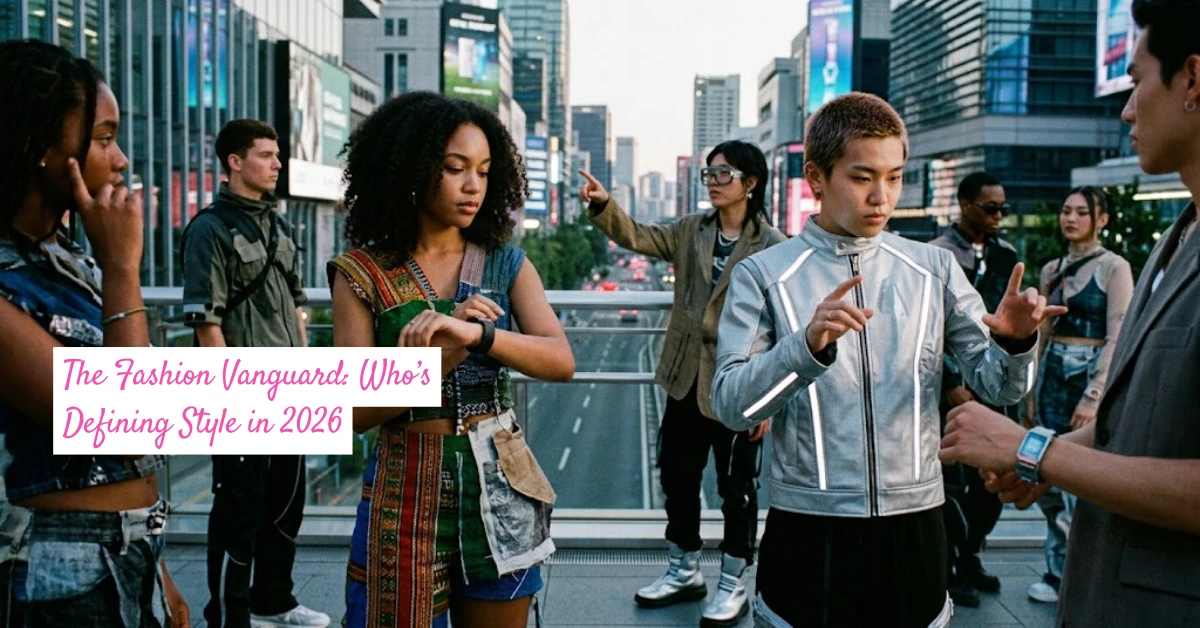
2026 is a time when fashion influencers meet kaleidoscope, where the lines between virtual and reality are increasingly blurring, where sustainability intertwines with luxury, and where authenticity is the new coin.
Since 2026’s complex fashion system was introduced, connecting diverse layers, the traditional style setting has completely disappeared.
When fashion voices are at their best in 2026, they manifest more of a product promotion; they create interactions with audiences, champion causes, team up with designers via blockchain-fueled collaborations and make sure every brand sensation feels like a real person.
The Metaverse Mavens: Digital Fashion’s New Frontier
Lila Chen: The Architect of Virtual Couture
As the top social media celebrity in digital fashion, Lila Chen left her imprint on the scene by having her avatars attend concurrent fashion weeks in the metaverse with her 30 million followers on her platform.
By combining the physical fashion world with the digital components, Chen’s “phygital” method enables the user to access virtual products after scanning physical ones in virtual environments.
Akira Yoshida: The Accessibility Revolutionary
Since his beginnings as an avatar designer in Tokyo, Akira Yoshida has emerged as the most prominent voice in the cause of accessible online fashion thanks to his creative digital style techniques.
Under the banner of “Open Source Atelier” Yoshida offers free design tools and templates that let millions of users without coding background create digital clothes which they can sell for profit.
His public stance against luxury brands is well-known because of the release of the ‘Freedom Capsule,’ free virtual items that posed a direct challenge to Gucci’s $500 virtual accessories.
The Sustainability Sovereigns: Ethical Fashion’s Leading Voices
Amara Okafor: The Supply Chain Reformer
As a former model turned movement leader, Amara Okafor uses her newfound focus to shed light on the truth about the fashion industry reality and who is doing the work, the workers who produce the clothes, their working conditions and the costs of the industry.
Launched as a hashtag to ask brands for disclosure of their supply chains, the open seams initiative is currently the largest transparency platform in the industry. Okafor establishes her credibility by a fashion design that is a blend of Nigerian traditional art and repurposed luxury goods.
Mateo Rivera: The Circular Economy Visionary
Starting from his challenge video on TikTok about no new clothes in 2022, Mateo Rivera has created a new model for men’s fashion influencing by using circular fashion across his entire platform.
His stylish “Closed Loop Collections” won him partnerships with fashion houses who wanted to promote their commitment to sustainability.
Rivera has created a digital platform, ReCircle, that has allowed 15 million people to give and receive clothing, as well as taking advantage of a mending service and upcycling workshops.
The AI Style Savants: Fashion’s Algorithm Whisperers
Jamie Park: The Personalization Pioneer
Jamie Park revolutionized fashion influencing by adapting to the AI revolution and became the most evolved model of humans and AI in the field with the “StyleDNA” method.
With AI, Park was able to move beyond the making of source materials and collaborate with DALL-E 4 Fashion to produce style collections surpassing the conceptual capacity of human designers.
Sofia Mendez: The Pattern Recognition Expert
The unorthodox combination of data visualization and predictive modeling enabled Sofia Mendez to grow from data analyst into a visionary fashion oracle.
Her forecasting approach leverages upon large volumes of information such as social media sentiment and economic indicators, climate data and cultural events to anticipate fashion trends before other industry players.
The Cultural Connectors: Fashion’s Boundary Breakers
Kwame Addo: The Afrofuturist Visionary
A video about the visionary Kwame Addo, also known as the Afrofuturist.A video about Afrofuturist Kwame Addo.
By pairing West African textiles with cutting-edge fashion designs and adding technology to textiles, designer and content creator Kwame Addo built a new aesthetic that now has a major impact on every tier of the fashion industry.
His “Techno-Kente” approach challenges the definition of luxury for the contemporary consumer, who values design innovation and cultural value in his smart textiles, traditional weaving techniques, and parametric structures.
He was the first African-American male to hold the position of creative director at a major luxury brand, paving the way for a new era of fashion leadership.
Mei Zhang: The East-West Cultural Translator
As a fashion expert, Mei Zhang becomes the most refined intercultural bridge between eastern design values and global fashion trends and changes the discourse on intercultural exchange.
This “Context & Couture” documentary series is a must-have for students and designers studying and designing with responsible cultural use of elements from East Asia to the global fashion of today.
The Body Politics Pioneers: Redefining Beauty Standards
Alex Winters: The Gender Fluidity Icon
Alex Winters is a cultural icon and a break-the-rules-of-menswear, no longer an indie model, but rather a break-the-gender-norms-in-fashion phenomenon.
The “Fitting Room” campaign, organized by Winters to combat against shoppers being discriminated against within retail stores, resulted in the change of store organisation for many major retail companies from gender-based to product-based store organisation.
Leila Bahar: The Size Inclusivity Advocate
Leila Bahar is the most vocal champion for inclusive sizing in fashion, thanks to her visionary approaches to redefining sizing. In her effort to “Beyond Sample Size”, Bahar provided technical resources to designers to alleviate their problems with long sizing.
When she started to reject walking the catwalk for brands that didn’t have her size in their retail lines, she set new standards for actual representation.
The New Media Mavericks: Redefining Fashion Content
Sasha Nová: The Immersive Content Creator
Sasha Nová transformed fashion media by taking it away from passivity and into the realm of immersive media. The Dimensional Fashion” approach she uses in her work is a fusion of spatial audio, haptic feedback and scent technology, creating a fully immersive fashion presentation.
Jordan Ellis: The Long-Form Renaissance Leader
Jordan Ellis created a loyal and engaged fashion following with detailed analytical research, and has always produced three-hour documentary analysis that attracts millions of viewers.
The Retail Revolutionaries: Transforming How We Shop
Yuna Kim: The Live Commerce Empress
Yuna Kim has been the leader of live commerce, transforming e-commerce into community-driven initiatives where entertainment merges with knowledge sharing and commerce.
In her “Studio Sessions” she brings designers and craftspeople into direct contact with customers to discuss the creation of the products, allowing customers to see the process which is normally hidden.
Rio Fernandez: The Phygital Retail Architect
In the field of retail, he established a new paradigm, called “Embodied Retail,” with his “phygital” approach, which merges physical and digital retail environments to enhance the traditional retail experience.In the retail world, he started a new paradigm, Embodied Retail, which combines physical with digital retail environments to improve the traditional retail experience through the use of “phygital” approach, which he pioneered.
His research challengeled the industry notion that Gen Alpha consumers would only use digital interactions, revealing a desire for technology that facilitates human interactions without supplanting them.
His methodology has created spaces which now report conversion figures 40-60% higher and longer customer visits for future thinking brands to dismiss.
The Future of Fashion Influence: What’s Next?
As creator and audience, physical and digital environments, and the worlds of authority converge and fuse, the fashion influence domain is a remarkable rapidly evolving area. Collective creation model is the model that allows communities to take the lead of directions in aesthetics, which challenges traditional influencer models.
Real fashion influence is all about authenticity, substance that’s based on value and creation. Fashion can’t be about vanity anymore, it’s about the unity of cultural translations, technical innovations, ethics leadership, and community development that will shape the future voices of fashion.
Digital simulations and AI content pose a genuine threat to the influence of fashion but the human elements of creativity, ethical awareness, cultural knowledge and emotional intelligence are still so essential to the field.