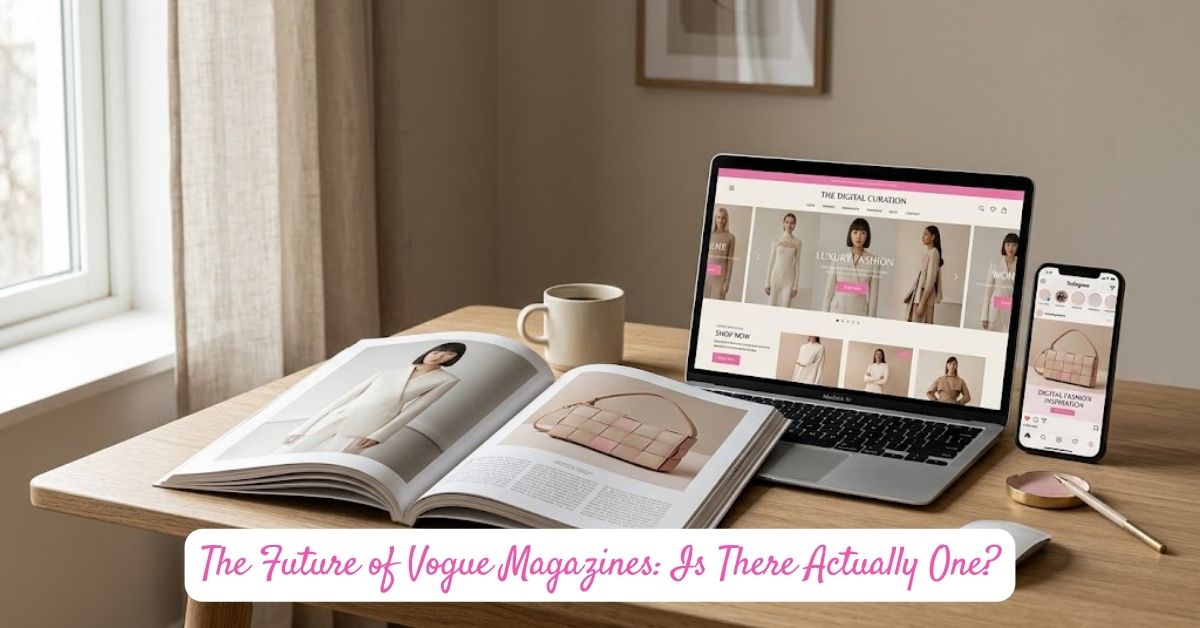
The entire media industry is facing something of a slow-motion crisis, and Vogue is experiencing it too. For more than 100 years, Vogue has told us what clothes to wear, whom we should care about and how we should feel about ourselves. That is a lot of influence coming from a piece of glossy paper. But here in 2026, the future of Vogue magazines Five years ago, most people never dreamed that this would look so different; however, present-day changes can either be viewed as an exciting opportunity to reinvent ourselves or say goodbye gracefully to something we were once accustomed to, depending on who you ask. Let’s take a look!
The End of an Era That Actually Ended
For 37 years, Anna Wintour led American Vogue as though it was her own personal empire , because it truly was. The trademark asymmetric bob, dark sunglasses, and front-and-centre seating at every major runway show she deemed important. She made an entire magazine into a major part of culture. But she would leave her editor-in-chief reign behind in June 2025.
However, she didn’t go far. She currently serves as Global Editorial Director and Chief Content Officer at Condé Nast; therefore, she is technically still able to influence the minds and work of those underneath her, but the operational decisions have been delegated to Chloe Malle, who is 39, the daughter of actress Candice Bergen, and has claimed herself as a “proud nepo baby.”
And, of course, the internet has had a say on this subject. Chloe Malle does, however, have 14+ years’ experience with Vogue, including her time spent as the editor-in-chief of Vogue.com, where she doubled the traffic to the website. So while the nepo baby label is interesting, it’s not completely correct.
Chloe Malle and the New Vogue Vision
Now it gets really good! Malle’s first issue as Head Editorial Content (this is her actual title, editor in chief no longer exists at Vogue) went out this spring; cover girl Rosalía, shot by Alasdair McLellan in Dior Haute Couture. So elegant, so purposeful, so cinematic – amazing statement.
Malle has also been very straightforward about what kind of magazine she wants Vogue to be. In an interview with the New York Times, she said that she wants each printed magazine to be considered a collectible by utilizing thicker paper and focusing on specific themes or cultural moments, instead of just printing the same stuff every month.
“I’m going to apply my personal touch to this so that it clearly becomes mine and will ultimately determine its success,” she said. “I want the magazine to be so different than it ever was before, that anyone looking at it will know I made it all my own.”
Clearly, she is not just riding the coattails of the past. She is someone who understands that this industry is not the same anymore, and she has decided to do things differently going forward.
Eight Issues a Year , Fewer, But Make It Fashion
The number eight was the biggest catalyst for change in 2026 as Vogue US reduced the volume of print publications from 12 in 2019 to 12 in 2023 (8 total), again reducing from 10 total to 8 total, etc.
Each issue will correspond to a significant cultural event: Spring equinox, Met Gala, Vogue World, Fall Fashion Week, Holiday Season, etc. Every issue will be significantly larger and printed on higher quality paper, all designed to create an intentional experience for readers.
These issues will no longer be viewed solely as magazines but rather as limited edition art objects. The September 2018 Beyoncé issue, shot by Tyler Mitchell (the first-ever Black photographer to shoot a Vogue cover in the history of the magazine), sold out before it even hit stores and became a highly sought-after collectible item. This is the type of energy that Malle is aiming for with every new issue. Unlike the previous monthly issues that were disposable and simply filler or compensation for the reader until Lemaire or Simons became available again, these new issues will truly be a showcase of artistry and will be a permanent fixture on your coffee table.
Is Scarcity the New Strategy?
Media executives have struggled to connect with Gen Z for a decade. Social media and technology give Gen Z the opportunity to rediscover ’80s and ’90s items such as vinyl records and film cameras; consequently, the resale value of print-based objects has increased for this generation. As a result of this generational shift in print culture, i-D magazine relaunched as a print publication in 2025 due to high demand.
In a nutshell, the less you produce in print, the more valuable it becomes. Print culture’s fashion equivalent is limited-edition drops (limited runs produced exclusively to coincide with a fashion collection season). Fashion brand consumers understand the fact that scarcity increases demand for products.
The Digital Reality Nobody Wants to Admit
But here’s the part we need to talk about honestly. Print is not the future of Vogue magazines , digital is. Everyone is aware of this including Wintour, who has publicly stated that Digital is “Where we can be able to be flexible, be fast, and also be timely.” Therein lies the issue: Vogue’s Digital platform has played catch-up for years; Since Influencers were developing their own digital native empires from scratch in a RAW, INSTANT and REAL manner, Vogue has merely uploaded this print-style mindset into a digital screen and claimed that was an innovation; Beautiful photos do not carry the same impact at 72 dpi on a mobile device compared to a magazine format.
Social media has completely changed the way we view and experience fashion; it has created a redistribution of power that Vogue previously owned. Trends no longer wait until the month; By the time a magazine goes to print, the trend above has most likely already hit its peak, has been memed, christmas sweaters and died on tiktok, amongst other platforms.
The plan that Malle has put together, clearly provides that division of jobs; The Digital aspect will be the active, reactively fast and directly in the process; The Print will be the slow, very beautiful and very lasting. Ultimately, the separation of jobs above is only as good as how the Digital side of Vogue can compete in a world, where there are UNIQUE creators who have zero overhead, and have ALL of the authenticity, without all of the overhead.
Teen Vogue Is Gone. That Says Something.
Teen Vogue ceased its stand-alone print publication in November of 2020 and is now a part of the overall Vogue brand. Employees were cut during this transition and the edition’s politically-minded audience of young people has disappeared after many years of establishing itself.
This decision is not simply a business decision, but a reflection of the difficulty of the current market; even magazines with strong cultural credibility have no recourse against hard times right now.
The AI Controversy Nobody Asked For
Vogue has been struggling with issues related to AI in its content as well. For example, there was a controversy over a Guess ad that featured an AI-generated image of a model. The fashion world has always had a tense history about body image (how do you represent a woman’s body?) and now the use of AI images creates more ethical dilemmas than just body image. There are no clear-cut answers yet, which is interesting because even someone like Vogue, who sets trends, is now part of this debate. This poses the ultimate question: If a magazine cannot define what a real human body looks like, then what are they curating?
British Vogue and the International Picture
Vogue as a publication has had many of the same challenges described previously. British Vogue’s gross circulation figure dropped about 5 percent, or approximately 180,000 copies per month in 2024, with digital losses unable to compensate entirely for that reduction in print sales.
What’s interesting is that there has been less uniformity in terms of how quickly different global editions have been moving forward. The digital communities built up by Vogue India, Vogue Arabia and other non-Western versions of Vogue are considerably more engaged and culturally relevant than those belonging to their American and European cousins; new editions of these magazines were created without the legacy infrastructures which support old ones. As Condé Nast tends to be a smart player (at least when it comes to strategy), they have likely been watching the activities of these editions very closely for insight into what truly works.
So, Is There a Future?
Yes. But it looks different.
The future of Vogue magazines is not twelve monthly issues on a newsstand. Vogue will publish eight stunningly made, extremely purposeful printed pieces each year, along with a digital presence that has to actually win its readers every single day – not only because it is Vogue, but because people really want to read what it has to say.
The collectible model works. Luxury labels have shown that scarcity + quality = continued interest, whereas mass distribution = no interest at all. Vogue is attempting to become the top-of-the-line magazine with respect to a Bottega Veneta – a piece that may not be suitable for everyone, or every place, but has serious value as soon as it arrives.
What will not work is assuming past prestige carries over into the future. It appears Malle gets that; her ultimate choice in artists was Rosalía – a performer who crosses over from pop to flamenco to high fashion on her own merits and with her own audience and does not need Vogue to validate cultural significance. That choice was representative of her vision.
The real issue is whether or not a magazine can endure in any type of form. There is a good chance Vogue will, but whether or not it continues being authentic in an environment where Vogue is not required to dictate what counts; this is a more difficult question than the previous one. 2026 will allow us to begin determining that answer.
Stay tuned to itismandystyle for more takes on fashion, media, and whatever’s happening at the intersection of both.