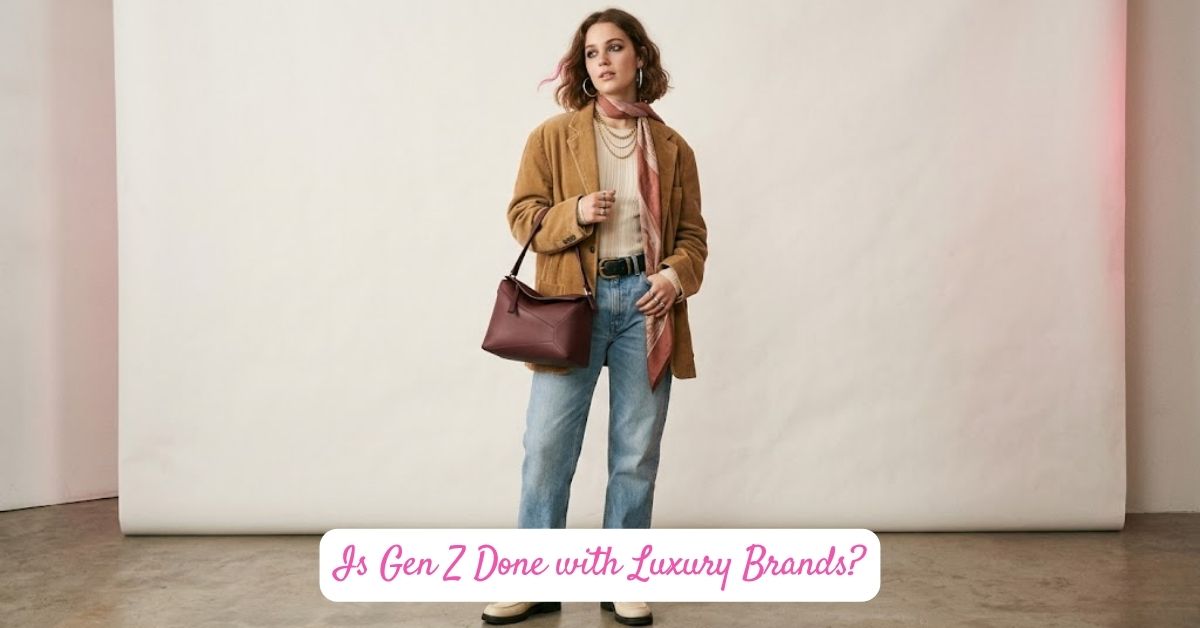
Let’s just be real for a second ,the luxury fashion world is having an identity crisis, and Gen Z is holding the mirror. The question everyone keeps asking is whether Gen Z and luxury brands whether they remain relevant in today’s society or if this generation has completely logged off and abandoned the concept. The short answer to this question is easy (yes or no), but the long answer is much more complex and has many interesting facets.
Let’s go!
Luxury Hasn’t Died , It Just Got a Makeover
Actually, people are misunderstanding Generation Z: they’ve not done away with luxury. They completely altered our concept of Luxury. Per YPulse, “69% of individuals aged 13 to 39 define luxury as a feeling, not a physical thing.” Read that again; luxury is a feeling (not a logo, price or an excessive display of monograms on a bag).
Furthermore, the Gen Z and Gen A consumers are rejecting the old notion of price-based prestige. Instead Gen Z and Gen A place their value on cultural capital, identity and the ability to engage with brands at a deeper level. They are not loyal to brands based on whether they have a logo; if they do not have engaging experiences they do not become loyal.
Therefore, when a bag priced at $3,000 from a heritage brand appears as something everyone possesses, and Generation Z doesn’t want it any longer. This is not a lack of purchasing power but rather a matter of being a matter of personal taste.
The Logo Era Is Having a Moment of Silence
Remember when the loudest bag in the room won? When the bigger the LV monogram, the better? Yeah, Gen Z and luxury brands have officially moved past that phase , at least when it comes to the old-school flash.
Logos serve as a visual uniform with the same brand bag, pattern, and look that are easily recognizable. However, younger consumers , especially Generation Z , want to express themselves through clothing, rather than buying a piece that all their friends have. They desire to have clothing that is personal to them and not simply prescribed by the fashion industry.
Therefore, it’s easy to understand why the “everywhere-ness” of brands means the loss of their exclusivity. The more accessible these once-exclusive products are to a larger market of consumers, the less valuable they become as status symbols.
Gucci , we are looking at you. Louis Vuitton has suffered the same fate as Gucci. Heavy logo’s and styles are no longer appealing to younger consumers and they are asking them to “create something new that’s original.”
The Brands Winning Right Now
While not all luxury houses are doing poorly, there are some that are doing exceptionally well,and they all have something in common: they are successfully connecting with Gen Z.
One of the most extraordinary cases of success in the fashion industry has been Miu Miu, which had an increase of 49% in sales between January and June 2025; many of these sales came from new luxury buyers, as Miu Miu has leveraged their success with leather bag charms to create an entry point into luxury for a new demographic. Each charm sells for $240 to $1,250, and Gen Z consumers are gradually accumulating bag charms, but it’s really brilliant marketing for Miu Miu as they have created the means for Gen Z consumers to define themselves through luxury, rather than requiring them to fit into an existing definition of luxury.
Loewe has another example of this trend, as they experienced an increase of 49% in sales during the first half of 2025 through first time luxury buyers acquiring, once again, small, easily-accessible pieces (in this case, leather bag charms). This demonstrates how Gen Z yearns for an avenue to represent their identities via their style and therefore their expression, rather than being forced to conform to an established identity.
Lastly, there’s the “comprehensive” success story that no one has predicted at all.
Coach: The Redemption Arc of the Decade
Five years ago, if you told people in the fashion industry that Coach would become a hot brand among Gen Z, you would have been laughed out of the room. Now look at this trend.
From January 2020 to January 2025, Coach’s market cap grew 140%. That’s not a misprint. The label that once sat in the corner of outlet malls beside Yankee Candles is now a hot topic of conversation in fashion.
Coach’s parent company, Tapestry, claims 35% of its new customers come from Gen Z, which is driving Coach above Wall Street expectations. As CEO Joanne Crevoiserat said on CNBC, “We are bringing in younger consumers at much higher rates than previously (before). The Gen Z consumer is engaged in fashion (like it no one’s business) and is spending a significant percentage of their budgets on the category”.
The Brooklyn, Tabby and Rogue handbag lines have become sensations for the Coach brand. The Brooklyn handbag was listed as the most desirable fashion item for the fourth quarter of last year by global shopping site Lyst. In the year ending last December, searches for Coach products were up by 332% year over year.
Additionally, they’ve done an excellent job with the customizability aspect of their products. In the United States, the number of “bag charms” and “ideas for bag charms” searches on Pinterest has increased 200% and over 10,000%, respectively. Coach’s cherry bag charm, which retails at $95, has become a true signifier of pop culture. People are paying close to $100 for a bag charm shaped like a fruit, and they couldn’t be happier about it.
So What Did Coach Do Right?
The Coach brand underwent a transformation in how it is viewed by customers. The brand had formerly been perceived as somewhat dated, associated with the older generation. As a result of this change in perception, Coach was able to re-position itself as an “expressive luxury” brand that is a good fit for the current generation of fashion trendsetters (Gen Z) who place importance on personal style and authenticity.
Coach stopped at attempting to appeal to all customers, regardless of age; they began to focus on expressing fun, unique vintage fashion (Y2K), and offering customized products. Coach’s decision-making process has resulted in a very positive response from Gen Z.
The Thrift-Store Flex is Real
Gen-Z’s purchases of Coach bags instead of burritos from Chipotle has surprised the fashion industry (as both Chipotle and Cava have reported decreased sales to young customers, some of whom have begun preparing their own meals). Tapestry claims that they have gained approximately 35% of their newest customers as a direct result of Gen-Z buying.
Gen-Z’s decision to buy high-end, statement-making products rather than burritos indicates that this generation is making thoughtful decisions about where they spend their dollars.
In addition, when luxury goods cannot be purchased brand new, many Gen-Z’ers are opting for seconds through vintage or pre-owned items. Other options are available to these consumers for purchasing secondhand goods, including shops like The RealReal and Vestiaire Collective; thus, many consumers have decided to purchase from the resale market instead of as an alternative to a new product. This trend is generating interest among brands regarding their participation in the secondary marketplace and will help move high-end fashion toward a circular economy.
There has also been a shift away from only items being purchased due to financial restrictions, as purchasing used goods is now one of the biggest ways for this generation to show their individuality.
The Future of Gen Z and Luxury Brands
What can we tell about the future of luxury consumption through the data? Big changes are in store for Gen Z. The average Global luxury consumption for Gen Z was only 4% of all global luxury consumption before COVID-19, but it will rise to around 25% by 2030 according to the Boston Consulting Group.
That’s a pretty big change to consider, and luxury brands are starting to realize it. In fact, luxury brands are projecting that millennials and Gen Z will make up 45% of the overall luxury retail market at the end of 2025. Essentially, this will completely change who luxury brands sell to эти это конструкционно значимые изменения.
After over a decade of growing, the luxury market has now shifted to the point where relevance cannot be taken for granted; it has to be earned by the consumer. This means that clarity of value, cultural legitimacy and organizational agility will be more valuable than size when it comes to which luxury brands will succeed by 2026 that understand Gen Z and luxury brands aren’t incompatible , they just require a completely different conversation. Less “look how expensive I am,” more “here’s what I stand for and why it matters to you.”
What Gen Z Actually Wants Going Forward
Gen Z distinguishes itself by more than simply by the clothes they choose to wear, but also by how they choose to wear them. They tend to build outfits based on comfort, flexibility, and identity, rather than on rigid trends. They also prefer a single piece of apparel that will work for many different occasions, tell a story, and feel personal, rather than like a uniform.
Brands that would never be considered competitors have surpassed brands with 100 times the marketing budget. Glossier, which was founded in 2014 and evolved from a blog into a brand, is now the second-largest cosmetics brand in the world. Palace Skateboards, a small skate brand, is now larger than Levi’s or H&M.
The takeaway from this? Authenticity has replaced pricing as the metric of value.
The Bottom Line
Gen Z and luxury brands aren’t over. They’re renegotiating the terms of business. The generation that has experienced an explosion of everything being shown, called out, and validated on social media was not going to simply purchase an item because of the brand name attached to it. This generation wants to know the story behind a product; they want it to have an emotional connection; they want it to actually be worth their money.
The brands that understand these facts (such as Coach, Miu Miu, Loewe, Bottega Veneta) continue to do well. The ones still anticipating that logo mania will make a comeback may need to rethink their business model.
Luxury has not died; instead, it has matured. We also matured during this process.