Paul the Apostle covered roughly 10,000 miles by foot and ship across the eastern Mediterranean, planting churches in cities that still exist today. Following his route means visiting places like Philippi, Thessaloniki, Athens, Corinth, and Ephesus, where archaeological sites and ancient texts line up in ways that make the New Testament feel less like distant history. Planning a trip along this path takes more preparation than a standard vacation, since the sites span three countries and require some background reading to appreciate fully. These seven tips will help you get the most out of the experience.
Read Acts and the Epistles Before You Go
Paul’s journeys are documented in the Book of Acts, and his letters to Corinthians, Ephesians, Philippians, Galatians, and Thessalonians reference the exact cities you’ll be standing in. Reading these texts beforehand transforms a pile of stones into a place where specific events happened. Set aside a few evenings to read Acts 13 through 20, which covers his three missionary journeys in detail.
Pay attention to the geographic markers Paul mentions, like the Areopagus in Athens or the marketplace in Philippi. These aren’t vague references. Archaeologists have identified the actual locations, and standing there with the text in hand makes the connection concrete.
Prioritize Philippi and Thessaloniki in Northern Greece
Philippi is where Paul established the first Christian church on European soil around 49 AD, after receiving what he described as a vision of a man from Macedonia asking for help. The site includes a well-preserved forum, a Roman theater, and a river believed to be where Lydia, the first European convert, was baptized. Thessaloniki, about 100 miles west, holds the ruins of the ancient agora and the Arch of Galerius, along with a strong tradition tying the city to Paul’s letters to the Thessalonians.
Both cities are manageable as a two-day stop if you’re working with limited time. Thessaloniki also has a modern airport, making it a practical entry or exit point for a Greece-focused itinerary.
Spend Real Time in Athens Beyond the Acropolis
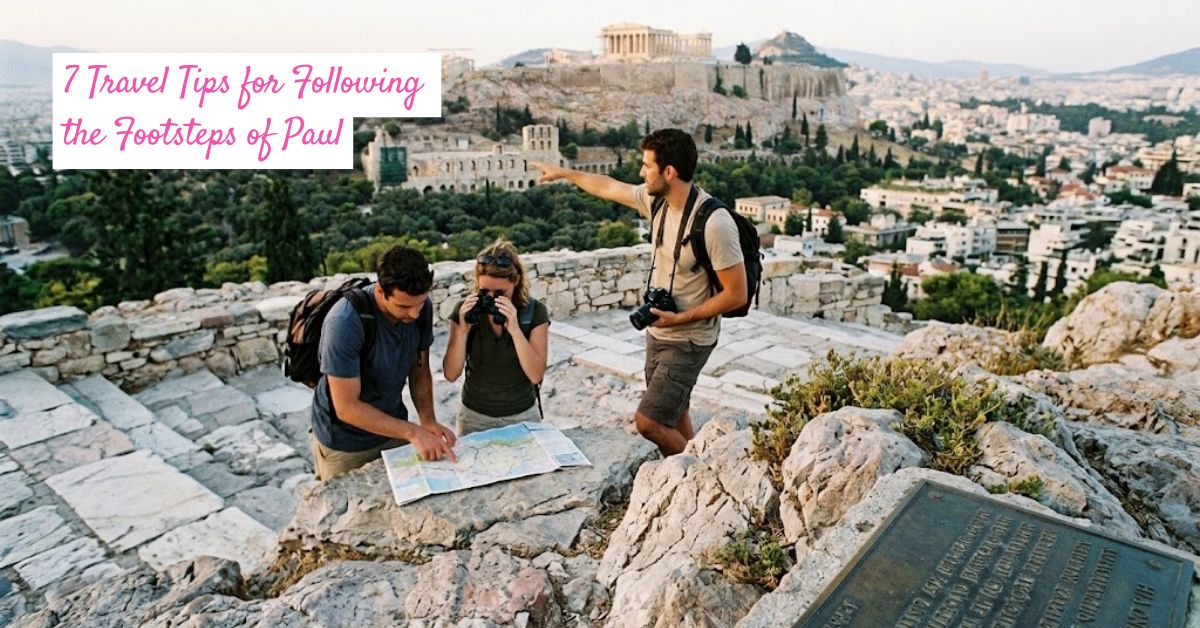
Most visitors to Athens head straight for the Acropolis and skip the Areopagus, the rocky outcrop just below it where Paul delivered his famous sermon to the Athenian philosophers in Acts 17. It takes about 15 minutes to climb, and there’s a bronze plaque with the text of his speech in Greek. Standing there gives you a direct sightline to the Parthenon, which Paul would have seen as he spoke.
The ancient agora, where Paul reportedly debated daily with Athenians, is also worth an hour or two. It’s a five-minute walk from the Acropolis metro station and rarely as crowded as the main attraction.
Visit Corinth for the Layered History
Ancient Corinth sits about an hour southwest of Athens by car or bus, and it’s one of the richest sites for anyone tracing Paul’s route. He lived and worked here for 18 months, longer than almost anywhere else on his journeys, and wrote both letters to the Corinthians addressing the church’s internal disputes. The site includes the Bema, a raised marble platform where Paul is believed to have been brought before the Roman proconsul Gallio.
The on-site museum has statues, inscriptions, and everyday objects that give a clearer sense of what Corinthian life looked like in the first century. Guided tours here are particularly useful because so much context isn’t obvious from the ruins alone.
Consider a Structured Tour Rather Than Independent Travel
Independent travel works fine for major cities, but connecting the smaller archaeological sites tied to Paul’s ministry often requires a car, local knowledge, and a fair amount of research. A well-designed Footsteps of Paul itinerary handles the logistics of moving between Philippi, Thessaloniki, Athens, and Corinth while pairing each stop with scripture readings and historical context from guides who specialize in biblical history. This matters especially for travelers with limited time who want depth without spending hours coordinating transportation.
Group tours also tend to include access to sites or scheduling that’s harder to arrange independently, like early entry before tour buses arrive.
Pack for Uneven Ground and Sun Exposure
Archaeological sites in Greece involve walking on marble that’s been polished smooth by 2,000 years of foot traffic, along with gravel paths and uneven stone steps. Closed-toe shoes with real tread are non-negotiable, and sandals will leave you slipping on the Bema at Corinth or the theater steps at Philippi. Most sites have minimal shade, so a hat, sunscreen, and a refillable water bottle matter more than a guidebook in July and August.
Spring and fall offer more comfortable temperatures for walking these sites for extended periods, generally April through June or September through October.
Budget Time for Reflection, Not Just Sightseeing
It’s tempting to treat this trip like a checklist of ruins, but the sites tied to Paul’s ministry carry weight for many travelers that goes beyond historical curiosity. Building in unstructured time at a place like Philippi’s riverside baptismal site or the quiet corners of ancient Corinth allows for something a rushed itinerary doesn’t: the chance to actually sit with what happened there.
Tracing this route works best when you treat it as a combination of history lesson and personal experience, not a race between bus stops. The sites will still be there whether you spend 20 minutes or two hours, but what you take away from them depends on how much room you leave for the second option.