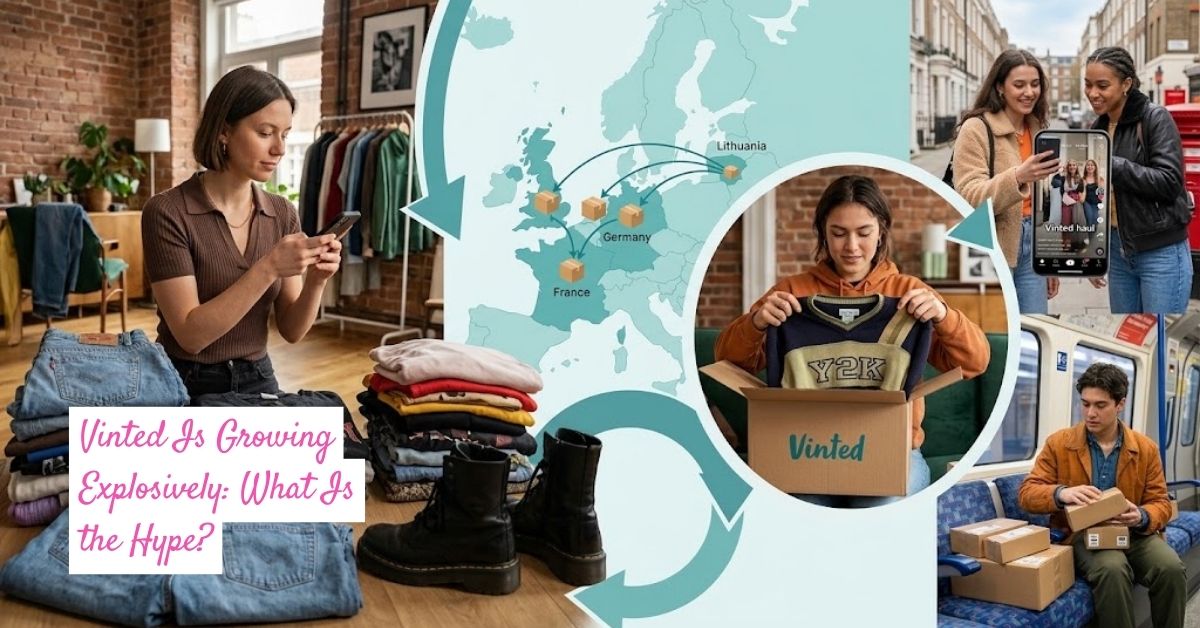
Has anyone else noticed that Vinted has taken over your entire life, or, at least, your entire existence? It’s in your Instagram ads, in your group chats, your friend won’t shut up about the “vintage Levi’s for six quid” she just found, and there’s a #vintedhaul video every time you open TikTok. I had to sit down and ponder about why is Vinted so popular these days? This isn’t just another cute side hustle app any longer, it’s one of the biggest fashion movements of the decade. Let’s get into it.
A Quick History Lesson (I Promise It’s Not Boring)
Vinted wasn’t born as a large fashion tech venture backed by VC’s. It began in Lithuania in 2008 when a woman called Milda was moving house and had a stack of clothes she didn’t wish to put in the trash. Her partner Justas created a basic website for her so that she could distribute them to her friends. There, it was a moving house scrub and a business worth many billions of euros.
It went from there, gained momentum in Germany, France, and pretty much any other country that has a postal system and people who are tired of the over-exuberant prices of fast fashion. But the true explosion occurred when Vinted arrived in the Netherlands and the UK. It was embraced quickly by dutch users due to its already budget-minded shopping culture and when it reached the UK, it was a ‘mental’ thing. In a couple of years, millions of Brits went from “what is Vinted?” to it being on their home screen forever.
Vinted’s Numbers Are Kind of Wild
I did the digging so you don’t have to and here are the stats that explain Vinted’s popularity in 2026 and beyond. The platform currently boasts more than 100 million registered users in more than 25 markets. Vinted earned in the base of €1.1 billion for revenue in 2025, an increase of almost 38 percent compared to the previous year, and gross merchandise value reached €10.8 billion, an increase of 47 percent.
France tops the charts with more than 13 million users; Germany is close behind, and the UK isn’t far behind. After all, it is a parcel delivery service that is now available in the five countries for which Vinted operates, with more than half a million drop-off points.
How Does Vinted Actually Make Money?
This is a really one of the savviest things in the resale world. Sellers list for free, no fees, no cuts. Sellers will be obsessed with selling your old jumper for a fiver, as other resale apps will cut in on your profits!
Where then is the money coming from? Buyers. There’s a small Buyer Protection fee per purchase, covering you if the item doesn’t arrive at all or not at all the same as in the pictures. Typically, it is a percentage, plus a deposit, and they’re willing to pay it, since it is less risky to purchase from a stranger online. Sellers retain all, buyers have peace of mind, and Vinted makes a ton of money by the millions of micro-deals.
Why Did This Blow Up When It Did
Timing is key and Vinted’s has been spot on. The cost of living crisis forced people to consider carefully how they spend their money, and second hand was no longer “cheap” and began to be considered “smart.” Throw in the fact that Gen-Z isn’t interested in purchasing something new because they want to and they would rather flex a rare ’90s find than a fast fashion haul, and you’ve got a whole generation that would rather flex a rare ’90s find than a fast fashion haul.
Then sustainability is there, too – the buzzword is not enough. Consumers have had enough of the “fast fashion is killing the planet” message to make a change in their shopping habits. When you purchase something secondhand, you’re not that extreme of a zero-wasteer, but you’re definitely helping to reduce how many garments are produced, dyed, shipped and eventually landfilled.
The Environmental Angle
Fashion is a very polluting industry on earth – period. Each item sold, not discarded, prolongs its life and prevents it from ending up in the landfill. Vinted’s been practically the poster child of the circular economy, that clothes should continue to pass from hand to hand rather than being created, worn two times and thrown away.
It’s not flawless, shipping indeed has a footprint but compared to the constant purchase of brand new, it’s a significant change, and it is one of the reasons why is Vinted so popular among those who want to keep their buying habits in line with their values.
What People Are Buying (and Finding) on Vinted
The sizable categories that are pulled include women’s and children’s clothing, and the platform has now branched out into sportswear, homeware, electronics and even collectables. It’s never too soon or too late to wear denim, never too early or too late for any Y2K, and vintage band tees forever seem to command a higher price than advertised.
The magic is in the real design, however. For example, people buy cheap Chanel, Miu Miu and archive Vivienne Westwood items because they do not know what they are getting or simply want to have them in their wardrobes again. It’s that treasure hunt energy; not only are you shopping, you are playing a game.
Tips for Actually Winning at Buying and Selling in 2026
When looking to find listings for sale, know the search terms and create saved searches to alert you to new listings. Look at reviews of the sellers, ask questions before you make an offer, and don’t hesitate to offer less than what the seller is asking because most sellers know they might have to make a few counter offers.
For the sellers, a good lighting and honest photos make a huge difference and a slightly lower price often does the trick for selling. Bundle deals also make for a good idea, as people like to get a deal on the shipping too.
How Vinted Stacks Up Against the Competition
Depop may still have that more focused and streetwear bent, but Vestiaire Collective is the true luxury resale, and they include authentication in the mix. ThredUp goes its own way in the US. However, in Europe in particular, none of them are as big as Vinted. A zero-seller-fee model combined with the user base makes there just be more stuff and more buyers in one place, and that’s what makes it win here over all its competitors. While Depop incurs selling fees that reduce profits, Vestiaire is more expensive and takes longer than Vinted, which is best for regular people.
The Itismandystyle Take
My personal and sincere opinion. Vinted is all about having you look good and feel like yourself, not a computer-generated algorithm designed to sell a particular type of product at an inflated price, and it really is my saving grace for items that I wouldn’t find in a high street shop. That’s the little weirdo jewels, the edgy little gems, the chunky boots, the random band t-shirts no one else has, the slip dresses, the grunge dresses, that’s the clothes that make you feel like YOU instead of another trend. Evidence that you don’t need to be a million bucks to be yourself.
So that is the whole dech as to why Vinted is so popular these days. It’s cheap, it’s eco-friendly, it has the feel of the hunt and it truly respects both the buyer and the seller, as most apps don’t anymore. If you haven’t downloaded it already, your wardrobe (and the planet) will thank you for it.