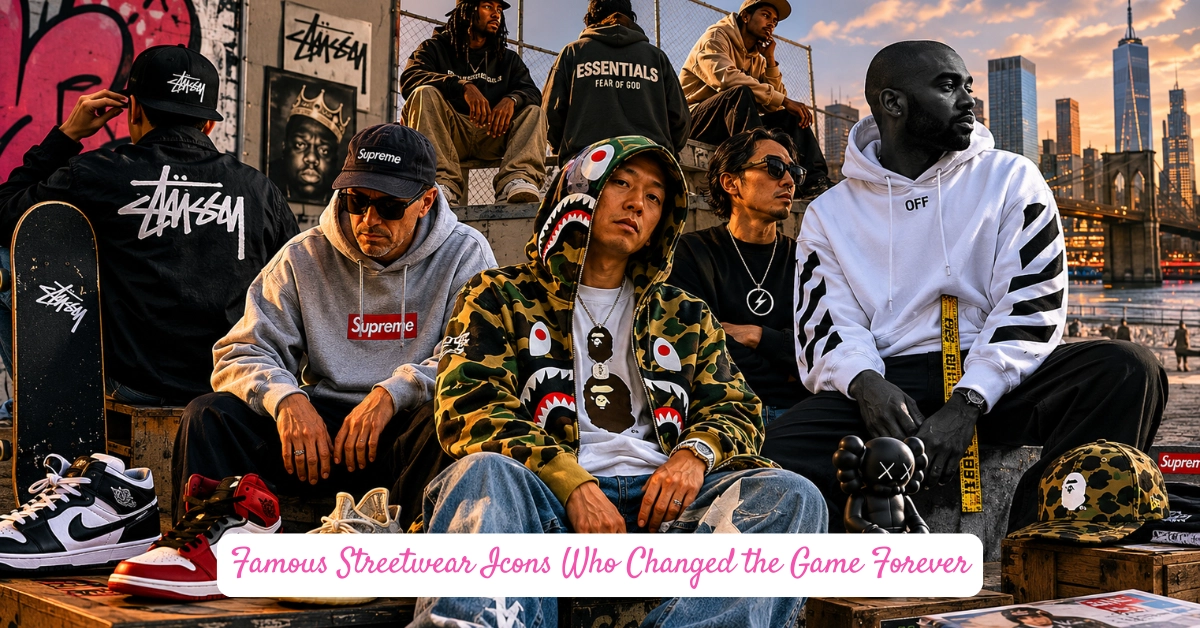
Let’s face it, folks! Each time you wear an oversized hoodie, lace up your sneakers or rock a graphic tee, you’re wearing someone’s revolution. Streetwear wasn’t simply conjured up out of nowhere like a sponsored Instagram post. It was constructed, step by step, collaboration by collaboration, by a few people who didn’t ask to be in fashion but came up with the idea and made it happen anyway. These are the well-known streetwear icons that turned the entire industry on its head, and trust me? They deserve all of our thanks.
These names were not just creating clothes, they were creating names from the surf towns of California to the back alleys of Harajuku, Tokyo. They created a thinking style. A way of existing. In 2026, their legacy is still felt in every drop, every hype drop, and every thrift pick up that Gen Z is doing on TikTok. Let’s get into it.
Shawn Stussy: The Original One
Before Supreme. Before Off-White. Long before this , in the early 1980s , surfing’s last name was scribbled on surfboards in Laguna Beach by Shawn Stussy. That hand-drawn signature? This was the template. It was a surf brand that was getting into the dirt of skate culture, punk music and hip-hop, and Stüssy just turned into a brand that no one could still talk about. We were eventually talking about “streetwear”.
Why He Still Matters in 2026
Stüssy is experiencing a complete renaissance of a culture right now. What Shawn’s brand has done has been accomplished in a way most of the legacy brands would only dream of: it has captured the Gen Z without losing the original audience. It’s one of the few labels that is truly inter-generational, and let’s face it, in a world that’s trying to be “core” anything, Stüssy just is. No explanation needed. There’s a real impact of the signature look of a bucket hat. Always will.
In the early 90’s, Shawn himself walked away from the brand, sort of iconic that would be. He erected a huge thing and then abandons it after he is gone. This is the kind of cool PR can’t make.
James Jebbia: The Man Behind the Box Logo
In 1994, James Jebbia opened a skate shop downtown Manhattan. He had no intention of building a fashion empire. He was attempting to serve skaters. But somehow, it’s that complete lack of desperation to be popular that made Supreme the most discussed streetwear brand in the world.
The Drop Culture Blueprint
James Jebbia is the man who literally created the modern-day hype machine. The limited drop. The circumference of the circular track. Your mom checking your PayPal; she thinks you are selling drugs. It all goes back to how Jebbia has made Supreme’s product, with a concept of scarcity, chaos and a community that is obsessed with it.
Despite the years of corporate ownership turmoil, Supreme is back in its skate roots, and those who were composing its epitaph have fallen silent. “Keep it real, keep it limited, never explain yourself” proved to be a formula that was unbreakable. The red box logo is a symbol that will be familiar to every fashionista, hands down.
Nigo: Tokyo’s Gift to the World
Whereas streetwear was infused with a California soul thanks to Shawn Stussy and a New York attitude thanks to Jebbia, Nigo gave it something different: Japan. In 1993, Tomoaki Nagao, or “Nigo” as he is universally referred to, opened a store called A Bathing Ape in Harajuku, Tokyo and everything changed.
BAPE and the Art of Making Fashion Playful
The camo patterns, the shark hoodie, the ape head logo – these were no ordinary garments. They were collectibles. Nigo knew that streetwear could be art, it could be a reference to pop culture, and it could make you feel like you’re part of something exclusive and joyous all in one. The two are early believers – Pharrell Williams and Kanye West – and when they call something cool, the rest of the world does.
BAPE will continue to create the Shark Hoodie and collaborate with other brands to create droppable content that stops people from scrolling in 2026. From the Japanese streetwear that Nigo helped create from Harajuku, to the K-pop fashion trends and the luxury fashion runways, the Japanese streetwear has made an impact. And Nigo himself? Now he works as creative director at Kenzo, a LVMH house. The outside became the inside and the establishment itself. The streetwear story, in one sentence.
Hiroshi Fujiwara: The Godfather Nobody Talks About Enough
If you ask 10 people who is the godfather of streetwear, you may only get 3 to say Hiroshi Fujiwara. This number should be more. The designer, DJ and cultural curator based in Tokyo is the one who gave Japanese streetwear the DNA it has got. In the 1980s, he introduced rap and hip-hop culture to Japan, shaped its meaning through his own experiences, and founded Goodenough in 1990, where he eventually inspired a young Nigo to create BAPE.
Quiet Influence, Massive Impact
Operating in the background is Fujiwara. He’s not looking for fame. It’s the one that the people in pursuit of clout are watching. He has worked with Nike, Louis Vuitton, Beats by Dre and Moncler, among others, for his Fragment Design brand. Lightning Bolt is a subtle and precise logo , a far cry from the brand frenzy that often accompanies a given name.
As a streetwear fashion that embraces noise so Fujiwara has always attracted attention. If you know, then you know. In 2026, that’s the energy that is more relevant than ever , real cool is quiet.
Virgil Abloh: The One Who Changed Everything and Left Too Soon
When it comes to the discussion about streetwear and luxury fashion, there is a before-Virgil and an after-Virgil. By trade, architect and engineer, Virgil Abloh founded Off-White in 2012 and took one final step to what, for decades, fashion gatekeepers had been trying to prevent: putting the quotation marks around everything.
The Architect of a New Language
The “quotation marks.” The zip ties. The industrial belt. The diagonal stripe. Virgil was a streetwear stylist who had a way of making the street seem both intellectual and accessible. He was stating that the distinctions between “high” and “low” that fashion makes are man-made. They’re just words. He placed them between quotation marks, word for word.
His appointment as Louis Vuitton’s menswear artistic director in 2018 was not only a moment for Black designers in a traditionally white world of fashion, but a statement that the streets had won. The children of Supreme and BAPE and sneaker culture were at the helm of the world’s most legendary fashion houses.
Virgil died in November 2021 from a rare type of cancer that he fought with privateally. He was 41. The “fashion and culture” loss is still in processing. But his influence isn’t going anywhere. Off-White continues. The quotes are continued. All of the designers from his era are still looking forward to 2026 and beyond, carrying his legacy with them. This is truly what legacy is.
The New Icons Shaping Streetwear Right Now
The iconic streetwear brands of the past established the base, but it wasn’t then and there that it ended. Jerry Lorenzo created Fear of God, and then Essentials, the defining “uniform” brand of which in 2026, the earth tones, the oversized fits, the quiet luxury that the fast fashion industry has been on a desperate pursuit of since 2019.
Denim Tears brought another more pressing element to the table – Tremaine Emory. The “Cotton Wreath” jeans were his creation and he used them as a teaching tool on the transatlantic slave trade. Streetwear as monument. Streetwear as loss and survival. That’s not something you can copy.
Clint419 and Corteiz out of London are doing it differently, guerrilla drops, no permission energy, and a ‘Rules the World’ attitude that is driving the UK streetwear scene to produce some of the best releases in the world. Corteiz does little in the way of marketing and yet here are some of the most loyal fans in the game. Pure community. Pure culture.
What These Icons Actually Taught Us
What brings all these famous streetwear figures together, from surfing on a Stussy board to sketching out buildings in architecture school to giving Clint419 coordinates to drop a location pop-up? Permission.Everyone, from Stussy to Abloh to 419, didn’t ask for permission.
Streetwear is created by individuals who were informed their culture was not fashion. Skaters. Surfers. Hip-hop kids. Japanese children addicted to American cartoons and rap music. Immigrants. Outsiders. Those who the industry did not supply clothes to, so they supplied their own clothes.
That’s the most important part for now, in 2026, when fashion is more affordable than ever, and more noisy than ever. The icons were not limited to selling clothes. They were creating a sense of community. They were establishing physical and cultural spaces in which those who were not traditionally represented in fashion could be seen and specific and themselves.
After all, that’s what itismandystyle’s all about, right? Not following a trend just because it was the trend of a magazine. Not wearing clothes for someone who is different from what others would have approved. Getting dressed for the day, which feels true. Because it’s yours.
Where Streetwear Goes From Here
The iconic streetwear greats of the past have been proven and tested but the street mentality they left behind lives on. The top fashion trends for streetwear 2026 are where sustainability and identity collide; vintage pieces are not just because they’re cheap, they’re because they’re real, and nothing fast fashion can ever be. Real community brands are outpacing brands that have only marketing budgets.
The metaverse effect is real , from digital fashions to holographic textiles to NFT-based drops , but the most interesting analog thing going on is simply more analogue. It’s young designers in Lagos, São Paulo, Seoul and London creating brands from scratch using the same playbook, but their own cultural codes inbuilt in each stitch.
Well-known streetwear names such as Stussy, Jebbia, Nigo, Fujiwara, and Abloh have DNA in their brands, as well. It’s in the permission that they gave. That you can make something out of your life, out of your block, out of your obsessions and the world will catch up to you eventually.
That energy? It’s not going south. That’s simply different attire now.