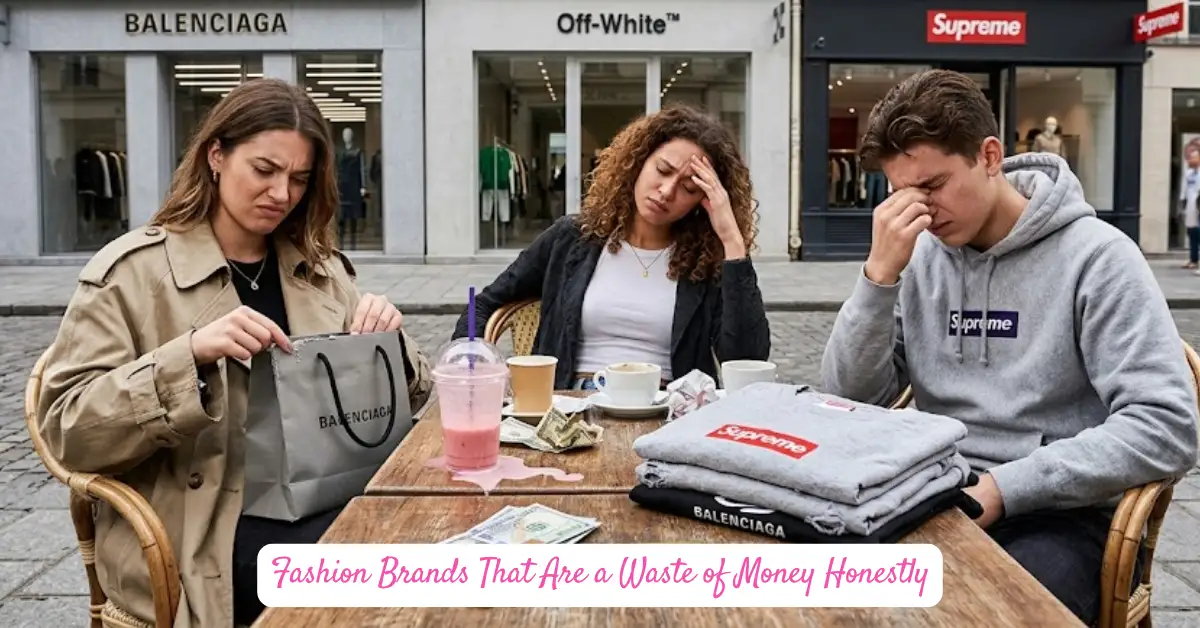
Alright, let’s face the uncomfortable reality at brunch time—there are a lot of fashion brands that aren’t worth the money that are still doing just fine in 2026 because the logo makes you feel a little bit better about yourself at the checkout. The product? Mid. The price? Insane. The marketing? Genuinely flawless. We keep falling for it, because at some point we took the word “expensive” and “good” to mean the same thing. They are not. Some of these brands are renting you a cotton tee so it may pill after three washes and they’re not telling you with a straight face.
Pack your iced beverage, we’re taking a few cows for a ride today. Lovingly. Sort of.
First, What Does “Waste of Money” Actually Mean?
I don’t mean that the pricey is bad. Five €120 leather bags that break in spring are not as smart as one €600 leather bag that will last you for fifteen years. That’s just math.
When the price relates to nothing at all but is a waste of money, it is a waste of money. If the name on the tag, the ad campaign or the “if you know you know” is what you are paying for, and the actual product is something you could have obtained for a third of the price, without anyone knowing the difference.
That’s the line. Taste that you can feel? Worth it. What kind of vibes are you paying 400% mark up for? We need to talk.
The Fast Luxury Trap
The twist that caused many minds to chew through last week was that a bit of “luxury” was produced in the same factories as the high street. Investigations in 2024 and 2025 in Italy revealed that the big-name houses used underpaid, undocumented and sometimes forced workers in sweatshops to produce goods, which were then sold at a four-figure price. One of the suppliers of the Dior was caught up in serious violations of labour rights. The dirty secret of fast luxury is that a higher price doesn’t necessarily mean a better quality. Sometimes it’s the same viscose fabric, but labelled with a more interesting name.
That’s why a lot of brands that are not worth your money are still doing business. They have told you that they have made a product that you will have to pay more for is actually just a margin.
Golden Goose
I’m sorry but I have to. Golden Goose manufactures sneakers that are sold with a pre-scuffed, pre-dirtied look, and are deliberately distressed to make the shoes seem like they’ve been worn for 10 years. You’re paying half a grand to have the appearance of having bought $40 shoes and gone on a hike in them.
Now — they’re made in Italy, the footbed is really comfortable — I’ll give them that! But it is so successful, that everyone has it or something something similar, which sort of renders the “individual artisan vibe” they are pushing irrelevant. If it’s meant to be worn in, and a €90 pair of Veja or a pair bought at a thrift shop has the same energy, then maths don’t matter that much.
The “French Girl” Contemporary Brands
You’re familiar with the guys — Sandro, Maje, The Kooples, the whole tier. They advertise themselves as affordable luxury in that Parisian dream, and many of these new brands are manufactured in the same low cost factories as middle market brands, only sold as a luxury. The construction is not the reason for the high cost, it’s the styling and the store lighting.
Are they cute? Wildly. When COS will do the trick, or even a well cut second-hand blazer, are the €400 worth? It’s the kind of chat in the group everyone wants to avoid.
The Logo Tax: When You’re Paying for the Name, Not the Thing
Speaking of logo fatigue, Gen-Z seems to have created the modern version of it. Once there was a time when a big logo on your chest was just a declaration of “Yeah, I did it. The loud-logo flex is dying down in 2026, subtle is now more popular than branding a billboard, and many of these hype brands are on the verge of running on a fumes and resale nostalgia.
Supreme
Artificial scarcity is the basis of the entire Supreme empire. Let demand run wild and let resale prices speak for themselves; drop a limited run. The box logo was for a time a real cultural currency. However, remove the hype and most of it is a printed tee or a hoodie – the very type of blank you can obtain anywhere – with a red rectangle that triples the price.
When it really cools down in the resale world (and the hypebeast era is definitely starting to wane), you’re stuck with a $200 sweatshirt while the hypebeast $30 sweatshirt is still hot. The whole product was the logo. That’s what a Logo Tax will be.
Off-White
Off-White just had a moment, man — the late Virgil Abloh was a moment. The brand, however, has taken the quotation-mark branding approach to the extreme (“SHOELACES,” “FOR WALKING”) and the industrial-belt styling additions that were priced at times that were only fitting during the hype. Many of those pieces were fundamentals + a well-known treatment. The value was the treatment. Upon the passing of the cultural heat, the resale value and the “worth it” goes with it.
Balenciaga
Balenciaga will sell you a sneaker that is intentionally destroyed, a bag that looks like a supermarket tote, and a hoodie that is more expensive than a flight or ticket. There is some clever, ironic commentary on fashion as art. Genuinely. However, many customers do not want to purchase the idea, they just want the name and want people to know it. When the joke is $1,000 and the punchline is “it looks cheap on purpose”, I want everyone to ask, “Who is being laughed at?
It’s Not Just Designer — Mid-Range Brands Get You Too
It’s the thing people forget. Four-figure brands aren’t the only brands that cost you money. There are lots of mid-range brands that have been raising prices and haven’t changed anything, hoping you won’t be able to tell.
Lululemon
I’ll begin a comment war and I don’t give a crap. Lululemon leggings are good, but $100-$130 good? The dupe market is so sensitive that even their most dedicated supporters can’t tell it’s not the original — even in a blindfold! Dupe’s are all in the clear in 2026, to find a great one to use is a flex now, not an embarrassment. When 82% of Gen-Z were ready to purchase dupes during the previous holiday season, it’s quite clear that the original prices no longer seemed to be fair.
If you are really fond of the fit and you’re going to use them for years, okay, it’s a values call. Purchasing them due to the little logo which means “I have my life together”? That’s the tax talking.
Brandy Melville
One size fits all, simple cotton, trend driven items — at a cost that is smuggled into your wallet. It’s not the build but the appeal and the exclusivity factor. Many of Brandy’s catalogues are the stuff of basic and straightforward, that you can often get second hand or from a more economical basics brand for half the price, minus the sizing politics. You don’t have to spend money and buy a pin-curated fantasy, but a dress that lasts through the selling season.
Where Your Money Should Actually Go Instead
The fun part is, clowning without a plan is negativity and here we aren’t.
Golden Goose’s “trashed and washed” sneakers do not even come close.Golden Goose would do well to take a look at Veja, Cariuma or, truthfully, a clean pair of vintage Adidas Sambas you ruse and wash yourself! COS and Uniqlo have both been going with well-cut, quiet quality instead of Sandro and Maje blazers, and they’re basically going with quiet luxury at a reduced price, and it’s working out for them. Don’t get some tees that have hype logos, instead purchase a heavyweight blank and brand it with your true personality.
And the underrated move of all: second hand and vintage. Today’s resale value is enormous, and you can get the real thing, the good stuff, at a much more reasonable price without the extra mark-up. One great investment option wins five times when it comes to mid panic buys.
Gen-Z Already Cracked the Code
The super-optimistic part. It’s a frightening thing for the younger generation to become so smart about shopping. The numbers don’t lie, Gen-Z is brand agnostic until they’re convinced otherwise, most will wait for sales, and they will value the idea of things being affordable, not pricey. There’s no longer a time for quiet luxury, and “I found this for way less” is the new flex.
The entire aspirational-marketing model — which has made fashion brands that are a waste of money so fat for so long — is coming to a crash. They’re overspending on one thing that truly is iconic, and they’re stealing or borrowing all the rest with no remorse. The claim is not cheap but rather that they are cheap. That’s being free.
So the next time you feel like you should want it when something expensive comes up, STOP. Ask whether the product or permission implies a certain type of person? The brands are putting their whole business on this: Do not ask that question.
Ask it anyway. Your wallet — and your closet where you have some clothes you really like — will thank you.