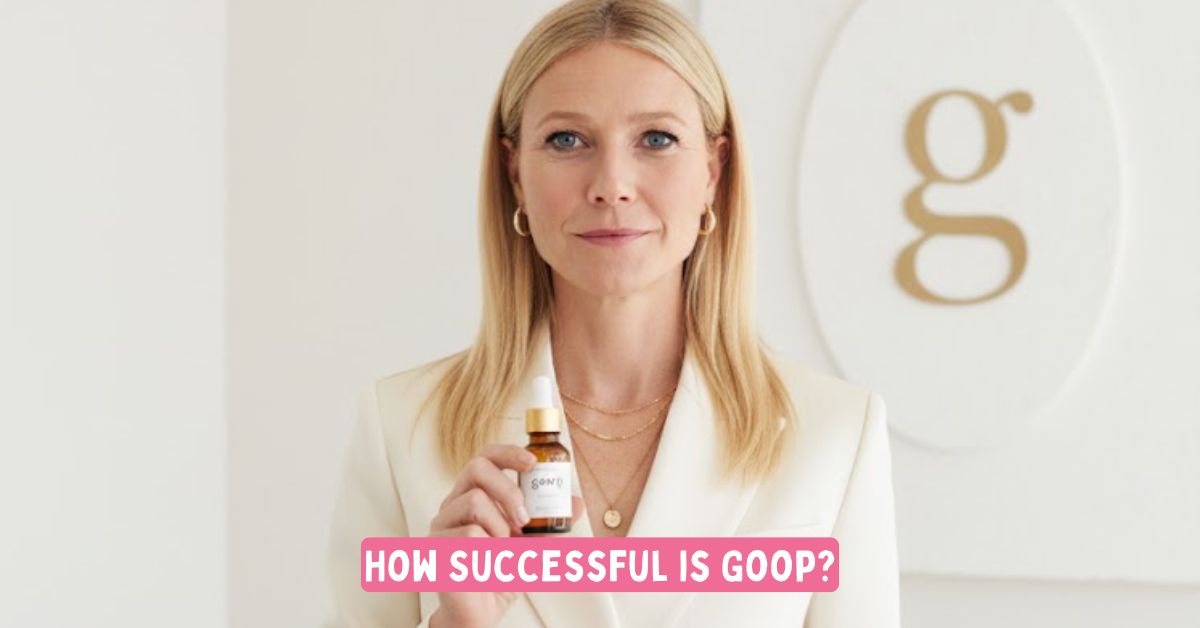
Let’s talk about something that’s been dividing the internet for years: How successful is Goop? The wellness revolution, fame, and business empire that Gwyneth Paltrow created and which is both hailed as a revolution in wellness and ridiculed as selling jade eggs that you need to pass through your what. You like it or not, there is no use denying the fact that Goop has turned into a cultural phenomena, which did not only make Gwyneth Paltrow an Oscar-winning actress, but a businesswoman who has created something that is unmistakably big. But here’s the thing – when we ask how successful is Goop, we are not only talking about the dollar signs (although there are quite a few of them). We are discussing culture influence, controversy, lawsuits, and a brand that is somehow continuing to expand selling vagina-smell candles and being dragged on Twitter every week or so. Strap in then, as we are going deep into the wild and weird and unexpectedly lucrative world of Goop.
The Numbers Don’t Lie (Even If Some of Goop’s Health Claims Might)
When you look at the actual financial data, how successful is Goop gets clear as day – it is a huge success at least on a financial basis. Goop is currently worth about 250 million dollars, and by 2026, industry observers have suggested that the company may even top 300-350 million dollars as the wellness spending keeps exploding across the world.
The company is reportedly earning above 150 million dollars in annual revenue, which is ridiculous considering the fact that it began as a weekly newsletter that was being published in the kitchen table of Gwyneth way back in 2008. Indeed – what started as a mere chain of fancy emails, has now become an entire lifestyle business complete with brick and mortar shop, a skincare brand, supplements, clothing, and more crystal-infused items that any New Age warehouse could store.
The real money is flowing through Goop e-commerce site. Their average order value on the internet is reportedly averaging at $135, implying that people are not just browsing their site, they are actually purchasing their vitamin packets at $75 and essential oil drop diffusers at $90. The brand has now moved to a physical retail with pop-up stores and permanent stores in cities such as New York, Los Angeles and London, which are Instagrammable, leading to both online sales and offline sales.
The Controversy That Actually Helps the Bottom Line
Here’s where it gets interesting: when we examine how successful is Goop, we cannot overlook the fact that controversy could be one of their business models. It was the famous $75 vagina-smelling candle that went viral in 2020. It was sold virtually immediately. The case of the jade egg that resulted in a settlement of 145,000 due to false health claims? That must have made them get a lot more publicity than any conventional advertising campaign. Goop has had several litigation and regulatory issues in the years. In 2018, they paid California prosecutors regarding those notorious jade eggs and a flower essence that purported to keep off depression. However, rather than tarnishing the brand, these scandals appear to reinforce what Goop is all about on the most basic level: it is the readiness to challenge conventional wisdom and provide an alternative to it, which is overlooked by traditional medicine. It is brilliant (or manipulative, depending on your opinion) that Gwyneth and her team have cast Goop as an agent of truth in a world full of dull and traditional thought processes. When doctors and scientists declare their pseudoscience, it makes the brand image stronger as a rebel against the establishment. It is fantastic advertising even though the science is dubious at the most.
The Goop Customer: Who’s Actually Buying This Stuff?
Understanding how successful is Goop requires understanding who shops there. The average Goop customer is a wealthy woman, aged 35-55 with high disposable income and interested in making the most out of every sphere of her life, starting with her morning smoothie habit and finishing with her evening skincare routine. These are no longer individuals seeking low-cost alternatives. They are the group that takes the wellness lifestyle as a full-time hobby and can afford to spend $200 on supplements or $500 on silk pajamas. Goop has reached a whole new plane of selling than selling products they sell aspiration, exclusivity, the notion that given the right culmination of products you too can live like Gwyneth Paltrow. It has also managed to create a feeling of community and trust towards the brand. Nevertheless, Goop has a very loyal customer base in spite of the controversies. They consider Gwyneth as a person that is like them (though the gap in wealth is enormous) someone striving to find her way in wellness, aging, relationships, and the challenges of the modern life. The intimate nature of the content of Goop, coupled with Gwyneth being more than happy to share the intimate aspects of her life, develops a parasocial relationship that is represented in retaining customers.
Looking Ahead: The Future of Goop in 2026 and Beyond
So what does the future hold when we consider how successful is Goop moving forward? The wellness market has been set to exceed 7 trillion dollars in the world by 2026 and Goop is setting itself to grab even a bigger portion of that huge market. The brand is increasing its content with additional podcasts, documentaries, and online experiences. Although the Goop Lab Netflix show was critiqued by the medical community, it reached millions of viewers and exposed them to the brand that might have never visited the site. This transmedia model of making Goop not a mere shopping place but a complete content ecosystem will only continue to increase. Goop is also putting a lot of investment in its own product lines as opposed to merely curating some other brands. Their skincare brand has done extremely well and they are venturing into additional categories that they can marginally control and message. The supplement industry, in itself, is estimated to make tens of millions of dollars every year, and, as the global supplements industry is on a booming scale, there is a lot of room to expand. Another frontier is international expansion. Although Goop is well established in the US and parts of Europe, the opportunities in Asia and the Middle East where luxury wellness spending is booming are enormous. Its brand is adjusting its approach to these markets, and may reduce the more controversial elements, retaining the aspirational lifestyle positioning.
The Real Answer to How Successful is Goop
At the end of the day, how successful is Goop depends on how you measure success. Financially? It is incredibly successful, a quarter-billion dollar company that is still growing year in year out. Culturally? It is either the most discussed style brand in the globe or not. However, here is my opinion in good faith: The success of Goop proves something awkward about the contemporary capitalistic and wellness trends. It demonstrates that it is possible to sell products that make dubious health claims, get sued and criticized by the media, and still emerge as successful since you have accessed the desires and insecurities of people to a sufficient extent. The brand does not fail despite the controversy, but it tends to succeed because of it. Goop has perfected the business of aspirational packaging with the vague science of the backdrop and has topped it with a bow of celebrity endorsement. Whether or not that can make it a brilliant business or an ethically dubious venture is one that every individual is expected to answer on his or her own. What’s undeniable is that when asking how successful is Goop, the answer is: extremely, and it’s not slowing down anytime soon. It is not whether Goop will ever be successful again, but can other brands recreate the formula without the inherent bonus of having an Oscar-winning actress in the founder position. My guess? They will, but there is only one Gwyneth, only one Goop, better or worse, it has cut a niche in the wellness market that is extremely hard to swamp.