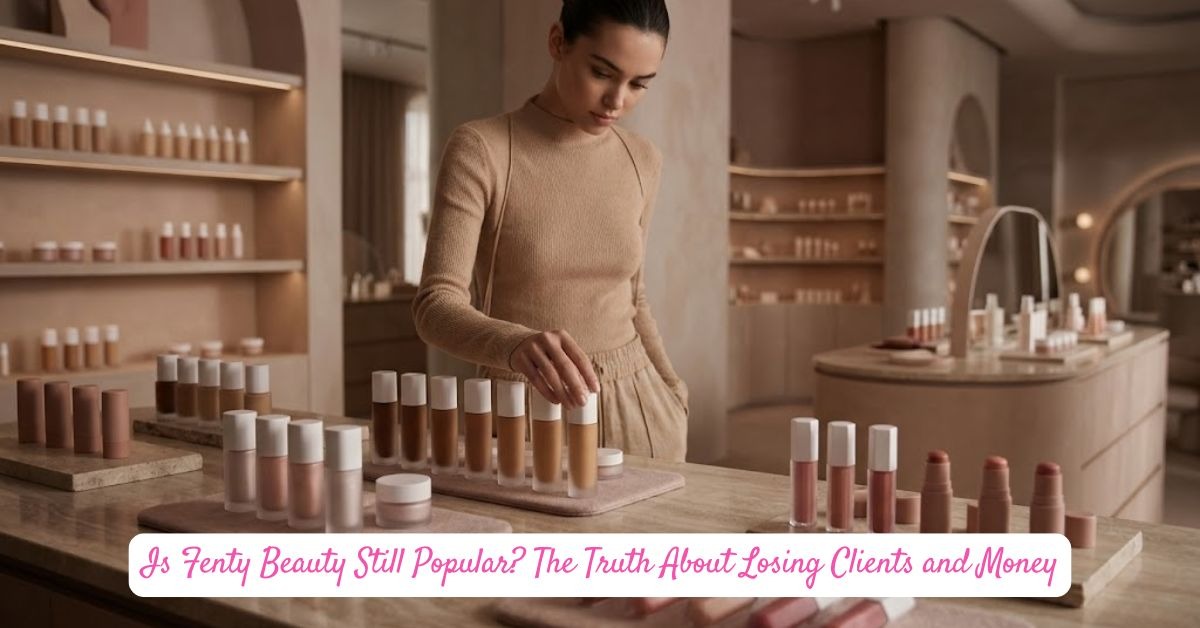
Hesitating can lead to missed opportunities in the beauty world, a brand that’s at the forefront of talking about new colours or shades can go from being a great colour or shade to people looking at it and thinking it’s not what they want. That uncomfortable reality exists for Fenty Beauty in 2026, and I think it needs to be talked about.
Fenty Beauty changed everything when it launched in 2017. During a period where many companies provide only 15-20 different types of foundation products (if at all), the new business created millions from more than forty different foundation shades (Rihanna). She created a cosmetic company with the purpose of changing the way the beauty industry does business – for both consumers and brands; she created a market for the beauty industry. Within the first twelve months after launching, her product grossed more than $550M in revenues and estimated at over $2.8B in value. This wasn’t just another cosmetic company – it was a revolution in the beauty industry.
What has happened?
When the Narrative Gets Louder Than the Products
Here is the thing about building a brand on cultural energy, the energy has to keep moving. And somewhere between 2020 and now, Fenty Beauty’s energy started to slow. The quality of the products is not an issue; the Pro Filt’r Foundation continues to be among the leading formulations globally; the Match Stix are certainly iconic. The absence of Rihanna as the brand’s daily representative said it all in terms of that gap in voice. According to sources who have some knowledge of the inner workings of Sephora, sales for the brand in North America have seen a decline of at least double digits.
In late 2025, LVMH, the 50% owner of Fenty Beauty through its Kendo subsidiary, began the process of selling their stake in Fenty Beauty to communicate that its partnership with Fenty was not a priority for LVMH anymore. In the first nine months of 2025, LVMH reported a 4% decrease in revenue and has since focused on cutting back on non-core assets as part of its overall strategy.
This is not just another drama-filled story; it is an example of a billion-dollar business using analytical reasoning because the data no longer meets the established trend analysis.
Rihanna’s Net Worth and the Fenty Effect
Numbers indicate what is going on, while unclear terminology does not reveal what is going on; therefore, to provide some examples of what is really happening, here are the numbers: According to Forbes, Rihanna was estimated to be worth 1.7 billion dollars at the end of 2022 which was peak wealth for her and made Rihanna the richest female musician in the world. By 2025, the 1.7 billion dollar net worth would have decreased to around 1 billion dollars, meaning she would have lost approximately 30% of her personal wealth in relation to the performance of the various brands associated with Fenty.
Additionally, by 2025, Savage X Fenty would also no longer have a CEO as the prior CEO left to run Victoria’s Secret. Although the brand created a partnership with the New York Liberty (WNBA) and opened a first-ever physical concept store for Fenty Beauty in China, which includes futuristic AI-driven makeovers, these actions appear more to be examples of the brand attempting to grow out of desperation rather than showing successful growth opportunities and thriving while preparing for the next chapter of the brand.
In short, the process she went through to establish her billionaire status has been jeopardized; this situation illustrates how much damage it can do when you actually stop telling a brand’s story completely.
The Competition That Did Not Wait Around
While Fenty Beauty was navigating ownership uncertainty and quieter marketing, the competition got louder and smarter.
Rare Beauty Took the Crown
Rare Beauty has been declared the top celebrity beauty brand of 2025 by “Fresha,” a beauty and wellness service that analyzed the worldwide search trends associated with the top A-Listers in the beauty and wellness industry, their fame on social media platforms, and overall global presence. Rare Beauty received a score of 9.48 out of a possible 10 and had 11.6 million Google searches in one year! Rare Beauty is considered to be valued at approximately $2.7 billion, therefore eclipsing “Fenty Beauty” in terms of cultural momentum, although it has not developed as much historical revenue yet.
Unlike other brands, Rare Beauty’s biggest distinction was their consistency. Selena Gomez has always remained visible in their branding. She has shared videos via TikTok showing a more realistic and unrefined side of herself, while speaking about her own mental health and lupus diagnosis; and how there were times in her life that by adding blush to her face was the only thing keeping her together emotionally. In 2025 alone, the brand’s Rare Impact Fund raised $600,000. Consumers buy Rare Beauty because they connect with the brand.
Rhode Got Acquired for $1 Billion
In the month of June 2025, e.l.f Beauty bought Hailey Bieber’s Rhode Skin for $1 Billion. This is crazy! A company that has been in business for far less time than Fenty sold for a price that caused the entire beauty industry to take notice. Rhode’s success has resulted from being extremely focused on certain aesthetics, with the glazed look, peptide lip treatments, and a specific aesthetic that has become a whole personality type to Gen Z.
Huda Beauty and the TikTok Machine
The beauty company, Huda Beauty, has been ranked first in the Q1-2025 list of cosmetics companies by Cosmetify due to the brand’s rapid growth on social media such as Instagram and TikTok. Huda Kattan, the founder of Huda Beauty, has consistently shared her face, opinions and complete personality through engagement on social media platforms with followers. In mid-2025, as the business became founded solely by Kattan, it sent a message that the business was still authentic and personal to the Kattan family.
What Gen Z Actually Wants From a Beauty Brand in 2026
This is where it gets interesting for us, because Fenty Beauty’s struggle is really a story about what Gen Z has changed in this industry. We do not purchase brand names; we purchase the impression we get from brand representatives. We invest in the brand’s ideals and in the feeling that we can relate to an individual working for the company in some way. Fenty was the first to do that, and made a statement by doing so. In order to remain visible, however, you must consistently work toward that end; and that is where the next generation of consumers differs from earlier ones. We will choose to use a different company’s product as soon as it meets one or more of our criteria: it is more genuine; it is more affordable; it expresses our identity. This is evident with e.l.f. cosmetics, it has established itself as a leader among younger consumers by being priced reasonably, appealing to TikTok, and consistently introducing new ideas while maintaining their pricing below $40 for blush. On the other hand, Charlotte Tilbury, a price-point leader in the past, dropped in popularity in 2025 because newer competitors are growing faster in this space.
At this moment, the beauty industry rewards brands that appear to be “alive”, that communicate with their customer base, that respond to criticism through public relations, and that are willing to admit when, for lack of a better term, they received a poor zero rating. In this regard, Fenty Beauty has not maintained the same level of interaction with their consumers as they had in years past; therefore, people have become aware of it.
Where Does Fenty Go From Here?
This is not a death sentence. Let us be very clear on this. Fenty Beauty still has great brand equity. The cultural impact of the original 40 shades rippled through the industry; nearly every major makeup brand has expanded its colour offerings since Fenty launched. It’s not going away quickly, either.
Also, by 2025, the brand expanded into India, which is one of the fastest-growing beauty markets in the world. Furthermore, the China store with AI-inspired make-overs is truly pioneering. There is distribution and infrastructure here, and there is a global market.
However, the biggest questions going into 2026 and beyond are if and when Rihanna will return to the brand as its storyteller. Next, how the brand will be structured post-LVMH stake sale, and whether or not the new structure will provide Fenty Beauty with the creative freedom and strategic focus it requires. Lastly, if Fenty Beauty is going to focus on competing with innovative and community-style brands, or if it will continue to ride the 2017 moment, which, for as wonderful as it is and was, cannot last indefinitely.
Currently, winning brands are those that can make someone feel something every week. Not once or twice a year, but rather consistently, week after week, and this will be the standard in 2026, but to keep up, they’re going to have to “show up”.
The Bigger Lesson
What Fenty Beauty’s current chapter teaches all of us is something worth sitting with. To make an impact, you must do more than create a new idea. And even though creating a breakthrough product in the beauty market is difficult, it is even more difficult to effectively communicate to your customers why your product is important. The beauty market is constantly changing; consumers are very demanding and will use multiple brands to acheive their beauty goals.
Rihanna created a breakout success. At the same time, the question now is whether she can re-establish that success again in 2026; everyone in the beauty industry will be watching for an answer. We will definitely be here to see what that answer is.