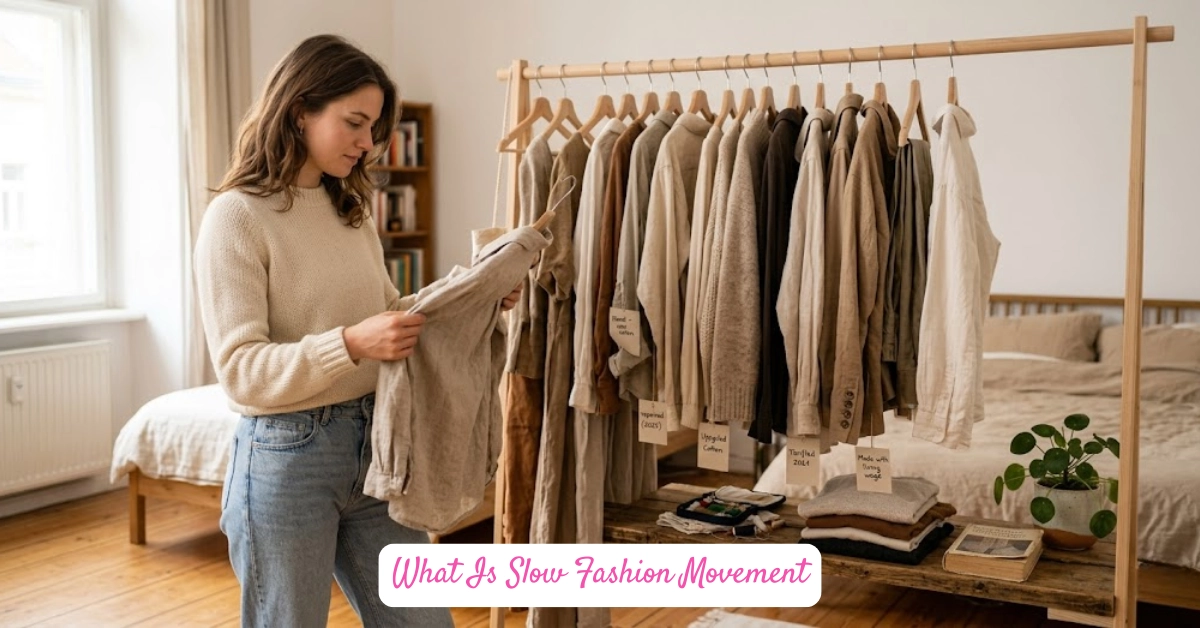
Fashion contributes to 10% of the world’s carbon emissions, more than international flights and maritime shipping. Wait a minute to process that. Every $7 top that’s added to your cart at some fast fashion app comes with the knowledge that somewhere a river runs blue with synthetic dyestuffs and somewhere a garment worker makes less money in a day than you do on your iced coffee. The slow fashion movement is in the fight to say exactly that and in 2026 it’s not confined to eco-warrior circles. It is the trendiest subject of fashion today.
Where It All Started
The term “slow fashion” was first used by fashion journalist Kate Fletcher in a 2007 article for The Ecologist. She took the concept from the slow food movement which began in Italy in the 1980s as a reaction against the fast food culture, and started using it straight for clothing. The message she was conveying was straightforward: Fashion had become industrialized, with shorter trends, and a vanishing quality.
However, the turning point was in 2013. More than 1100 garment workers lost their lives in one day in the Rana Plaza factory collapse in Bangladesh. Cracks could be seen in the building. Workers were instructed to go in wherever they could. Those images were transmitted to the world and something changed. People began to ask inappropriate questions: Who made my clothes? How were they made? How much did they cost? That tragedy made slow fashion a movement.
So What Actually Is the Slow Fashion Movement
The slow fashion movement is simply the exact opposite of fast fashion. Slow fashion is suggesting that you spend less so that you can spend better, and hold on to it longer than you would spend buying twenty cheap pieces and discarding them when the design goes out of style. It’s a matter of selecting quality over quantity, knowing where your clothing is made, and understanding the true human and environmental price of a price tag.
It’s not about being perfect. It’s the question of deliberate intent.
The Core Values Behind It
There are a handful of concepts that lay the foundation of slow fashion. The first is its durability , clothing that will last years and not a single washing. The second one is transparency – brands that let you know that your product is made by this person and this way. The third is ethics; fair wages, safe working conditions, and no exploitation behind the pretty Instagram feed.
In 2026, a fourth pillar has come into the picture which can no longer be neglected: circularity. The concept of clothes that never goes out of style – repair, sell, upcycle, or recycle into new use.
Fast Fashion Is Still Winning, And That Is the Problem
Here’s the straight answer, which no one wants to say out loud. Fast fashion, which represents more than 60% of all new clothing sold worldwide, remains the primary source of new garments.Fast fashion remains the main source of new garments and represents more than 60% of new clothes sold worldwide. SHEIN is still one of the most downloaded apps among Gen Z. The fast fashion industry is not diminishing, it is expanding!
And brands are up to their old tricks on it. Zara created a re-sale site. There is a “Conscious” range at H&M. These are super interesting until you remember that these are the same companies creating hundreds of new collections a year. Lifting the term “slow fashion” onto one capsule collection and everything else being the same isn’t slow fashion, it’s greenwashing. It is PR. And you deserve to know the difference and you do.
Greenwashing Is Real and It Is Everywhere
Greenwashing occurs when companies use eco-friendly terms to appear sustainable without making any substantive shift in the way they operate. People are bombarded with all sorts of jargon such as “eco-conscious,” “green collection,” and “made with recycled materials,” which implies that only 5 percent of the material in one item is recycled. Major retailers such as Zara and H&M have established sustainability efforts which, despite producing positive results, have been criticized for their lack of comprehensive solutions to the issues of fast fashion, as they remain reliant on high speed production.
The rule of thumb? Those who make over 4 collections a year, and call them slow fashion, are probably lying.
Gen Z Is Changing the Game
The one thing that brings real hope is this. Gen Z isn’t simply “trendsetters,” they’re the ones who are changing the fashion landscape when it comes to how fashion is made, worn, and celebrated. This generation pays attentions to the environmental and social consequences of their clothes. Unlike previous generations, they’re making those values visible and loud.
Sixty-four percent of Gen Z says they would be willing to pay more for items that are more environmentally friendly, while 25 percent have already cut back or stopped purchasing from companies that are less sustainable. That’s not a small number. That’s a generation that’s choosing to spend with their vote.
Artists and Icons Who Are Actually Walking the Talk
Billie Eilish has been a loud voice in this place. Her large scale, gender-fluid collections were an anti-fashion statement to the hyper-sexualized fast fashion of her time, while her partnership with sustainable brands helped to highlight the generation’s conscious consumption. She has shown that it’s possible to look bold without spending a lot of money on new clothes every week.
Another one is Zendaya. She has a style defined by intentional minimalism, neutral colours, simple cuts and an emphasis on sustainable designers who are ethical in their production. Her partnerships with progressive fashion brands make it impossible to miss the fact that sustainability isn’t a passing fad but the future of luxury.
In a quiet way, Emma Chamberlain has made vintage and thrift wearing the sexiest thing you could ever do. She changed second-hand fashion from “I had no choice” to “this is the only choice that is worth doing.
The Slow Fashion Movement in Numbers
Numbers do the talking for this case. By 2026, the sustainable fashion market is expected to reach over $12 billion, and digital creators are making an impact on real-world trends toward re:store, up:cycle and low-impact brands.
Meanwhile, garment workers (80% of whom are women) are paid poverty wages and less than 2% of them are paid a living wage. The fashion industry uses 93 billion cubic meters of water every year. This equals the capacity of 37 million Olympic sized swimming pools. These are no mere numbers. They’re the cost of inexpensive clothing.
The Secondhand Market Is Exploding
The resale industry is one of the most thrilling areas of slow fashion currently and it is such a great addition. The secondhand fashion industry is booming, with sites like ThredUp predicting a 10% share of global fashion sales will be secondhand. It’s not just the last stop anymore, it’s the first for shoppers who are seeking one-of-a-kind items without the environmental guilt.
But it is not only Depop and vintage stores. Some companies have their own buy-back scheme, such as Patagonia. Since 2009, Eileen Fisher has gathered more than 1.2 million garments via their take-back program. Old shoes for Nike are also ground into materials for running tracks and yoga equipment.
How To Actually Start Without Burning Out
The number one falsehood people have about slow fashion is that they must completely overhaul their closet and make a list of everything they want to be ethical about.The first falsehood people have about slow fashion is that they need to completely overhaul their wardrobe and make a list of all the ethical things they want to have. This is tiresome and unnecessary as well. Slow fashion begins with the use of the clothes you already have , longer.
If it breaks, get just one good one instead of 3 cheap ones. Think about cost-per-wear. A ten year coat which costs more initially is many times cheaper than having to replace a cheap coat every other winter. A good t-shirt lasts for 5 years, whereas several cheap fast fashion t-shirts bought over the 5 years are far more expensive year on year.
Small Moves That Actually Matter
Do some second hand shopping first. Don’t purchase a product because of a brand name without knowing what it is. Learn basic repairs. Buttons can be easily released, and a modest tear does not have to doom a piece to the trash. So why am I buying this? Is it a necessity, or just something because I’m bored?
The 2026 forecast is even more of a change towards self-expression than to impress others , no more dressing up, it’s all about creating one’s own style. And that’s where slow fashion and self-expression intersect. Stop chasing every fleeting trend, and start creating a wardrobe that looks like you.
The Future of Slow Fashion
Which feels like a paradox, but makes complete sense, is the slow fashion movement moving quickly in the right direction. The demand for sustainable fashion and ethical brands and slow fashion has grown by more than 200% in recent years. Brands are now being called to account for their supply chain in Europe. AI is helping to lower textile waste during the manufacturing process. Mycelium, algae, and recycled fibres are being incorporated into the mainstream collections as new materials.
According to consumer demand research, 65% of people want to purchase more sustainable clothes, while 79% of Gen Z are aware of sustainability when shopping for brands. The industry is being pushed to change, or it won’t be able to.
It’s not asking you to be perfect with the slow fashion movement. It’s calling on you to know. To take some time before making a purchase. To be somewhat interested in the origin of clothes and their maker. Fashion should feel good on your body and on your conscience , and after all, we have a lot more information, choices and community to make that possible in 2026.
A wardrobe is one of the most intimate possessions that you have. Let it have a purpose.