If you’ve ever watched a drag queen makeup tutorial and thought “okay but how do they DO that,” you’re not alone. The contouring, lashes, and blinding highlight – they seem like magic. The fact is drag makeup is not just for performers (queens) onstage, it is a way to show skill, grow confidence and use your face as a canvas. In 2026 many more beginners have discovered drag and will use this artistry to express themselves or perform or because they think regular makeup is boring now. So let’s take it step by step; let’s look at where to begin and what techniques are effective for those who have never held a beauty blender with any type of skill and how to use them with confidence.
Why Drag Makeup Is Actually the Best Makeup School
Here’s something nobody tells you when you’re starting out: drag queen makeup tutorials will teach you more about makeup in one hour than five years of “natural glam” content ever could. Makeup in drag is an intentional form of extravagance; thus, every technique is easily found, every error can be remedied with additional application, and every lesson learned will create an exaggerated memory. The foundations of drag makeup are derived from the idea of the natural face being the beginning of the drag face and that understanding light and shade will enable you to create a totally different appearance by using your eyebrow to move the eyebrow 2 inches higher on your face. Blending is a framework of living; it is not just a process; it can be used in any makeup application, regardless of whether the application is for drag or everyday life.
The Face Is a Blank Canvas, And That’s Liberating
The initial thing drag teaches is how to “cancel” your background. It sounds dramatic, however, it simply means to create a heavy coverage, either a colour-correcting primer or a heavy foundation in a colour about three times lighter than you would normally wear, to neutralise your natural physical features in order to create new ones. This is where the magic happens. After you have learned that you can change your face shape using a combination of makeup and neutralizing your natural form, nothing starts to seem as terrifying.
Where to Start: Foundation, Coverage, and the Base
To achieve, the most extravagant lashes and highlight, you want a solid base to make your look come together. In drag, the base is the key piece because that’s what makes it all work together for the look.
A beginner’s base would be to prime first (a pore-filling primer that will fill-in any texture on your face and hold get a product to your face).
After this, you will want to use a full-coverage foundation that matches your skin tone and is generally one or two shades lighter for a more traditional drag transformation. Finally, you will want to set your base with a good amount of translucent or set powder (this is necessary; all of your work will come off if you do not use either powder under stage lights or normal life activities).
Almost all drag performers mention using RCMA No-Color Powder as part of their makeup routine; it is considered a “must-have” when it comes to setting makeup in place and keeping it looking fresh on camera, it is completely matte so that when set you don’t have any “cake” looking pieces on camera. If you are on a budget, NYX HD Finishing Powder is a close dupe.
Colour Correction Is Your Best Friend
To conceal shadows from facial hair or darker patches of skin, apply red/orange concealer prior to applying foundation. Many people who are new to using colour correctors do not apply them correctly, resulting in a blotchy foundation. Therefore remember to do this step before applying your other products.
Contouring Like a Queen: The Technique That Changes Everything
This is where drag queen makeup gets really interesting. Contour with Drag Makeup isn’t a one-time “swiping bronzer”, it’s sculpting from the bottom of your cheeks to your forehead, chin, and nose. You can achieve dramatic and strong contouring with the use of shadow, light and shading on the face. The classic technique uses a matte brown or grey shadow applied in the hollow of the cheekbone, around your nose, on the sides of & across your forehead, and rounded out under your jawline. After you’ve cut back the shadowed area, apply light bright highlight to the high points of your face-Top/Middle of Forehead, Nose bridge, cheekbones, Cupid bow and on your chin. When you blend the two together you have a totally different looking face in a photograph than in the mirror, and that is why Drag was created-performance & photography; and by 2026 you can bet your drag makeup will be used for social media too!
Eyes: The Part Everyone’s Actually Here For
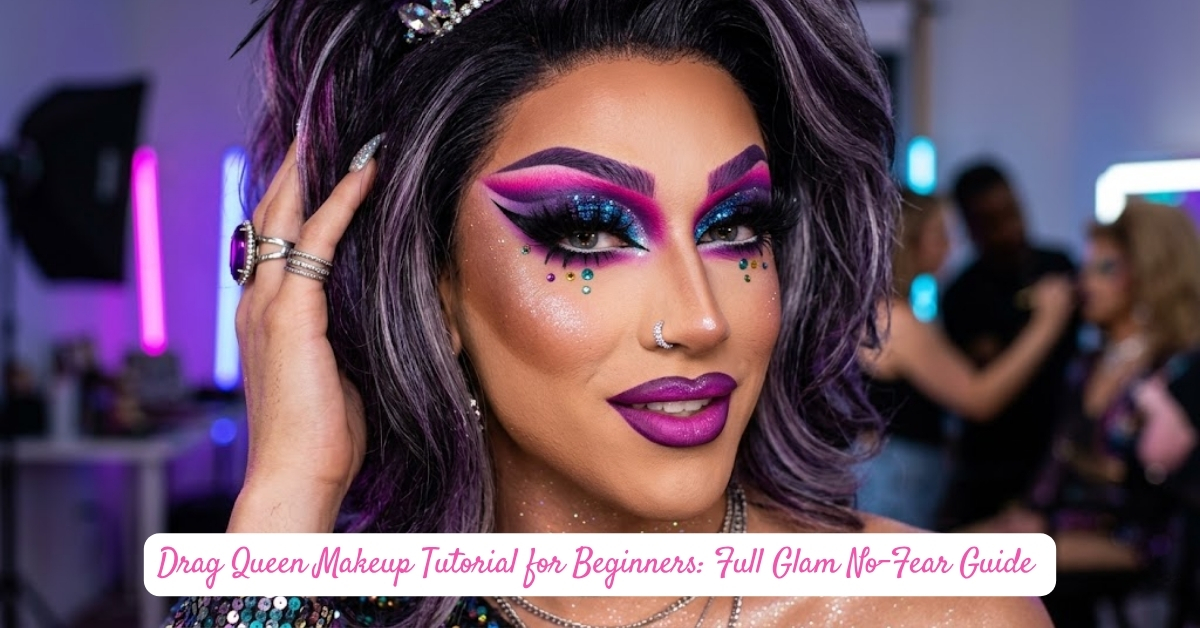
There exists an entire universe of drag eyes. The most important thing to remember when starting out is that eyeshadow with drag is not subtle. You will be using darker colours, a lot of blending and normally creating shapes outside of the eye socket itself.
The cut crease is the best example of a drag eye and uses either concealer or light shadow placed in a straight line so that you can create a false lid which makes your eyes appear larger and more defined. Kim Chi and Alexis Stone have awesome tutorials that use logical reasoning behind where they put colours and what they are doing versus simply showing you how to do it.
Lashes: Go Big or Go Confused
The one rule of drag that is essentially a law is that lashes are important. Beginners will have much easier time applying individual cluster or demi-wispy (or half height) lashes compared to applying the most dramatic full strip lashes. Once you get used to wearing lashes, you can try full strip lashes, stacked (two lashes on top of one another) lashes, or even make your own using feathers and rhinestones.
Dark duo glue is certainly the classic glue of choice because it dries fast and the color of the glue can help disguise the gaps in your lash application.
YouTube Tutorials That Are Actually Worth Your Time
Drag tutorials abound on YouTube, but there are some creators who do a really good job of explaining why they are doing things as they are, which is very helpful for beginners
Alexis Stone is one of the most educational YouTube drag creators that I’ve found. Their transformation videos are mind-blowing, however, they also make tutorials for beginners, which include techniques that a beginner can replicate as well as explanations to go with each one.
Stacy Layne Matthews gives you tutorials with a very warm and encouraging tone that help make the whole process feel accessible, and like you don’t need a professional drag kit in order to participate in drag.
Gottmik is the first transgender man to appear on RuPaul’s Drag Race, so it’s no surprise that he has a lot of amazing tutorials that show both traditional drag techniques as well as modern editorial makeup. The tutorials are incredibly informative, and are also very up to date.
Trixie Mattel provides tutorials that are excellent in terms of being humorous, detailed, and very educational when explaining the classic drag aesthetic, which is characterized by heavy contouring, bold eye makeup, and a distinct painted look that takes great photographs.
Kim Chi is probably one of my absolute favorites for beginner drag tutorials. The pace at which Kim moves through the tutorial is spot on, and he explains the artistic elements of each tutorial in the same way that a professional makeup artist does – according to makeup principles, rather than “I do it this way.”
All of these creators have made plans for posting through 2025 and 2026. This means that their recommended products as well as the techniques they demonstrate will still be relevant in a rapidly changing beauty industry.
The Tools You Actually Need (Not the Whole Store)
The cost of your first drag queen makeup kit does not have to be extravagant. You will require the following items for a beginner’s drag queen makeup kit: a full-coverage foundation, setting powder, a matte contour shade, highlighter, neutral eyeshadow (plus one bold color), pencil eyeliner (both liquid and pencil), false eyelashes, and bold lipstick.
In regard to brushes, brush type is more significant than most people realize. Flat foundation brushes, fluffy powder brushes, small eyeshadow blending brushes , and fan-shaped highlighter brushes are all that you need to begin your drag journey. Many reputable brands offer ample beginner brush sets (such as Morphe or Real Techniques) that are budget-friendly.
Your Phone Is a Studio Light
Drag queens often recommend that you practice in front of your front camera. This way, you get the benefits of using a ring light (which helps to create a professional-looking video) and you can practice seeing how your makeup will look on the screen (which is a completely different view than seeing it up close in the mirror). Most of us are creating content for TikTok and Instagram anyway, so why not use our front camera to help rehearse?
Breaking the Rules Is the Whole Point
In the year of 2026, the most significant aspect about drag queen make-up is that there are no established rules. The art form of drag has transformed from its formerly easily identifiable aesthetic into an all-encompassing genre defined by an individual’s identity and their gender expression; as well as an infinite number of creative outlets to express themselves through drag.
There is so much diversity in drag that it has changed dramatically from even just a few years ago; this will be beneficial for new performers looking to become drag queens because they will not be required to replicate a “drag look” but rather to create a version of transformation for themselves. Your look could range from full-on old Hollywood glamour to horror-inspired editorial to pastel maximalism with rhinestones glued directly to your face. No matter what your individual look may be, it begins with the same basic technique.
The point of a drag queen makeup tutorial is never just to look like someone else. It’s to figure out what your face can do when you give it full permission to be anything.
So get the powder. Get the lashes. Watch Kim Chi contour for forty-five minutes. And then sit down at your mirror and start.