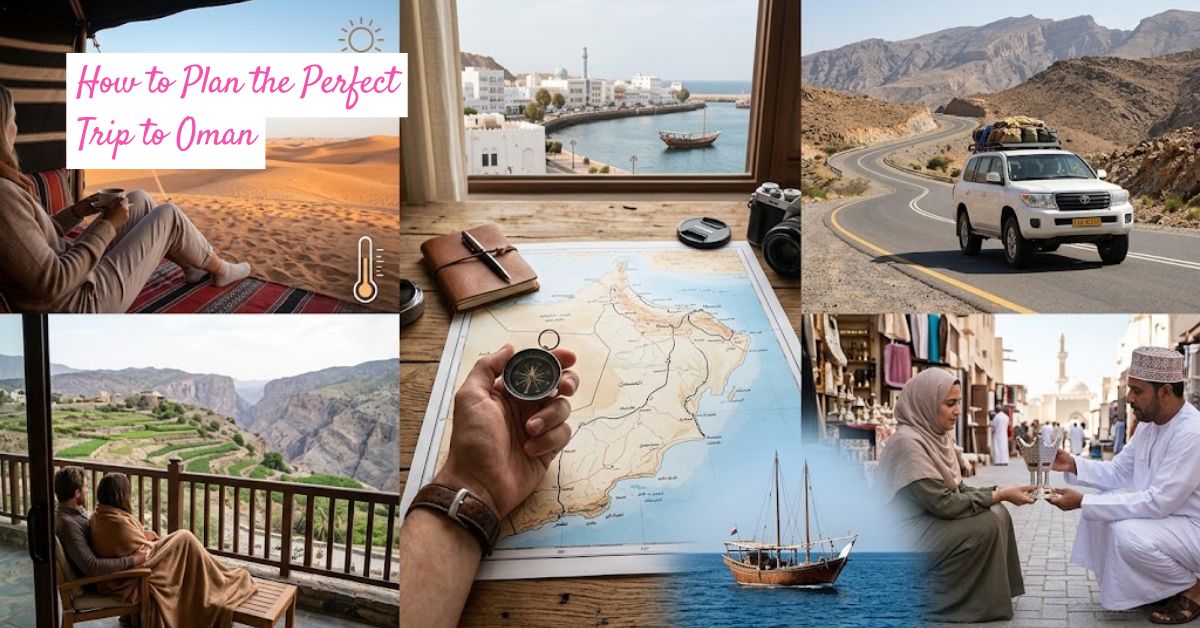
man rewards planning more than most destinations. Between the shifting desert heat, mountain roads that demand a 4×4, and coastal towns that only make sense with the right timing, a trip here goes much smoother when you map things out before you land in Muscat. Here’s how to put together a trip that actually matches what Oman does best.
Decide When to Go
Oman’s climate splits the year into two very different experiences. From October through April, daytime temperatures sit in the comfortable 20s and low 30s Celsius, making it the best window for hiking Jebel Shams, camping in Wahiba Sands, or wandering the souks in Muscat and Nizwa.
From June through August, temperatures in the interior can climb past 45 degrees Celsius, which rules out most outdoor activity except very early morning or evening. The exception is Salalah, in the south, where the khareef monsoon season brings cooler temperatures, mist, and green hillsides from late June to September. If mountains and desert are the priority, aim for winter. If you’re drawn to Salalah’s unusual monsoon landscape, summer works in your favor.
Figure Out How Long You Need
Ten days is a realistic minimum for seeing Oman’s highlights without rushing. That’s enough time for Muscat, the Nizwa and Jebel Shams area, a night or two in the desert, and a stop in Wahiba Sands or the Sur coastline.
Two weeks lets you add Salalah in the south, which requires either a domestic flight or a full day of driving each way. Anything shorter than a week means picking one region and accepting you’ll miss the rest — still worthwhile, but worth knowing upfront so expectations match reality.
Choose Your Route
Most itineraries follow a loop out of Muscat: north to the mountains around Nizwa and Jebel Akhdar, east through Wadi Bani Khalid to the dunes of Wahiba Sands, then along the coast through Sur back to the capital. This route covers Oman’s main landscapes — cities, mountains, desert, coast — in a manageable circuit of around 600 to 800 kilometers.
Renting a car gives the most flexibility, and Oman’s highways are well-maintained and easy to navigate, though some routes into the mountains or through wadis require a 4×4. For travelers who’d rather not self-drive, joining organized Oman tours takes care of route planning, vehicle logistics, and local guiding, which is especially useful in areas like Jebel Shams where road conditions and directions can be tricky without local knowledge.
Sort Out Visas and Entry Requirements
Most nationalities, including the US, UK, EU, and Australia, can apply for an Oman e-visa online before departure. The standard tourist visa costs around 20 Omani rial and is typically processed within a few business days, so applying at least a week ahead is a safe buffer.
Double-check passport validity — Oman requires at least six months remaining from the date of entry. It’s also worth printing a copy of the approved e-visa rather than relying solely on a phone, since some border checks still ask for paper documentation.
Pack for Oman’s Range of Climates
Oman spans desert heat, mountain chill, and humid coastal air, sometimes within the same day. Lightweight, breathable clothing covers most of the trip, but a warm layer matters for evenings in Jebel Akhdar or overnight desert camps, where temperatures can drop sharply after sunset.
Modest dress is expected in public spaces — shoulders and knees covered for both men and women, particularly when visiting mosques like the Sultan Qaboos Grand Mosque in Muscat, which also requires a headscarf for women. Sturdy walking shoes matter more than sandals if wadi hiking or canyon walks are on the itinerary, since the terrain is often loose rock and uneven ground.
Book Accommodations and Transport Early
Desert camps in Wahiba Sands and mountain lodges in Jebel Akhdar have limited capacity, and they fill up fast during the cooler months of November through February. Booking these at least a month ahead avoids getting stuck with a lesser option or a long drive to the nearest alternative.
Muscat has a wide range of hotels across every budget, so it’s less urgent to book far ahead there, though the Eid holidays and Omani National Day in November can tighten availability citywide.
Budget for the Trip
Oman sits in the mid-range for Gulf travel — pricier than neighboring countries with budget backpacker infrastructure, but noticeably cheaper than Dubai or Abu Dhabi for equivalent hotels and meals. A realistic daily budget for a mid-range traveler, including a rental car, meals, and a mix of hotels and desert camps, runs between 60 and 100 rial per day.
Fuel is inexpensive by international standards, which helps offset the cost of long driving distances between regions. Entry fees for forts, museums, and natural sites are modest, usually under 5 rial each, so they rarely strain a budget the way accommodation and car rental do.
Putting It Together
The trips that work best in Oman are the ones built around the country’s natural rhythm — cooler months for the interior, careful timing for Salalah, and enough days to actually cover the distances between regions. Get those three things right, and the rest of the planning falls into place with far less guesswork.