The queer community and the fashion industry have always had a complicated relationship that is all about borrowing creativity, culture, and edge.without sending any thank-you notes. However, 2026 is showing some signs of change. The upcoming queer fashion brands are no longer waiting for mainstream fashion to make room. These designers are creating their own table, their own runway, and their own set of rules when it comes to fashion. They are producing some of the most exciting apparel that exists today! It is not just a collection of bright hoodies introduced in June and discarded by July. These designers have developed true brands that are created with thought and purpose, owned by members of the LGBTQ+ community and made for the entire spectrum of LGBTQ+ identity (which is complex and beautiful). Let’s check them out.
Why This Moment in Queer Fashion Actually Matters
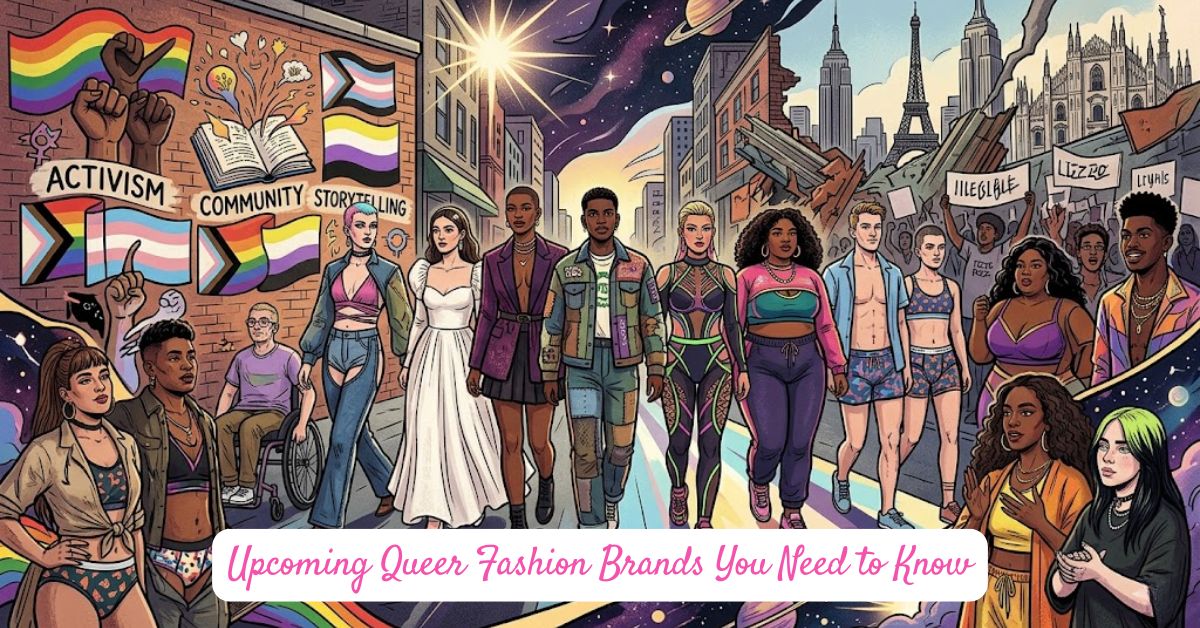
There is a reason why conversations about upcoming queer fashion brands keep coming up in every corner of the internet right now. Today’s fashion world has moved beyond glitzy sequins or rainbow colors, and has instead embraced multiple forms of self-expression, activism, and community-based storytelling. The once “niche” conversation is now serving as a framework for what will appear on the main trend-making runways in New York, Paris, and Milan.
There is an additional layer of complication due to the current political environment, where queer people’s rights are being discussed in the courtroom and the parliament. As designers, queer people are expressing some of that tension in their creations through aggressive cuts, reclaimed materials, or unapologetically-sized garments. Fashion has always contained a political element. In fact, queer fashion is currently doing some of the heaviest political work of any creative area.
Although the fashion sector is frequently portrayed as LGBTQ-friendly because of the number of women and gay men working within it, many have overlooked the privilege of gay cisgender men serving as the gatekeepers to and tastemakers for bodies that do not match theirs. The brands listed here are actively pushing against that dynamic, thus they are worth noting.
Phlemuns
Founded in 2013 by James Flemons, Phlemuns is a Los Angeles-based designer label focused on providing inclusive, luxurious yet accessible apparel to a diverse audience. Its line exists in the rare space between both the streetwear aesthetic and the bespoke craftsmanship exhibited by many of today’s fashion brands.
Phlemuns’ use of deadstock material allows the designer to produce one-of-a-kind garments such as backless tees, shirts with reversible sleeves, and denim chaps. This label has received recognition from celebrities such as Lizzo, Lil Nas X, Solange, Keke Palmer, and , as a short aside , was responsible for designing the costume worn by Billie Eilish when she portrayed Sally during an October 30, 2020 performance of the film “Nightmare Before Christmas.”
The defining characteristic of Phlemuns lies in the time factor. In an industry that generates product every week and rewards trends that have an average lifespan of 11 days, Flemons has chosen to take his time when designing and producing collections. He is extremely thoughtful about each collection he creates and the unique characteristics/business purposes of each silhouette and style he creates for that collection. If you desire apparel that has been thoughtfully constructed, not algorithmically derived, Phlemuns would be the ideal choice.
Tanner Fletcher
If you’ve not heard about Tanner Fletcher, this will hopefully serve as your introduction and a small reprimand for not paying attention to them.
Tanner Fletcher has been getting attention as a designer of custom wedding suits and dresses to specifically serve queer couples, breaking out of the mould of how we expect a wedding outfit, and putting gender fluidity at the core of bridal fashion. The company is owned by the couple Tanner Richie & Fletcher Kasell; the brand’s essence can be deeply described as romantic but in a very subversive manner. The new Fall 2026 collection adds a new dimension to the brand as it was directly inspired by their Midwestern home and is very different from the usual queer fashion references of New York City’s nightlife or European-style minimalism.
Tanner Fletcher is an example of how radical queer fashion can be quietly radical. Sometimes the most revolutionary thing you can do is simply to create something that is so exquisite that you place it on a body that has been marginalized from the fashion industry for too long.
Official Rebrand
The philosophy behind the fashion label “Official Rebrand,” created by nonbinary artist MI Leggett, is to introduce a new eco-aesthetic through the reclamation of used clothing; to explore the merging of climate change fears and a desire for luxury.
The name is loaded, and each part carries a significant burden. This is not an effort at environmental PR through upcycling; it is an artisanal approach to reworking what exists, so that nothing needs to be discarded, and to rework and redesign one’s own identity.
MI Leggett is aiding the movement for gender-neutral clothing design and individualism through their transformative use of reclaimed clothing in order to make new and original sustainable garments from discarded materials.
When we get to 2026 and have a sport of greenwashing and every fast-fashion brand offers a ‘conscious collection,’ we can expect Official Rebrand to be an actual business.
Chromat
The label Chromat has been in existence long enough that referring to it as an “up-and-coming” brand may create some confusion; however, in terms of its cultural momentum and its intended trajectory, Chromat absolutely merits inclusion on this list.
Chromat has distinguished itself as one of the few queer-owned fashion labels that have consistently presented their collections at NYFW and continues to achieve its reputation as a leading designer of innovative swimwear and bodywear in large measure due to the fact that the line is regularly modelled by people of colour, trans and disabled individuals and plus-sized individuals. Celebrities such as Beyoncé, Nicki Minaj, and Madonna have worn Chromat, and the company’s website showcases the same diversity as the collections on the runway by featuring their swimwear on people of all sizes and ethnicities.
Founded by Becca McCharen-Tran, the rationale behind Chromat’s operations is fundamentally simple and radical: to design for the bodies that the fashion industry excludes, with intention and workmanship. Because of this philosophy, Chromat’s swimwear and bodywear allow individuals to feel truly amazing about themselves, not just accommodated.
Berriez
If you’re frustrated with the fashion industry’s treatment of plus-size bodies, you should be, because it’s truly infuriating. However, Berriez is a brand that will give you back some of that faith.
Berriez is a great example of a small indie label that is doing things differently than the big brands when it comes to size offerings. Berriez creates and sells clothing that challenges traditional fashion industry standards as well as the larger social norms around what constitutes a plus-size woman or a plus-sized body. Their clothing blends nostalgia with streetwear to create something that is not just about a corporate diversity initiative, but rather feels like it was designed for someone who put thought into who would wear it and what they would want out of it.
In this era of “extended sizes,” in which many brands begrudgingly offer a small selection of larger sizes, Berriez has taken a fresh approach to designing its collection by reconsidering its entire process from the start.
Both& Apparel
In 2020 Finnegan Shepard started Both& Apparel when he was recovering from having top surgery and was excited about going swimming topless for the first time. He did a Google search for “trans swimwear” and found little to no options available. This lack of options created a gap in the market and helped create a brand. Both& brings a complete clothing line to the trans-masculine/non-binary community & designs all clothing with those bodies in mind (nothing to modify). The name Both& is very appropriate because it means BOTH NOT EITHER/OR. It denotes that you are not in one box or the other, but that you encompass the complexity of who you are as a whole. The One who needed to be this kind of brand did not have anyone making it therefore the origin stories of the behind the brand reflect in everything they design.
TomboyX
Started by the wives of Fran Dunaway and Naomi Gonzalez, TomboyX creates colorful, stylish underwear and swimwear for a variety of body types. The line has since expanded to include loungewear and casual clothes like t-shirts, shorts and workout clothes.
TomboyX is a true wardrobe staple for a good part of the queer community, and the reasons are easy to see. The base items are actually well made. The sizing is actually inclusive. The aesthetics are somewhere in between sporty and casual enough to be the kind of things that many people, queer or not, want to wear all the time.
TomboyX has also quietly been worn by many celebrities, including Tegan and Sara, Lizzo, and Evan Rachel Wood; and when all these cool people consistently wear a brand, you can bet that it’s worth it.
The Bigger Picture
The rise of these upcoming queer fashion brands is not happening in a vacuum. The LGBTQ Fashion (Queer Fashion) Community has long seen that personal style + political values are intertwined and in each new iteration of Fashion (2026), observe greater emphasis on ethical production, sustainable fabrics, and fashion that does not violate the human rights of workers who create the product. Queer brands are leading the charge in being transparent, providing fair wages to their employees, and being environmentally responsible.
In contrast to the big box “Pride Collections” that exist during the month of June, and have disappeared by the following July, the brands listed here are also created by Queer people for Queer people, but they also have a commitment to: transparent supply chain, sizing, design language, and community in which they are continuing to grow.
The Fashion industry has realized, while designing for those outside its norm, the designs created for those outside its norm, tend to be widely loved AND sought after by all. The transformation of Fashion is not just about the continued growth of the marketplace; it is about a renewed way to think about how we share who we are through fashion.
The Fashion industry has spent decades profiting off of Queer creativity, while refusing to include Queer voices at the leadership level in Fashion, on runways or in the size ranges, but we are seeing what will be the changing of this paradigm and it is refreshing to see how quickly this shift is occurring.
Follow these brands; they will be satisfying additions to your closet.