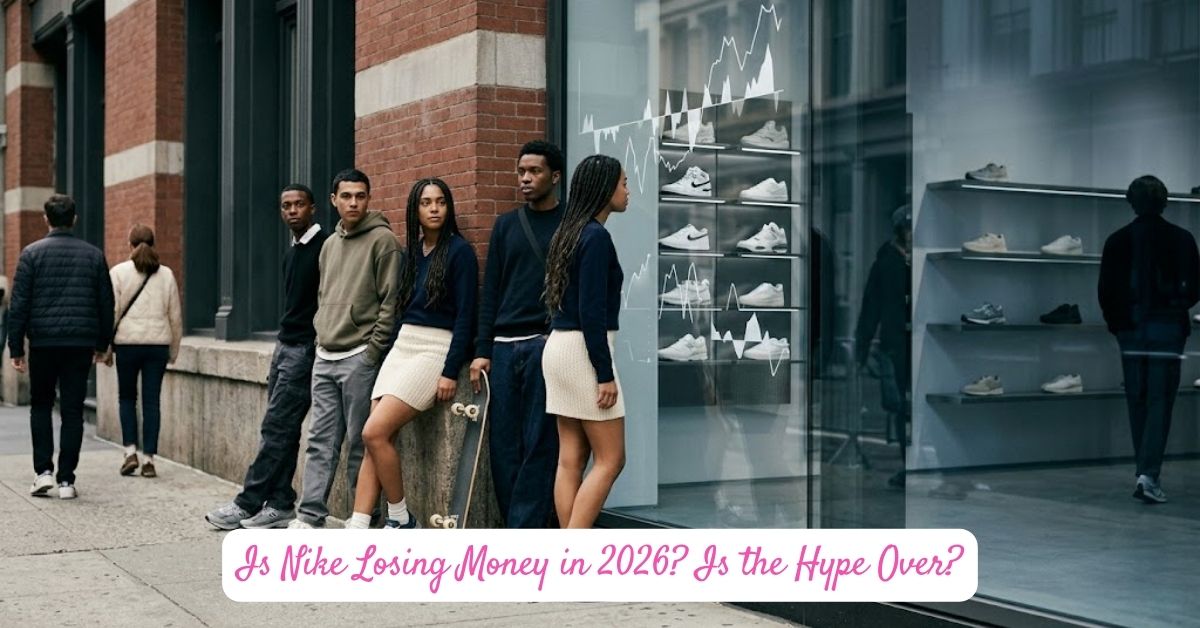
Yikes, Nikeskims was a big flop, this does gen-z not like at all! kimk is not a woman that gen-z is into. Gen-z is a different kind of generation.
Seeing an iconic one of the most successful brands in human history, stumble is absolutely surreal. It didn’t just collapse or disappear, but as the whole world looked on, they stumbled repeatedly and in slow motion. Nike is losing money in 2026, and We need to discuss the situation. There are some huge developments happening with Nike’s brand and its business. Nike was once a huge hit with kids who begged their parents for expensive sneakers but they’ve gone through dramatic changes that have resulted in a very difficult time for the company recently. So what actually happened and is it truly over for Nike or just going through a period of recovery? Read below to find out more.
The Numbers Don’t Lie (And They Are Not Pretty)
I understand how many people may find numbers boring, but these numbers shock me. In Q4 Fiscal Year 2025, Nike reported a revenue decrease of 12%, with net income dropping by 86% (that is correct: 86%), to an astounding $0.20 billion. Yes, I said a ‘b’.
Revenues totaled $46.3 billion for the whole year (down 10%) while Nike Direct sold $39.01 billion (down 13%) and Digital Sales had a staggering decrease of 20%. To put it lightly, that’s less money generated from each sale through [Nike.com](http://nike.com) and [Nike](http://Nike.com) App.
In early Fiscal Year 2026, Q3 numbers show revenues of $11.27 billion (flat), but down 3% on a currency-neutral basis; and net income dropped 35% to $520 million. Nike is losing money in 2026 in ways that would have seemed unthinkable five years ago.
How Did We Get Here? The Strategy That Backfired
Nike began its descent from the top to near the bottom starting in 2017 with what was called the Consumer Direct Offense. Nike’s strategy involved cutting out retailers as middlemen and instead selling their product directly to consumers through their own channels. There was no reason for Nike to do this because they had everything they needed (facilities, employees, distribution networks) to get the products to the end consumer quickly, but it did not care about the distribution side of the business anymore. That ultimately cost them sales in 2021 when they abandoned valued partners (like most small specialty athletic stores) and also established retailers who had relied on Nike for approximately 70% of their total sales during that same year. Imagine at that time how someone would feel to sever a 70% (or more) relationship with their main vendor and still act like nothing had changed.
While Nike was busy focusing on becoming the “digital retail expert”, it completely forgot about the shoes that were on its shelves.
On Running and Hoka Walked Right Through the Door Nike Left Open
What makes this even more appealing than simply exciting is how poetic this is.
Hoka, Brooks, On Running, New Balance, etc. did not just fill spaces on shelves left vacant by Nike; they completely changed how retailers viewed Nike. These brands appealed to retailers through better margins, better marketing support, and a more sincere approach to partnerships.
In New York City at the marathon finish line, Elliott Hill (CEO of Nike) was there to meet the winners. However, neither of the winning men or women were wearing Nike; they were wearing Adidas and On (who won the men’s and women’s races, respectively). This image speaks more to a company’s success than financial information can ever accurately reflect.
The recent growth numbers at Hoka (27.9%), On Running (32.3%), and New Balance (23%) are all due to these brands focusing on consumer segments and performance categories that have been ignored by Nike but have great potential.
Also, not only do serious runners respond to these brands; but so do teenagers (the leading indicator of cool). For the first time in the last several years, Nike lost market share across every category measured in Piper Sandler’s teen market study while Hoka and On gained market share among affluent teens (the very same teens that used to have a strong preference towards Nike).
The China Problem Nobody Wants to Talk About
Nike’s struggles in North America can be compared to China’s financial problems as they are experiencing a downturn due to a lack of supply or excess demand. They are slowing down their distribution and expect to see a drop of at least 20% in sales next quarter. The chief financial officer indicated that there may be some improvement in China, but it will not be consistent and most likely will be gradual.
In Greater China, sales were down nearly 20% during the most recent quarter due to increasing competition from Anta and Li-Ning, as well as the general economic downturn. Chinese consumers have begun to prefer local brands, which could take a while to reverse.
As a result, Nike will be working to improve its standings in China until fiscal year 2027, which will occur next spring; therefore, they cannot fix what was broken in 2026. Because of these challenges in one of the largest markets, Nike is working to fix everything at the same time.
Enter Elliott Hill: The Man Tasked with the Comeback
In terms of who is going to be the one to fix all of this is Elliott Hill – who is the current CEO for Nike and in what we would consider to be one of those dramatic moves you’d see in a Hollywood-style film, a 32-year Nike veteran that has just come out of retirement to help save the brand he truly loves.
Hill’s plan for ‘Win Now’, consists of five different pillars: culture, product, marketing, marketplace & in-person experiences. The greatest transformation will be to repair wholesaling partnerships, which were ignited by the previous CEO’s direct relationship with the consumer but failed. The second quarter of FY2026 saw an increase in wholesale revenue of 8%, and a total of $7.5 billion in revenue.
In all honesty, that wholesale number is incredible. Nike has returned to Amazon, Foot Locker, Dick’s Sporting Goods and retailers are starting to react positively as well. The previous relationship that was destroyed is slowly being rebuilt
The reality is that Hill himself told the employees, “I am exhausted, just like you are, from discussing ways to fix this business; I want to talk about ways to inspire and accelerate growth and begin having fun.” When a CEO makes a public statement that he has become tired from doing everything possible to get the company back on track, that should give you a very clear insight into just how deep the hole is.
Analysts agree that Nike is on the right path; however the “turnaround” is moving at a slow rate, and there is still a significant amount of work to be done to revitalize their entire portfolio of products and resize their global business.
Tariffs, Layoffs, and the Bill That Keeps Coming
Although Nike has faced challenges due to its own decisions and the challenges presented by the external environment, the $1 billion in gross cost increases from new tariffs will create even more obstacles for Nike to overcome in the long run by adjusting its supply chain and raising prices to offset these costs.
In addition to the job losses at its U.S. distribution facilities on April 3, 2026, Nike also announced that it would be eliminating approximately 775 corporate jobs last summer.
At this moment in time, in 2026, Nike is focused on price increases, job cutbacks, a much different supply chain, and ultimately trying to gain more of a profit margin while still trying to convince everyone they are the coolest brand in the world. It’s an exhausting task.
So Is the Hype Actually Over?
Here is the real question and the honest answer is: not quite, but it’s definitely on probation.
Nike is losing money in 2026 in a real, measurable, concerning way. Nike’s stock is at an 11-Year Low, and China is a mess. Converse (the Converse they own) revenue dropped 35% to $264 Million across all Regions. This is painful because Converse was supposed to be a reliable, constant revenue producer.
On the other hand, North America grew 9% in Q2 of 2026, with Wholesale revenue that grew 8%. There is momentum with the running category, which is early evidence that some of the “Win Now” strategy has a pulse.
As a Company, Nike is 62 Years Old and experiences a combination of Mid-Life Crisis and a radical reincarnation , while the Financial Forecast of 2026 is Challenging, the Company has a Solid Balance Sheet and a Dominant Market Share that provide a Foundation to Build on.
Nike Still Owns the Jordan Brand, Nike Still has LeBron; and, Nike’s “Swoosh” is the #1 Recognizable Logo on Earth. The Swoosh Will NOT Be Gone Overnight. Later in 2026, the FIFA World Cup will be held. Nike is making Strategic Investments to Market Through Sports Like They Haven’t in Years. If the Product Improves (which the running category seems to be Improving), A Path Will Exist.
However, for that path to be realized it will take time, execution and a bit of luck with the global economy. The Swoosh has Experienced more Difficult Times. Will It Maintain its Relevance While On Running and Hoka continue to take the “Cool Kids?” That is the race now , and, it is by far the most entertaining race going on anywhere besides an actual track!